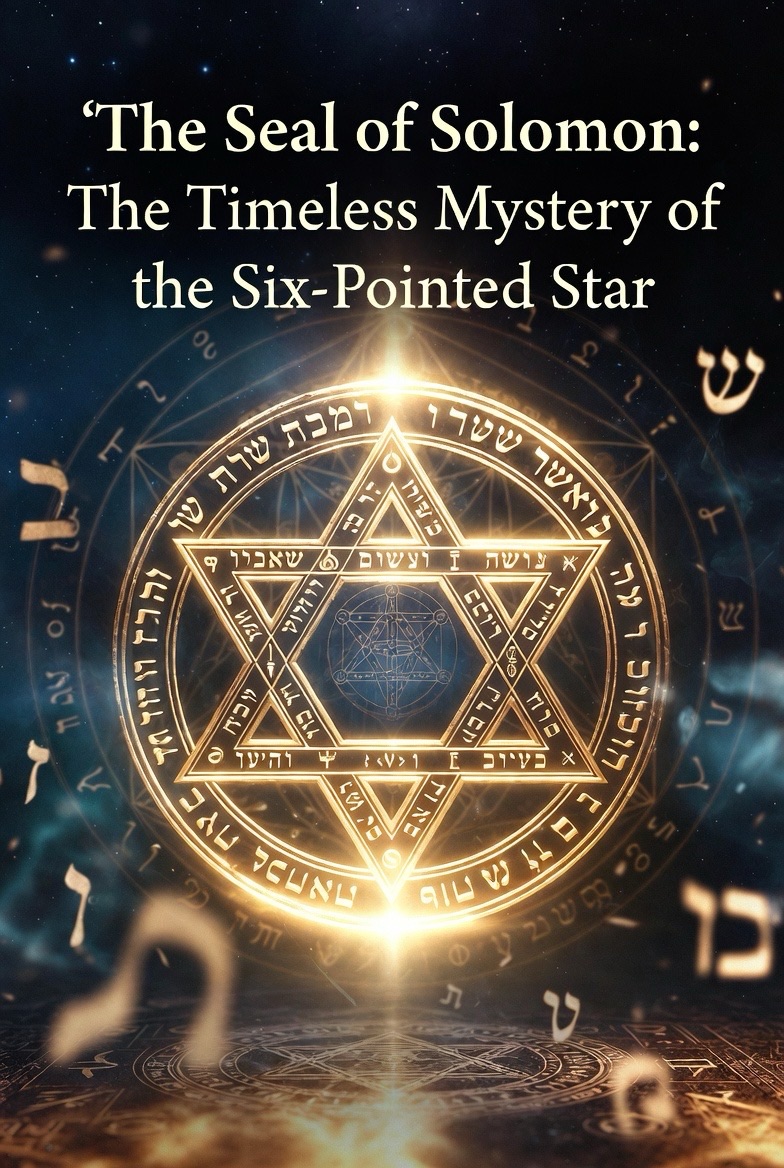
The six-pointed star, formed by two overlapping equilateral triangles, is one of humanity’s most enduring and versatile symbols. Known as the Seal of Solomon (or Ring of Solomon), it has captivated mystics, artists, and believers across centuries and cultures. Far from being confined to any single faith, this hexagram represents balance, protection, harmony, and the union of opposites—earth and heaven, fire and water, male and female. Its legendary roots trace back to King Solomon, the biblical ruler said to have wielded divine wisdom and command over spirits through a magical signet ring. Though the symbol itself is not mentioned in the Bible, medieval traditions—particularly in Jewish, Islamic, and Western esoteric lore—attributed it to him as a powerful talisman.

Scholars trace the hexagram’s association with Solomon to medieval Arab literature, from which it later entered Jewish Kabbalistic traditions in Spain. Early on, both five- and six-pointed stars were interchangeably called the “Seal of Solomon,” serving as magical emblems to ward off evil or invoke protection. Over time, the six-pointed version gained prominence, evolving into a universal motif found in ancient Mesopotamia, Byzantine art, and beyond—long before it became tied to any modern religion.2

The Star of David and the Flag of Israel
In Jewish tradition, the symbol is best known today as the Magen David (Shield of David) or Star of David. Though it lacks direct biblical or Talmudic origins and was not exclusively Jewish in the Middle Ages (appearing on Christian cathedrals and Muslim artifacts alike), it gradually became a marker of Jewish identity. The Jewish community in Prague adopted it as an official emblem in the 14th century, and by the 17th century it appeared on seals and synagogues across Europe. Zionist leaders embraced it in the late 19th century as a unifying emblem, mirroring how the Christian cross represented Christianity. It was officially incorporated into the flag of the State of Israel in 1948: a blue hexagram centered on a white field flanked by two blue stripes inspired by the tallit (prayer shawl). Today, it flies as a proud national symbol, representing Jewish resilience, heritage, and sovereignty.
The Six-Pointed Star in Christian Tradition and the Pope’s Mitre

The hexagram has deep roots in Christianity as well, where it is often called the “Star of Creation” or “Creator’s Star.” Its six points evoke the six days of creation in Genesis, with the center sometimes symbolizing God’s rest on the seventh day or the union of divine and human natures in Christ. Medieval churches and cathedrals incorporated the motif as decorative art, and it appears in Christian iconography without any exclusive Jewish connotation at the time.
A striking modern example appears on papal headgear. The Pope’s ceremonial mitre—a tall, pointed hat worn by bishops and popes for centuries—has occasionally featured the six-pointed star. Notably, Pope Benedict XVI wore a mitre prominently displaying an interlaced hexagram, interpreted by many as the Seal of Solomon rather than the flat Star of David. Christian sources describe this as the “Star of Creation,” emphasizing its ancient role in symbolizing God’s creative power and harmony. Earlier popes, such as Pius X, included similar stars on their coats of arms, where it represented hope and steadfast faith. Far from being a recent innovation, the symbol’s presence in Catholic tradition underscores its shared spiritual heritage across Abrahamic faiths.1016
The Seal of Solomon in Islam and Other Religious Traditions

In Islamic mysticism and Sufi tradition, the symbol is revered as the Khātam Sulaymān (Seal of Solomon). It decorates mosques, manuscripts, and artifacts, symbolizing prophetic wisdom, protection against evil, and divine authority. Some historical Islamic flags and architectural designs incorporated hexagrams, reflecting the same medieval legends of Solomon’s ring that influenced Jewish and Christian usage.

Beyond the Abrahamic faiths, the six-pointed star appears in Hinduism as the Shatkona (or Shiv-Shakti star). Here, the upward triangle represents Shiva (the masculine, divine consciousness) and the downward triangle Shakti (the feminine, creative energy). Their union symbolizes cosmic balance, enlightenment, and the interplay of Purusha (spirit) and Prakriti (matter). Similar motifs surface in Buddhism and Jainism as emblems of harmony and peace. In Western alchemy and occult traditions, the hexagram stands for the reconciliation of opposites—fire above water, spirit above matter—and was sometimes called the talisman of Saturn or the “King’s Star.”

A Symbol of Universal Harmony
What makes the Seal of Solomon so powerful is its refusal to be owned by any one group. Whether fluttering on Israel’s flag, adorning a papal mitre, etched into a mosque, or meditated upon in a Hindu yantra, the six-pointed star speaks the same language: balance in duality, protection through wisdom, and the sacred interconnectedness of all things. In an age still grappling with division, its ancient message feels more relevant than ever—a quiet reminder that humanity’s deepest spiritual truths often overlap in beautiful, geometric harmony.
Next time you spot this humble star—on a flag, a building, or even a ceremonial hat—pause and reflect. Behind its simple lines lies a rich tapestry of shared human longing for divine order and universal peace. The Seal of Solomon endures not because it belongs to one tradition, but because it belongs to all who seek wisdom.

Leave a Reply