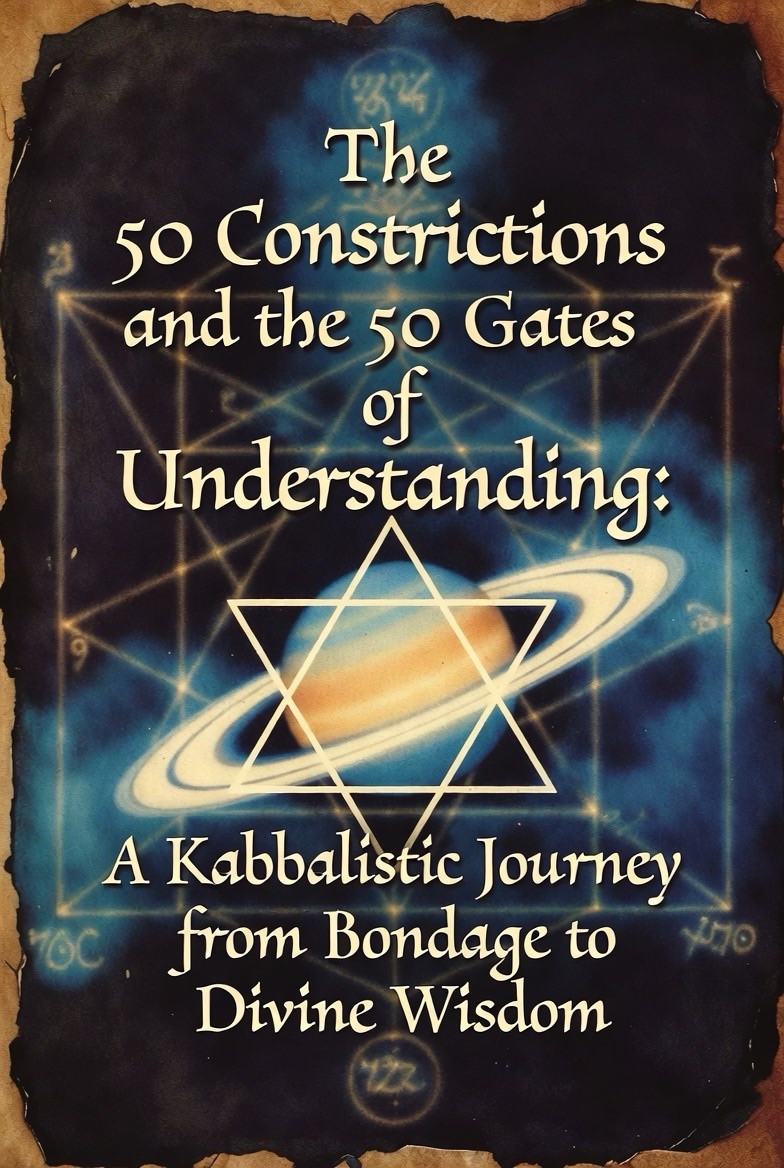
In the profound teachings of Jewish mysticism, the number fifty stands as a gateway to transcendence. It is the numerical value of the letter Nun, symbolizing the soul’s leap beyond the natural order into the realm of the miraculous. Central to this mystery are two intertwined concepts: the 50 constrictions (metzarim) that bind the spirit, and the 50 Gates of Understanding (Sha’arei Binah) that liberate it. These ideas, drawn from the Talmud, the Zohar, and the esoteric wisdom of King Solomon, illuminate the soul’s descent into Egypt and its ascent to Sinai—and beyond.

The 50 Constrictions of Mitzrayim
The Hebrew word for Egypt, Mitzrayim, holds a hidden key. Its root tzar means “constriction” or “narrow place,” while the suffix yim carries the numerical value of fifty. Thus, Egypt is not merely a geographical land but the archetypal realm of 50 constrictions—the layered limitations of fear, doubt, materialism, and spiritual narrowness that trap the human soul.1518

According to the mystics, these fifty levels parallel the fifty possible degrees of impurity. The Zohar and later Kabbalistic masters teach that the Children of Israel sank into 49 gates of impurity (sha’arei tumah) while enslaved in Egypt. One more day in that land, and they would have plunged into the fiftieth gate—from which, the tradition warns, there is no return without direct divine intervention. The 49-day count of the Omer that follows Passover is precisely the process of peeling away these layers of spiritual grime, ascending from the depths of tumah toward purity.
Had the people remained longer, redemption would have been impossible. Yet the Holy One, Blessed Be He, in His mercy, drew them forth just in time—on the fiftieth day, at the foot of Sinai, where the Torah would be revealed.

The 50 Gates of Binah: Talmud, Zohar, and the Questions of Job
The Talmud records a striking declaration: “Fifty gates of understanding were created in the world, and they were all given to Moses except one” (Rosh Hashanah 21b; Nedarim 38a). Moses attained forty-nine gates of Binah—the sefirah of Understanding—yet the fiftieth remained beyond mortal grasp in this world. This supernal gate is the realm of pure divine insight, the “point of no return” in holiness, where the soul merges with the Infinite.
The Zohar deepens the mystery by linking these gates to the Exodus itself. The Torah mentions the departure from Egypt exactly fifty times. Each mention is a rung, a portal through which the soul can climb from constriction to liberation. The fiftieth mention hints at the ultimate freedom that will be fully realized only in the World to Come or in the Jubilee year (Yovel), the fiftieth year when all slaves are freed and all land returns to its original owner—symbolizing the revelation of Binah in its fullness.
Strikingly, the Zohar and later Kabbalists (including teachings recorded in the Arizal’s tradition) connect these fifty gates to the end of the Book of Job. There, the Almighty speaks to Job from the whirlwind, posing a series of profound rhetorical questions about creation, the cosmos, and the limits of human knowledge. Kabbalistic interpretation counts fifty such questions as corresponding directly to the 50 Gates of Understanding. These divine interrogations are not meant to humiliate but to humble and elevate: only by confronting the vastness of the Creator’s wisdom can one begin to enter the gates of Binah.4

King Solomon’s Kabbalah and the Symbolism of Lebanon
King Solomon—wisest of men and builder of the Holy Temple—stands as the human embodiment of these mysteries. His three books—Proverbs (Mishlei), Ecclesiastes (Kohelet), and the Song of Songs (Shir haShirim)—are, in the Zohar’s reading, an encoded Kabbalistic manual. Proverbs reveals the path of Chochmah (Wisdom) that precedes Binah; Ecclesiastes teaches detachment from the constrictions of this world; and the Song of Songs unveils the mystical union that occurs once the fifty gates are approached.
The Zohar frequently invokes Lebanon (L’vanon) as a cipher for the supernal realms of purity and understanding. “Lebanon” evokes both whiteness (lavan)—symbol of holiness—and the lofty cedars that Solomon used to construct the Temple. In the Song of Songs, the divine Bridegroom calls: “Come with me from Lebanon, my bride…” (4:8). The Zohar interprets this as an invitation to ascend from the lower worlds into the embrace of Binah. Solomon’s palanquin (or pavilion), built “of the wood of Lebanon” (Song of Songs 3:9), becomes a mystical chariot carrying the soul through the gates of understanding toward union with the Divine.
In the Zohar’s vivid narratives, the disciples of Rabbi Shimon bar Yochai sit beneath trees by the Sea of Galilee and contemplate how the cedars of Lebanon represent the pillars of creation itself—each gate of Binah a living cedar in the supernal forest. Thus, King Solomon’s Kabbalah and the Zohar’s Lebanon imagery together teach that true understanding is not intellectual mastery but a fragrant, living ascent from the narrow places of Egypt into the open, white heights of divine wisdom.

Ascending in Our Time
Today, every soul still wrestles with its own fifty constrictions—financial worries, emotional narrowness, technological addictions, existential fears. The forty-nine days between Passover and Shavuot remain our annual ladder. By refining character traits, studying Torah, and performing acts of kindness, we peel away the layers of impurity and step closer to the fiftieth gate.
The Talmud reminds us that even Moses fell short of the final rung. Yet the Zohar promises that in the era of redemption—when the Jubilee sounds and Lebanon’s cedars sing—the fiftieth gate will swing open for all. King Solomon’s Song of Songs will be fulfilled literally: the Bride and Bridegroom united, constriction transformed into infinite understanding.
May we merit to leave our personal Egypt, traverse the fifty constrictions, and stand at the threshold of the fiftieth gate—where questions cease and pure Binah reigns. As the Zohar declares, “Fifty gates of understanding… and all were given to Moses except one.” That one remains the promise: what was withheld from Moses will be granted to the generation that completes the ascent.
Baruch HaShem.

Leave a Reply