Part 1: The Generous Bishop Who Became a Global Legend
Beneath the twinkling lights and roaring fireplaces of modern Christmas lies a story that begins not in the snowy North Pole, but in the sun-drenched ports of the ancient Mediterranean. In the year 270 AD, in the coastal town of Patara—part of the Roman Empire and now nestled in modern-day Turkey—a child named Nicholas was born to wealthy Christian parents. Little did the world know that this boy would grow into one of the most beloved figures in history, a man whose quiet acts of compassion would one day transform into the jolly, red-suited gift-bringer we call Santa Claus.

As Bishop of Myra, Nicholas earned a reputation for extraordinary kindness. Legends tell of him secretly tossing bags of gold through windows to save three impoverished sisters from a life of desperation, the coins miraculously landing in stockings hung by the fire to dry. Another tale speaks of him resurrecting three young boys who had been cruelly murdered and hidden in a barrel. These stories of anonymous generosity and protection of the innocent spread like wildfire across the Christian world after his death around 343 AD, turning Nicholas into the patron saint of children, sailors, and the poor. By the Middle Ages, his feast day on December 6 had become one of the most eagerly anticipated celebrations in Europe, especially in the Netherlands, where he was lovingly called Sinterklaas.
It was this Dutch tradition that crossed the Atlantic with early settlers. In the bustling colony of New Amsterdam—later renamed New York—the name Sinterklaas slowly morphed into the more familiar “Santa Claus.” But the bearded bishop in solemn robes was still far from the figure we know today. That transformation began in earnest in 1823 with the publication of a poem originally titled A Visit from St. Nicholas, now immortalized as ‘Twas the Night Before Christmas. Suddenly, the saint became a magical, elf-like being who arrived in a sleigh pulled by eight tiny reindeer, slipping down chimneys to fill stockings with toys.
Over the following decades, illustrators like Thomas Nast gave him a home at the North Pole, a workshop filled with elves, and a distinctive red suit trimmed with white fur. By the 1930s, Coca-Cola’s iconic advertising campaigns cemented this cheerful, rosy-cheeked version in the global imagination. What began as the quiet charity of a 4th-century bishop had evolved, through centuries of cultural blending, into the ultimate symbol of holiday joy and abundance.
Yet beneath this heartwarming tale lies a far stranger and more ancient thread—one that takes us far from churches and European ports, across vast frozen tundras to the shamans of Siberia, where red-and-white mushrooms and flying reindeer hint at a wildly different origin story for the man in the red suit.
Teaser: Into the Snowy Realms of the Shaman
What if the flying reindeer, the red-and-white colors, and even the tradition of entering homes through the chimney weren’t invented by 19th-century poets at all, but echoes of far older rituals practiced by indigenous peoples beneath the northern lights? In the next part, we journey deep into the icy world of Siberian shamanism, where hallucinogenic mushrooms and sacred reindeer may hold the true psychedelic roots of Santa Claus.
The Hidden Origins of Santa Claus: From Saint to Shaman to Sacred Secret
Part 2: The Psychedelic Shaman – Ancient Siberian Rituals and the Magic Mushroom
Imagine a world of endless winter nights under the aurora borealis, where nomadic reindeer herders in the vast tundras of Siberia turned to the spirits for guidance during the darkest time of the year. In these remote communities—among peoples like the Koryak, Evenki, and Chukchi—shamans served as healers, visionaries, and bridges to the unseen world. During winter solstice rituals, they sought altered states of consciousness to commune with ancestors and divine forces, often using a striking red-and-white mushroom known as Amanita muscaria, or fly agaric—the very same toadstool that fairy tales depict as a gnome’s seat or a poisonous trap.

This bright-capped fungus grows in symbiotic harmony beneath pine and birch trees, emerging like gifts from the earth after summer rains. Shamans collected these mushrooms, drying them carefully to reduce toxins and enhance their psychoactive effects, which could induce vivid hallucinations, euphoria, and a profound sense of disconnection from the body—sometimes described as flying through spiritual realms. Reindeer, sacred animals in these cultures, were drawn irresistibly to Amanita muscaria; they would seek it out and consume it, becoming intoxicated and frenzied, leaping about in ways that might easily inspire legends of “flying” beasts.
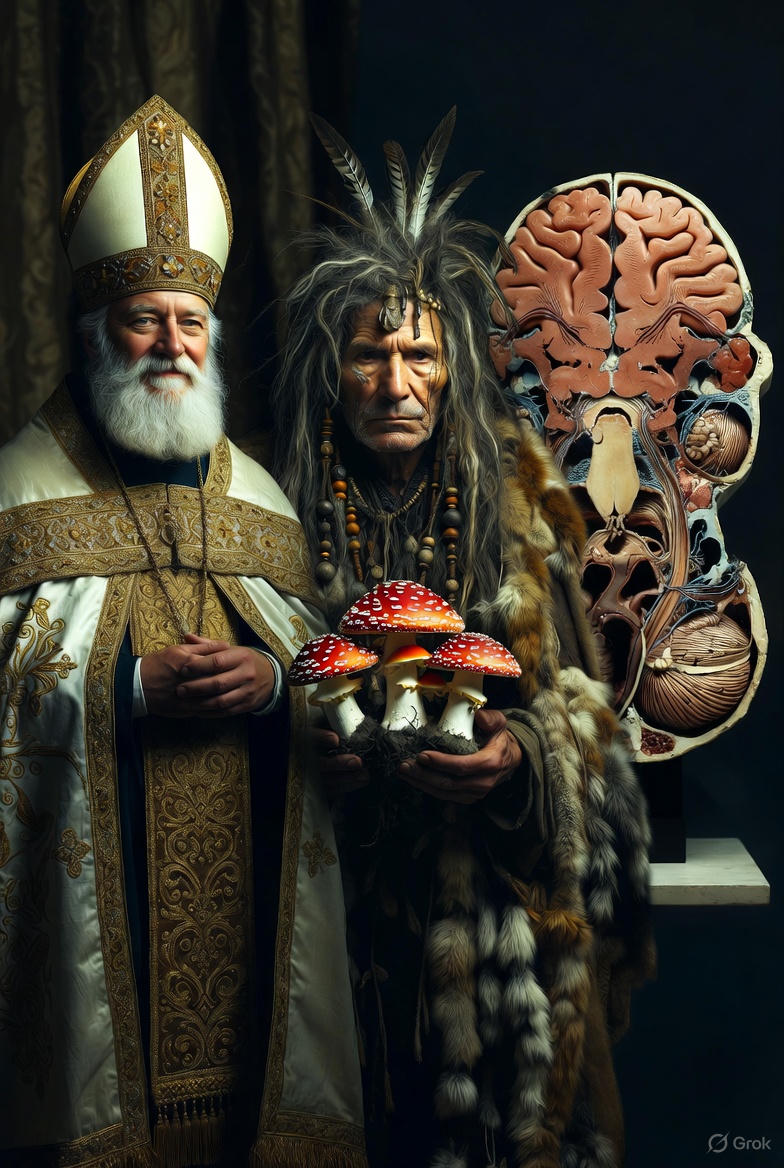
The parallels to Santa Claus are uncanny and have captivated storytellers for decades: the mushroom’s red cap with white spots mirroring Santa’s suit; dried mushrooms hung on pine branches (echoing ornaments on a Christmas tree); shamans entering snow-bound yurts through the smoke hole in the roof—much like slipping down a chimney—when doors were blocked by drifts; and the distribution of these “gifts” that brought visions and joy during the long, harsh winters. Some accounts even describe shamans wearing fur-trimmed garments in earthy tones, evoking a wild, northern figure laden with a sack of sacred offerings.
Yet, while these connections feel almost too perfect, scholars urge caution. Historical records confirm that Amanita muscaria was indeed used by some Siberian shamans as an entheogen—a substance to facilitate divine encounters—though its use was limited, often restricted to the shamans themselves rather than widespread community gift-giving. Reindeer do consume the mushroom and exhibit excited behavior, and urine-drinking rituals (to recycle the active compounds while filtering toxins) are documented in certain tribes. However, there’s no solid evidence of shamans dressing specifically in red-and-white to mimic the mushroom, routinely using reindeer sleds for solstice deliveries, or directly influencing European Christmas traditions. The theory, popularized in the late 20th century by figures like ethnomycologist R. Gordon Wasson and later amplified in books and online lore, is often critiqued as a modern myth—fascinating coincidences woven into a compelling narrative, but lacking direct historical links to the evolution of Santa from Saint Nicholas.
As for Mongolian shamans, their ancient Tengrist traditions—worshipping the eternal blue sky, nature spirits, and ancestors—involve powerful drumming ceremonies, elaborate costumes with fringes and mirrors to ward off evil, and invocations for healing or balance. While Mongolia shares cultural ties with Siberian peoples through reindeer-herding groups like the Tsaatan, there’s no established connection between Mongolian shamanism and Santa Claus imagery or Amanita muscaria rituals in the same speculative way. The psychedelic Santa story remains rooted in the Siberian Arctic, a tantalizing “what if” that blends real ethnobotany with imaginative folklore.
Whether ancient echoes or clever coincidences, these shamanic tales add a layer of wild mystery to the holiday season, reminding us that beneath the commercial gleam lies something primal and mind-expanding.
Teaser: The Inner Santa – A Journey into the Brain’s Hidden Secrets
But what if Santa Claus isn’t just a saint or a shaman—what if the entire myth is a coded map to the human body’s own sacred physiology? In the final part, we dive into one of the most esoteric interpretations: “Santa Claustrum” as an allegory for the brain’s mysterious claustrum, cerebrospinal fluid, and the alchemical path to enlightenment hidden within us all.
The Hidden Origins of Santa Claus: From Saint to Shaman to Sacred Secret
Part 3: The Inner Santa – The Brain’s Claustrum and the Alchemical Journey Within
What if the greatest Christmas story of all isn’t about a figure who comes from the North Pole or ancient Siberian tundras, but one that has been hidden inside every human body since the dawn of our species? In certain esoteric and mystical circles, “Santa Claus” is reinterpreted not as a person, but as a profound physiological and spiritual allegory—a coded map to enlightenment embedded in our very anatomy. At the heart of this interpretation lies a little-known structure in the brain called the claustrum, a thin sheet of gray matter whose name derives from the Latin word for “hidden” or “secret enclosure.” Proponents of this theory playfully anoint it “Santa Claustrum,” suggesting that the jolly old gift-bringer is a symbol for an inner process of regeneration and awakening that occurs within us all.

According to this esoteric view, the claustrum secretes a precious “oil” or fluid—often identified with cerebrospinal fluid—that travels a sacred path through the body. This fluid is said to rise from the sacrum (the triangular bone at the base of the spine, whose name means “sacred bone”) and ascend along the spinal column, sometimes described as a “chimney.” If preserved through disciplined practices—such as meditation, breathwork, or sexual continence—this sacred substance can be “raised” upward through the 33 vertebrae (mirroring the 33 years of Jesus’s life) to reach the brain. There, in the optic thalamus and the pineal and pituitary glands—likened to the biblical “Joseph and Mary”—it triggers a profound alchemical marriage, activating higher states of consciousness, deep spiritual insight, or even visionary experiences reminiscent of mystical rebirth.
The pineal gland, often called the “third eye,” becomes the Christmas tree itself, the Tree of Life under which enlightenment manifests as the ultimate gift. This monthly or seasonal cycle of descent and ascent is framed as the true meaning of “Christ-mass”—the anointing (from Greek chrism, sacred oil) that brings light into darkness during the winter solstice period when the sun appears to “die” and be reborn. Practitioners claim that preserving and raising this inner oil leads to heightened awareness, enhanced creativity, and a sense of unity with the divine, transforming ordinary perception into something miraculous.

While these ideas weave together ancient alchemical traditions, biblical symbolism, Kundalini yoga, and Gnostic teachings, they remain firmly in the realm of speculative mysticism rather than established science. Modern neuroscience recognizes the claustrum as a fascinating structure involved in integrating consciousness, attention, and sensory processing—some researchers even call it an “orchestra conductor” of the brain—but there is no evidence that it produces a special mystical oil or that cerebrospinal fluid follows the dramatic alchemical path described. The pineal gland does produce melatonin and has been poetically linked to spiritual experiences throughout history, yet claims of endogenous DMT production or direct ties to enlightenment lack rigorous scientific support.
Nevertheless, this inner Santa interpretation endures in New Age and occult communities because it offers something profoundly empowering: the idea that the magic of the season isn’t something we wait for from the outside world, but a latent potential waiting to be awakened within. Whether we celebrate with gifts under a tree, visions induced by ancient mushrooms, or quiet reflection on a long-ago saint’s generosity, perhaps the deepest truth is that the spirit of Santa—wonder, renewal, and selfless giving—has always been closest to home, hidden in plain sight inside the human experience itself.
Closing the Circle: Three Faces of the Same Eternal Myth
From a generous 4th-century bishop to a mushroom-wielding Siberian shaman to the secret alchemy of the human brain and spine, the story of Santa Claus reveals itself as far more than a children’s tale. It is a multilayered myth that has absorbed humanity’s oldest longings—for generosity, transcendence, and rebirth in the darkest time of year—reminding us that magic, in whatever form we find it, is ultimately a reflection of the light we carry within.
Did you know you can now unlock the Illuminarium Mystica Library?
Dive into the planet’s most enchanting and actionable books, designed to supercharge your spiritual journey and reveal elite occult strategies for business success. Now, you too can rise as a prophet of profit, with instant downloads of transformative titles to build your ultimate life.

Discover the ancient art of spiritual healing and transform your life with The Spiritual Healing Handbook: The Essential Guide to Using Spiritual Healing to Improve Your Quality of Life. This concise and empowering e-book delves into alternative therapies that have been practiced across cultures for centuries, offering a holistic approach to addressing physical, mental, and emotional ailments in today’s fast-paced world. Find it here
Leave a Reply