
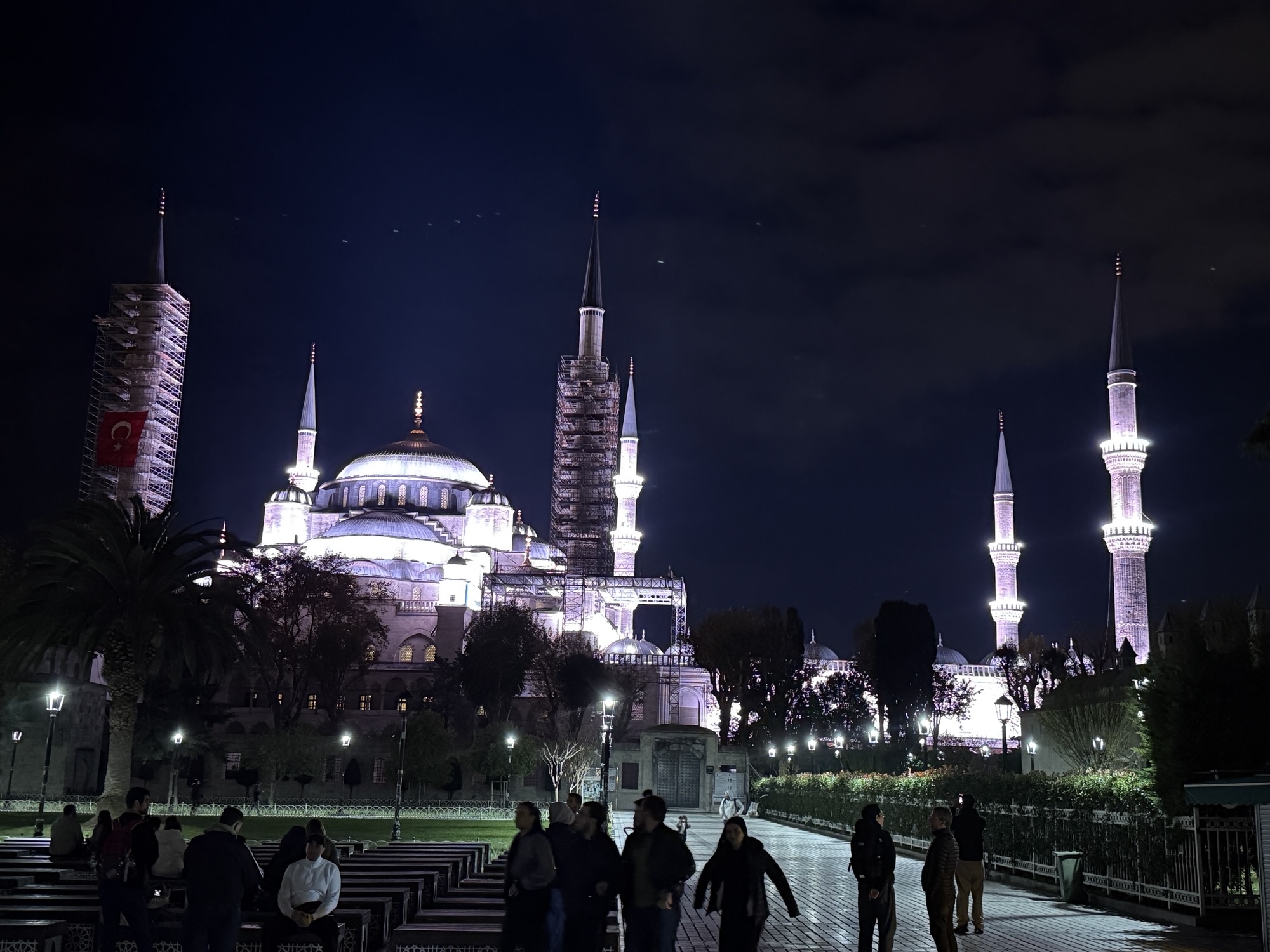
A Symphony in Cerulean Tile
Imagine stepping through a marble portal at dawn, when the first call to prayer drifts like incense across the Hippodrome, and suddenly the sky itself seems to have spilled downward in liquid sapphire. This is the Blue Mosque—officially the Sultan Ahmed Mosque—where more than twenty thousand hand-painted İznik tiles climb six soaring domes and half-domes in cascading waves of turquoise, cobalt, and indigo, each blossom and tulip motif glowing with the inner fire of centuries-old kilns. Built between 1609 and 1616 under the audacious vision of a fourteen-year-old sultan who sought to eclipse the Hagia Sophia across the square, the mosque remains a living paradox: an imperial flex of Ottoman might that now welcomes camera-toting pilgrims from every continent, their whispers mingling with the rustle of prayer rugs as sunlight fractures through 260 stained-glass windows into prismatic prayers on the carpeted floor.

The Boy Sultan’s Audacity
Ahmed I was barely past puberty when he commissioned the architect Sedefkar Mehmet Ağa—student of the legendary Sinan—to craft a sanctuary that would silence critics who claimed the empire’s golden age had dimmed. Breaking with tradition, Ahmed funded the project from his personal treasury rather than war spoils, a move that scandalized the ulema yet ensured every tulip-shaped tile and calligraphic medallion bore the purity of private devotion. Six minarets—unheard of at the time—stabbed the skyline like ivory lances, prompting outrage from Mecca until Ahmed quietly financed a seventh for the Kaaba. Today those same minarets host laser projectors during Ramadan, casting Quranic verses in neon green across the night, while tourists queue for virtual-reality headsets that let them “walk” the scaffolding with 17th-century masons, feeling the weight of wet plaster and the vertigo of domes that seem to float without visible support.

The Forest of Elephantine Columns
Enter the prayer hall and the world falls silent beneath a canopy of red-and-blue carpet thick enough to swallow footsteps. Fifty-meter granite columns—quarried from ancient forums, reused from Byzantine palaces—rise like primordial tree trunks, their capitals exploding into muqarnas honeycombs that transition the eye from earth to heaven in a dizzying geometry of stalactites. Above, the domes ascend in perfect proportion: the central cupola, 43 meters high and 23.5 meters wide, rests not on walls but on four massive “elephant foot” piers, creating an interior volume so vast that early European visitors swore they heard echoes of their own heartbeats. In modern evenings, fiber-optic stars embedded in the ceiling mimic the 17th-century night sky as it appeared on the mosque’s inauguration, while climate-controlled vents whisper conditioned air across the tiles, preserving pigments that have survived earthquakes, sieges, and the soot of a million oil lamps.

Courtyard of Ablution and Selfie Sticks
The outer courtyard—larger than the prayer hall itself—unfurls in a marble sea of alternating pink and white slabs, once cooled by fountains fed from Roman aqueducts that still snake beneath Istanbul’s tramlines. Here, ablution fountains carved with poetic inscriptions now compete with Instagram influencers angling for the perfect shot of the cascading domes framed by pencil-thin cypress. Yet the ritual endures: businessmen in tailored suits roll up sleeves beside backpackers in flip-flops, water splashing in rhythmic unison as the muezzin’s voice—now amplified through discreet Bose speakers hidden in the minarets—calls the faithful to surrender. At dusk, the courtyard transforms into a lantern-lit theater where whirling dervishes spin in LED-illuminated robes, their white skirts flaring like opening tulips, bridging the mystic Sufism of Rumi with TikTok algorithms.

The Hippodrome’s Eternal Dialogue
Across the lawn, the ancient obelisk of Theodosius and the serpentine column from Delphi stand as silent interlocutors to the mosque’s youthful bravado. Sultan Ahmed deliberately oriented his complex to converse with the Hagia Sophia—its domes mirroring Justinian’s masterpiece in a visual rhyme that spans a millennium of faith and empire. Today this dialogue continues in unexpected ways: the mosque’s floodlights synchronize with Hagia Sophia’s own, creating a nocturnal light show that reflects off the Bosphorus like liquid architecture, while underground sensors monitor seismic activity in real time, data streaming to engineers who reinforce 400-year-old mortar with carbon-fiber injections invisible to the naked eye.
Night Falls, Tiles Breathe
As the sun collapses behind the Prince’s Islands, the Blue Mosque exhales. The tiles—fired at temperatures that would melt steel—absorb the day’s heat and release it slowly, creating microclimates where moths dance in thermals invisible to tourists snapping final selfies. From the upper galleries, reserved for non-Muslim visitors, one can trace the evolution of light: from the blood-orange of sunset through the electric violet of LED minarets to the ghostly blue of conservation lamps that preserve the pigments without fading them. Somewhere in the distance, a ferry horn sounds, and for a moment the 21st century dissolves; you are simply a traveler in a chain of millions who have stood beneath these domes, each leaving a breath print on the cool marble, each carrying away a fragment of impossible azure etched behind the eyes forever.
Did you know you can now unlock the Illuminarium Mystica Library?
Dive into the planet’s most enchanting and actionable books, designed to supercharge your spiritual journey and reveal elite occult strategies for business success. Now, you too can rise as a prophet of profit, with instant downloads of transformative titles to build your ultimate life.

Leave a Reply