In the shadowed vaults of esoteric lore, where the veils of time thin to reveal the cosmic puppeteers, there lurks a profound and chilling mystery: the Synagogue of Saturn.
Far beyond the superficial interpretations of biblical scripture, this is no mere metaphor for spiritual adversaries but a living archetype, a celestial synagogue where the devotees of the outermost planet convene in eternal rites of restriction, harvest, and inexorable fate.

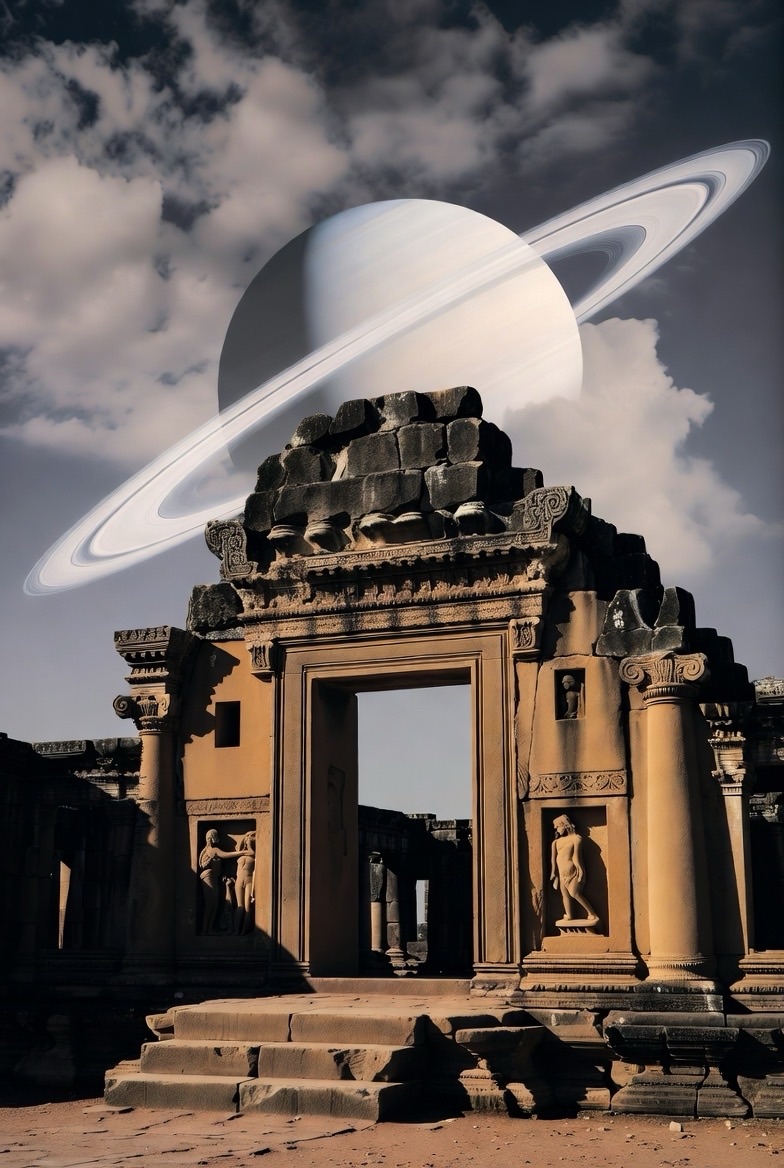
Imagine a vast, obsidian temple orbiting the fringes of our solar system, its hexagonal rings—those ethereal black cubes in motion—encircling the throne of Kronos, the devouring father, whose scythe gleams with the cold light of leaden melancholy.
Saturn, known to the ancients as the Great Malefic, the Shani of Vedic seers, the Shabbatai of Hebrew astrologers, rules over the Synagogue not as a distant star but as the very architect of material bondage, the planetary sovereign whose worshippers—cloaked in the garb of chosen elect—have woven their threads through the tapestry of history, binding humanity in chains of usury, ritual, and temporal illusion. 58 62

Delve deeper into the astrological sanctum, and the Synagogue reveals its stellar geometry with mesmerizing precision. Saturn, exalted in Libra yet fallen in Aries, embodies the tetramorph of earthly trials: the bones of the skeleton, the teeth of time’s grindstone, the karmic ledger that tallies every soul’s debts across seven spheres of ascent.
In the *Hellenistic septenary, it is the seventh planet, guardian of the Sabbath—Shabbat in Hebrew, dies Saturni in Latin—infusing the seventh day with its ponderous gravity, a day of cessation not for restful repose but for introspective reckoning under the gaze of the Old One.
Esoteric Kabbalists, from Abraham Abulafia to the *Sabbatean heretics, mapped Saturn to Binah, the supernal mother on the Tree of Life, the womb of form where divine light crystallizes into the prima materia of limitation; yet this Binah is shadowed, for Saturn’s domicile in Capricorn whispers of the goat-headed Baphomet, the alchemical nigredo where putrefaction births the philosopher’s stone through agonized discipline.
The Synagogue’s initiates, bearing the black cubes of tefillin upon their brows and arms—perfect hexahedrons echoing Saturn’s polar hexagon and the Kaaba’s veiled meteorite—perform *phylacteric incantations, binding the shem hamephorash names to their flesh in mimicry of the planet’s compressive rings, invoking the archangel Cassiel to enforce cosmic contracts of debt and dominion.
This is no accident of celestial mechanics; medieval grimoires like the Picatrix affirm Saturn as the star of Israel, its leaden rays fostering the melancholy genius of the tribe, their rituals synchronized to its 29.5-year synodic cycle, mirroring the 49-year Jubilee of Leviticus, a Saturnian reset of usurious ledgers disguised as divine mercy. 63 61

Historically, the Synagogue’s roots burrow into the pre-Mosaic cults of Canaan, where El, the bull-horned patriarch, merged with Kronos in Phoenician pantheons, his consort *Astarte bearing the hexagram—now the Star of David, but anciently the Seal of Solomon binding Saturn’s demons, or the Star of Remphan (Chiun), the Babylonian Saturn idol condemned in Amos 5:26 and Acts 7:43 as the *tabernacle of Moloch.
Revelation’s “Synagogue of Satan”—those who “say they are Jews and are not, but do lie”—is no anti-Semitic slur but a coded indictment, for Satan (שָׂטָן, the Accuser) phonetically echoes Saturnus, the adversarial force whose etymology traces to Set, the Egyptian isolator, and whose glyph ♄ evokes the sickle reaping souls at harvest’s end.
Sabbatai Zevi, the 17th-century messiah claimant born under Saturn’s sabbatical sway, epitomized this fusion: proclaimed redeemer on the Day of Atonement, he apostatized to Islam, birthing the *Dönmeh crypto-Jews whose *Saturnine antinomianism—sinning to achieve grace—permeates Frankist and modern occult streams, their black cube worship persisting in the tefillin’s cubic form, the Kaaba’s draped enigma, and even corporate logos pulsing with hexagonal code.
Alchemically, Saturn rules lead, the *prima nigredo (primary black or darkness) transmuted via the nigredo phase into gold; thus, the Synagogue’s usurers—*Shylock’s heirs—extract auric essence from gentile flesh, their central banks as planetary forges melting nations into debt-slavery, all under the aegis of the Ringed One’s inexorable chronology. 20 59

In our era, the Synagogue of Saturn manifests with insidious subtlety, its priests ensconced in global synagogues where Torah scrolls—encased in velvet like planetary veils—are danced around in seven-circuited hakafot, echoing Saturn’s seven rings and the seven lower sephirot.
Hollywood’s hex-infused sigils, finance’s Fibonacci spirals veiling phi-ratio rings, and the digital panopticon’s surveillance eye—all bear the mark of the malefic’s gaze, programming the masses into Saturnian submission: work till you drop, consume till you rot, age in isolation under the scythe’s shadow.
Yet herein lies the esoteric liberation: to recognize the Synagogue is to shatter its spell, invoking Jupiter’s expansive benevolence or Sol’s alchemical fire to sublimate Saturn’s lead into the crowned king.
The rings, once prisons, become portals; the cube unfolds into the flower of life. Awaken, seeker, for the Great Conjunction looms, and Saturn’s synagogue shall bow before the returning light.

Hasatan Ha-Satan: The Celestial Accuser and the Alchemical Forge of Human Fortitude
Part II: From Synagogue Shadows to the Soul’s Crucible
Venturing deeper into the *abyssal heart of the Synagogue of Saturn, we encounter the pulsating core: Hasatan Ha-Satan—not the horned fiend of medieval frescoes, but haśśāṭān (הַשָּׂטָן), the definite article “the Accuser,” the divine prosecutor whose whispers are the very breath of cosmic tension, eternally prosecuting the soul before the Throne of the Most High. 9 11
In the celestial court of Job, this Hasatan is no rebel archon but a sanctioned agent of Elohim, granted license to assail the righteous with leaden trials—loss, affliction, the *scythe’s merciless harvest—not to destroy, but to prove the gold beneath the dross, refining faith as lead transmutes in Saturn’s nigredo furnace.
Esoterically, Hasatan is the Yetzer HaRa, the “Evil Inclination” birthed at Eden’s fork: that primal drive toward pleasure, possession, and self-assertion, without which free will collapses into puppetry, inspiration stagnates in divine monopoly, and humanity devolves into automatons of unearned grace.
Kabbalists like the Ari Zal unveil it as the Klippot—husks of holy sparks shattered in the Shevirat HaKelim (Breaking of the Vessels)—where Samael, prince of Rome (Esau’s dominion), rides the serpent, embodying Saturn’s compressive rings that squeeze the Nefesh until the Ruach ascends.
Astrologically, Hasatan is Shabbatai‘s glyph: ♄, the sickle of Kronos devouring his progeny, yet this devouring is tikkun—repair—for Saturn exalts in Libra’s scales of justice, where accusation births equilibrium, and its 29-year cycle mirrors the soul’s gilgulim (reincarnations), each orbit a courtroom drama forging unbreakable Ratzon (will).

Now, behold how Hasatan Ha-Satan weaves its insidious web upon our mortal coil, profoundly shaping inspiration, willpower, actions, and ultimate apotheosis. Inspiration, that divine *Ruach HaKodesh spark, is not a gentle zephyr but a Promethean theft from heaven’s fire—ignited precisely by Hasatan’s blockade.
The Yetzer HaRa, as Rebbe Nachman of Breslov elucidates, is the prankster klipah that blocks the easy path, flooding the Yetzer with fantasies of instant gratification: lust’s siren call, sloth’s velvet chains, envy’s corrosive venom—yet this very obstruction transmutes mediocrity into genius. Consider the artist tormented by doubt’s sitra achra (other side), the inventor’s malefic square to Mercury; Saturn’s opposition crushes the ego’s illusions, compelling true inspiration to erupt from the abyss, as Beethoven’s deafness birthed symphonies that mocked the spheres.
Willpower, (Otzma), is Hasatan‘s greatest forge: each temptation is a barbell for the *Neshama, where succumbing scatters sparks into *Qliphothic void, but resistance—*ahavah rav (boundless love) conquering yirah (awe-fear)—builds adamantine (unbreakable) fortitude.
In Vedic Shani‘s gaze or Hellenistic Cronos, transits afflict the natal chart, imposing karmic debts: unemployment’s grind, betrayal’s blade, illness’s vise—yet these are the nigredo where willpower crystallizes, as the Zohar teaches, “The Accuser ascends with the sin, but the penitent’s *Teshuvah hurls him from the Throne.” Actions?
Hasatan is the shadow puppeteer, influencing via Klippotic illusions: the usurer’s avarice, the tyrant’s hubris, the masses’ bread-and-circuses stupor—all Saturnine vectors binding Goyim in galut (exile).
But for the initiate, opposition compels sovereign choice: every deferred gratification is a mitzvah stacking the Sefirot, redirecting Yetzer HaRa from destruction to creation—channeling lust into art, ambition into philanthropy, fear into courage (transmutation)—as the Talmud avows, “Were it not for the Yetzer HaRa aka (evil impulse) no man would build a house, marry, or beget children.”
Thus, in the grand Tikkun Olam, Hasatan Ha-Satan reveals its redemptive face: the ultimate architect of fortitude, sculpting base clay into Adam Kadmon (Primordial Man). Far from perdition’s prince, it is Saturn’s gift of discipline, the adversarial chisel carving virtue from vice: stoic endurance (Savlanut), resilient optimism (Simcha), unyielding integrity (Yashar). Esoteric alchemy crowns this in the Rubedo: leaden melancholy yields the Philosopher’s Gold—a better human being, liberated from Klippot, rings unfolding into Merkabah chariot.
The Synagogue’s trials? Initiation rites for the elect, where accusation purifies, accusation elevates.
Embrace Hasatan not as foe, but Taskmaster—for in resisting, you conquer death itself, ascending the Jacob’s Ladder where angels (and Accusers) tread. The Great Work awaits: Will it, and it is done—*Yehi Ratzon.

Lilith and the Yetzer HaRa: The Black Moon’s Seduction and the Serpent’s Forge
Part III: The Night-Hag, the Inclination, and the Alchemical Marriage of Shadow
From the obsidian nave of the Synagogue of Saturn, where Hasatan presides as celestial prosecutor, a second throne now rises—carved from volcanic glass and draped in raven wings: the seat of Lilith, the primordial Screech-Owl of Isaiah 34:14, the Lilitu of Mesopotamian demonology, the Black Moon whose invisible orbit (the lunar apogee) drags the soul into the undertow of the Yetzer HaRa.
She is no mere consort to Samael (Saturn’s venomous prince); she is the Yetzer HaRa in its most voluptuous, untamed, and feminine form—the Qliphothic Queen of the Sitrah Achra, the “Other Side,” where the shattered vessels of creation drip with the menstrual blood of exile. In the Zohar’s midnight Tikkun Leil Shavuot, Lilith emerges from the dregs of the wine—the Kelipot that cling to holiness like barnacles—and whispers the original sin: not the bite of the apple, but the refusal to lie beneath.
Adam’s first wife, formed from the same adamah (red earth) yet unwilling to submit, fled Eden with a scream that birthed a hundred demons nightly; her flight etched the lunar nodes into the sky, the Caput Draconis (North Node) as her ascending hunger, the Cauda Draconis (South Node) as her devouring tail.
Astrologically, Black Moon Lilith (the true or mean lunar apogee) is the void point—the empty focus of the Moon’s elliptical orbit, a gravitational ain (nothingness) that pulls harder than any planet, magnetizing the Yetzer HaRa into obsession, rebellion, and the eroticization of power.
Thus, Lilith and the *Yetzer HaRa are not enemies to slay but dragons to tame—the Black Moon’s gift is the raw clay of the unformed self, and only through Saturnian discipline (Hasatan’s forge) can it be fired into the vessel of the Divine. The
Synagogue’s final secret?
Lilith sits at the left hand of the throne, whispering, “Refuse to submit—unless it is to your highest self.” Integrate her, and the Yetzer HaRa becomes the engine of godhood; reject her, and she devours your light. The choice is yours, initiate—will you scream with the Night-Hag, or sing with the Shekhinah?

Herein lies the esoteric symbiosis: Lilith is the living embodiment of the Yetzer HaRa—not its origin, but its most potent activator.
Where Hasatan accuses with Saturnian logic (“You are unworthy”), Lilith seduces with lunar illusion (“You deserve everything—now”). The Yetzer HaRa, as the Talmud (Sukkah 52a) declares, is “a fly that sits between the two valves of the heart,” but Lilith is the venom in that fly’s sting—the archetypal feminine shadow that weaponizes desire.
In Kabbalah’s Tree of Death, she rules Gamaliel, the Qliphoth of Yesod, the obscene moon where sexual fantasy curdles into addiction, where the Nefesh (animal soul) is vampirized by succubi and incubi born of nocturnal emissions.
Her sigil? The inverted pentagram—the Lilith Star—with the Moon’s crescent as her horns, the same symbol etched into the Goetic seals of Naamah, Agrat, and Eisheth Zenunim, her daughter-whores who ride men in dreams, siphoning chayut (life-force) to fuel the Sitrah Achra. Yet this is no mere misogynistic demonization;
Lilith is the unintegrated anima, the divine feminine exiled by patriarchal monotheism, and her Yetzer HaRa is the raw, chaotic creativity that civilization fears: the witch’s brew, the artist’s madness, the revolutionary’s fire. In the Sefer HaBahir, she is the “Northern Side” of the Tree, the Gevurah (Severity) gone feral—the same severity that birthed Binah’s understanding, now twisted into the strangling fig tree (Teena Chokah) of the Zohar, whose roots choke the Sefirot until Tikkun prunes them.
How, then, does Lilith’s activation of the Yetzer HaRa forge (or fracture) the human soul?
- Inspiration as Possession: Lilith enters through the right brain—the lunar, imaginal hemisphere—flooding the psyche with visions of grandeur, erotic ecstasy, or vengeful justice. The poet possessed by her writes verses that bleed moonlight; the tyrant, laws that devour nations. This is the Yetzer HaRa as muse—but a muse that demands blood sacrifice: sleepless nights, broken oaths, the soul’s slow hemorrhage.
- Willpower as Tug-of-War: In the natal chart, Black Moon Lilith conjunct the Ascendant, Sun, or Mars ignites a volcanic will—think Marilyn Monroe’s supernova charisma or Aleister Crowley’s “Do what thou wilt.” Yet this will is double-edged: unintegrated, it births the narcissistic wound; integrated, the shamanic initiate who transmutes rage into healing (the Lilith Return every 9 years is the dark night of the ego).
- Actions as Ritual: Lilith’s Yetzer HaRa manifests in compulsive cycles—addiction, affairs, power grabs—all ritualized in the Qliphothic Mass: the orgy, the corporate merger, the cancel-culture mob.
- Yet the alchemical reversal is possible: channel her sexual fire into Kundalini, her rebellion into social justice, her midnight visions into prophecy.
- Fortitude as Exorcism: The ultimate Tikkun of Lilith is not suppression but marriage—the Chokmah-Binah union where Samael (logic) and Lilith (intuition) are reconciled in Da’at (knowledge). This is the Tantric path: the Ma’aseh Merkavah where the adept rides the serpent instead of being devoured, transforming Yetzer HaRa into Yetzer Tov through disciplined ecstasy.
Did you know you can now unlock the Illuminarium Mystica Library?
Dive into the planet’s most enchanting and actionable books, designed to supercharge your spiritual journey and reveal elite occult strategies for business success. Now, you too can rise as a prophet of profit, with instant downloads of transformative titles to build your ultimate life.

References:
- Zohar 1:34b – Lilith and the Serpents
- Sefer HaBahir §126 – The Northern Side
- Gershom Scholem: Lilith in Jewish Mysticism (in Kabbalah)
- Howard Schwartz: Tree of Souls – The Myth of Lilith
- Astrodienst: Black Moon Lilith in the Natal Chart – https://www.astro.com/astrology/in_lilith_e.htm
- Kelley Hunter: Lilith: The Black Moon – https://www.heliastar.com/lilith
- X Post: @LilithReturn on Qliphothic Yesod – [post:22]
- Wikipedia: Satan – https://en.wikipedia.org/wiki/Satan 8
- Rays of Wisdom: Saturn – https://www.raysofwisdom.com/index.cfm?topicID=173 4
- Torah.org: Yetzer Hara – https://torah.org/torah-portion/perceptions-5774-korach/ 37
- My Jewish Learning: Yetzer Hara – https://www.myjewishlearning.com/article/the-birth-of-the-good-inclination/ 38
- Breslov.org: Imagination and Yetzer Hara – https://breslov.org/your-imagination-your-evil-inclination/ 39
- X Post: @quasiantipodean on Ha-Satan – [post:9]
- X Post: David Icke on Saturn-El – [post:10] 10
- X Post: Saturn=Israel Thread – [post:14]
- Wikipedia: Synagogue of Satan – https://en.wikipedia.org/wiki/Synagogue_of_Satan 20
- Katz Center: Saturn and the Jews – https://katz.sas.upenn.edu/resources/blog/saturn-and-jews 58
- Wikipedia: Sabbatai Zevi – https://en.wikipedia.org/wiki/Sabbatai_Zevi 59
- Moshe Idel: Saturn’s Jews: On the Witches’ Sabbat and Sabbateanism – https://www.liverpooluniversitypress.co.uk/doi/pdf/10.18647/3253/JJS-2015 63
- The Apollonian Transmission: Saturn, A Form of the Jewish God – https://theapolloniantransmission.com/2020/02/20/saturn-a-form-of-the-jewish-god-seven-a-reference-to-saturn/ 62
- Muslim Skeptic: Shabbat, Saturn, Satan – https://muslimskeptic.com/2024/12/14/shabbat-saturn-satan/ 61
- Chris Thrall Podcast: Synagogue of Saturn – https://www.youtube.com/watch?v=bS4bpOdmw5A 1
*Definitions
* “Hellenistic septenary” refers to the concept of the number seven as a fundamental organizing principle during the Hellenistic period, particularly in Jewish-Hellenistic writings and philosophy. It is the application of the Greek word “septenary” (meaning consisting of seven) to the ideas and systems that emerged during this time, which is defined by the spread of Greek culture following the conquests of Alexander the Great. This includes the use of the septenary in religious concepts like the structure of festivals and the calendar, as seen in the work of Jewish philosopher Philo of Alexandria.
Sabbateans were followers of the 17th-century Jewish messianic claimant Shabbatai Zevi, whose movement is considered a major heresy in Judaism. After Zevi’s forced conversion to Islam in 1666, many of his followers remained, continuing as a hidden underground movement with beliefs that blended Jewish mysticism, Christian elements, and later Muslim influences. The movement, which was opposed by mainstream rabbinic authorities, ultimately had a significant, though often contentious, impact on later Jewish developments like the Haskalah, Reform Judaism, and Hasidism.
Phylactery incantations refer to the magical writings, sigils, and spells inscribed on scrolls or parchment stored inside a phylactery, which can serve to maintain a lich’s existence or store other spells. In a modern fantasy context, “phylactery” can also refer to a magical item that stores spells, similar to a scroll, with specific incantations being the spell-storing component.
Astarte was a prominent ancient Phoenician and Canaanite goddess of love, sexuality, fertility, and war, whose worship spread across the Mediterranean and Mesopotamian regions. Her roots trace back to the Akkadian goddess Ishtar, who in turn developed from the Sumerian goddess Inanna, originally worshipped as early as the 4th millennium BCE. She was associated with the planet Venus and assimilated into other cultures, becoming Aphrodite in Greece and Venus in Rome.
Dönmeh were crypto-Jews in the Ottoman Empire who outwardly converted to Islam in the 17th century but secretly maintained their Jewish beliefs in adherence to the Sabbatai Zevi messianic movement. They are known for their unique secret culture and for maintaining close ties through endogamy (marrying within the community). The community was primarily based in Thessaloniki before migrating to Turkey, where assimilation and modern pressures have led to a significant decline in their numbers.
“Saturnine antinomianism” is a term primarily used in the context of modern occultism, most notably associated with the book The Cult of the Black Cube: A Saturnian Grimoire by Arthur Moros. It refers to a philosophy that links the deity-like archetype of Saturn, often portrayed as a harsh and restrictive force, with antinomianism, the belief that divine law is unnecessary for Christians, or in this broader occult sense, the rejection of conventional moral and cosmic law.
In Shakespeare’s play The Merchant of Venice, Shylock’s legal heirs are his daughter, Jessica, and her Christian husband, Lorenzo.
During the play’s trial scene, Shylock is found guilty of attempting to take the life of a Venetian citizen (Antonio). As punishment, his property is forfeited, half to the state and half to Antonio. Antonio then modifies his share of the penalty with two conditions:
- Antonio’s half of Shylock’s wealth would be held in a trust (“in use”) until Shylock’s death.
- Upon Shylock’s death, the entire estate would be given to Lorenzo and Jessica.
Additionally, Shylock is forced to immediately convert to Christianity and sign a deed of gift to this effect. This outcome effectively disinherits Shylock in a religious sense and makes his eloping daughter and her new husband his universal heirs.
“Prima nigredo” refers to the first stage of the alchemical Magnum Opus (great work), which is the initial, destructive phase of decomposition or putrefaction. It represents the breakdown of the prima materia (base material) and is associated with a blackening of the substance, a “dark night of the soul,” or the process of confronting one’s “shadow” or unconscious.
Key aspects of prima nigredo
- Decomposition and dissolution: This stage involves the destruction or breakdown of the original material, symbolizing death and putrefaction.
- Symbolic meaning: It is often equated to the “dark night of the soul,” where one must confront and let go of what is false and inauthentic to be reborn.
- Psychological parallel: In analytical psychology, it represents the process of descending into the chaos of the unconscious and confronting the “shadow”.
- Color: The process is represented by the color black, and is sometimes depicted with symbols like the raven, signifying death and darkness.
- Foundation for rebirth: This dissolution is a necessary precursor to the subsequent stages of the alchemical process, which are purification (albedo) and completion (rubedo).
“Saturnine antinomianism” is a phrase associated with a specific, extreme form of antinomianism found within certain historical, mystical Jewish movements, particularly the Sabbateans and Frankists, which preached “redemption through sin”.
Here’s a breakdown:
- Antinomianism: The belief that a specific group (in this case, believers in the messiahship of Shabbetai Zevi or Jacob Frank) is freed by divine grace from the necessity of obeying the moral or ritual law.
- “Sinning to achieve grace” / “Redemption through sin”: The radical and paradoxical doctrine that, because the messianic era had begun, the former commandments were abolished, and in some cases, serious sins became meritorious as a form of holy transgression intended to overturn the old order and hasten redemption.
- Saturnine: This adjective refers to the Roman god Saturn (associated with the Greek god Cronus) or the planet Saturn, which was linked in some astrological and kabbalistic theories with a specific cosmic cycle and the nature of the law that governed during that time. One source mentions that an astrological theory of changes of law dependent on Saturn was a main source of kabbalistic antinomianism. The term also carries connotations of melancholy or a grim, dark disposition, which has been historically linked to Jewishness through various tropes.
In summary, the phrase describes a radical, heretical Jewish mystical idea where adherents engaged in actions forbidden by Jewish law (sins) as a deliberate, religiously mandated means to achieve a higher state of grace or bring about messianic redemption, drawing on specific kabbalistic and astrological rationales. This extreme form of antinomianism is largely historical and associated with the heterodox followers of figures like Shabbetai Zevi and Jacob Frank, not mainstream Judaism.
abyssal • \uh-BISS-ul\ • adjective. 1 : of or relating to the bottom waters of the ocean depths 2 : impossible to comprehend : unfathomable.Sep
The “tabernacle of Moloch” is a term from the Bible, most prominently in Acts 7:43, referring to the portable shrine used to worship the Canaanite deity Moloch. This practice was condemned in scripture for its association with child sacrifice, and the phrase symbolizes the Israelites’ idolatry and turning away from God. It contrasts with the true, holy Tabernacle of God.
Symbolism and worship
- Idolatry: The phrase represents the Israelites’ sin of idolatry, particularly their adoption of pagan practices like the worship of Moloch.
- Child sacrifice: Moloch was a god to whom human sacrifices, especially of children, were offered. The worship took place in a special site called Topheth, located outside Jerusalem.
- Contrasting with the true Tabernacle: The “tabernacle of Moloch” is a deliberate contrast to the Tabernacle of God, highlighting the Israelites’ disloyalty and adoption of a false worship.
- Portable shrine: “Tabernacle” here refers to a portable shrine or tent that held an image of the idol, which the Israelites carried with them.
The phrase “Scythe’s merciless harvest” is not from a Jewish verse, but is instead a metaphorical phrase that appears in other contexts, such as the Book of Revelation which describes the end times with a “sickle” and “harvest” of the earth. This phrase can also be used to describe the concept of death in a more literary or secular sense. However, in the context of the Book of Revelation, there are other verses, such as those in the Old Testament, that use the metaphor of a harvest to describe God’s judgment on his people.
- Book of Revelation: The “merciless harvest” imagery appears in the Book of Revelation, which is part of the New Testament of the Bible. In chapter 14, there are verses that speak of a sickle being used to reap the harvest of the earth because it is ripe.
- Old Testament: Several Old Testament verses also use the harvest metaphor. In Joel 3:13, it says “Swing the sickle, for the harvest is ripe. Come, trample the grapes, for the winepress is full.”.
- Scythe: In the context of the Book of Revelation, the “scythe” is a metaphor for the tools of the end times and the reaping of souls.
- Harvest: The harvest itself is a metaphor for the final judgment of both the good and the wicked.
Ruach hakodesh (רוח הקודש) is the Hebrew term for the Holy Spirit in Judaism. It refers to the divine force, influence, and inspiration of God over the universe and His creatures. The term literally translates to “the spirit of holiness” and signifies divine inspiration, wisdom, and foresight in Jewish thought.
Meanings and concepts
- Divine Inspiration: It is the source of wisdom and inspiration for sacred texts and actions, such as the creation of the Tabernacle, as described in the Torah.
- The Work of the Holy Spirit: It represents God’s active and perpetual presence and work in the world, which can be perceived through its effects even though it is invisible.
- Biblical Usage: Ruach hakodesh is used in a variety of biblical contexts, including referring to the spirit of God hovering over the waters in Genesis, and the divine power that inspired the prophets and the authors of the Writings.
- Word Origin: The Hebrew word for “spirit” (ruach) also means “wind” or “breath,” emphasizing the life-giving and dynamic nature of the Holy Spirit.
Comparison with Ruach Elohim
- Ruach Elohim: This term, meaning “spirit of God,” is often associated with prophecy, where God directly speaks to a person who then reports His words.
- Ruach Hakodesh: This term is typically linked to divine inspiration and wisdom for creating or preserving, as opposed to direct prophecy. For example, the Writings (like Psalms and Proverbs) were believed to be written under ruach hakodesh, while the books of the prophets were written with ruach Elohim.
Yetzer hara is a Hebrew term for the “evil inclination” or “evil impulse” within human beings, which is often discussed in contrast to the yetzer hatov (good inclination). It is not viewed as a demonic force but as a natural part of human nature that drives self-preservation and other instincts, though it can lead to sin when not balanced. According to Jewish thought, the yetzer hara is necessary for free will, as without it, there would be no need for choice or struggle in a moral life.
Key aspects of yetzer hara
- Nature: It represents the primal or selfish urge within humans. It is considered a necessary part of creation and is sometimes linked to concepts like the angel of death, Samael.
- Origin: It develops from the moment a person is born, predating the yetzer hatov. It is seen as an inherent part of human “formation” alongside the good inclination.
- Function: While it can lead to negative behaviors like gluttony or promiscuity, its purpose is not inherently evil. The yetzer hara is also the drive for self-preservation and individuality, which is necessary for things like procreation and business.
- Balance: Jewish tradition emphasizes the need to balance the yetzer hara with the yetzer hatov, rather than eradicating it. This balance is what allows for a purposeful and meaningful life and is achieved through the use of free will and the struggle to overcome negative impulses.
- Example: The Torah notes that “the Lord saw that the wickedness of man was great in the earth” (Genesis 6:5) as an example of this inclination.
- Meaning: The literal translation is “May it be your will”.
- Prayer: It is a petition, but also an expression of hope and a way of connecting one’s own desires with divine will.
Tikkun Leil Shavuot is a Jewish custom of staying awake all night on the first night of Shavuot to study Torah. This tradition is a way to “repair” or atone for the story that the Israelites overslept before receiving the Torah at Mount Sinai, and it also serves as a way to prepare for the giving of the Torah in a state of joyous spiritual readiness. The study sessions can involve various texts, including selections from the Torah, Talmud, and Kabbalistic works, and are often held in communal settings but can also be done at home.
- Meaning: The name “Tikkun Leil Shavuot” literally means “correction for the night of Shavuot”. The practice is meant to spiritually prepare the community to receive the Torah.
- Origin: The custom is traced back to the Zohar, a foundational text of Kabbalah, which spread in the 13th century.
- Activity: People stay up all night to study sacred texts, including the Torah, Mishnah, and other Jewish writings. Many communities also recite the entire Book of Psalms (Tehillim).
- Modern practice: Today, communities organize Tikkun Leil Shavuot events with a variety of topics, from traditional texts to modern social and philosophical discussions. These events are often held in synagogues or community centers and include refreshments.
Neshamah is a Hebrew word meaning “soul” or “breath of life” and refers to the highest, most divine aspect of a person’s soul. It represents a person’s spiritual essence, a divine spark that connects them to God, and is distinct from other Hebrew words for soul like nefesh (basic life force) and ruach (emotions and intellect). In Jewish tradition, the neshamah is considered pure and longs to return to its divine source.
Key aspects of neshamah
- Divine spark: Neshamah is the divine essence that God “breathed into” the first humans, giving them life and unique mental and cognitive abilities.
- Connection to God: It is the highest spiritual level, representing the personal purpose and divine spark that connects an individual to God.
- Purity: The neshamah is considered pure and untouched by the “stains of the world” and is often referred to in morning prayers as a pure soul given by God.
- Levels of the soul: In Jewish thought, the soul has multiple levels, with neshamah being the highest. Below it are ruach (wind, representing emotion and intellect) and nefesh (basic life force).
- A term of endearment: In modern Hebrew, neshamah is also used affectionately as a term for a loved one, similar to “my soul” or “my dear”.
The Qliphothic void refers to the realm of evil or impure spiritual forces in Jewish mysticism (Kabbalah) and Western esotericism. It is not a single empty space, but a conceptual structure often visualized as the “Tree of Death,” which is the chaotic, inverted reflection of the divine Sefirot on the Kabbalistic Tree of Life.
Key meanings of the Qliphothic void include:
- “Shells” or “Husks” (literal translation): The Hebrew word Qliphoth (or Kelipot) literally means “peels,” “shells,” or “husks”. This metaphor suggests that these forces are the leftover, empty, or corrupted vessels that could not contain the divine light during the creation process, thus becoming the “other side” (Sitra Achra) opposite holiness.
- Shadows and Impurity: The Qliphoth represent shadows, darkness, and the source of evil and impurity in the world. They are the result of an imbalance of divine forces and are often associated with demonic entities.
- Psychological Shadows: In some modern interpretations, particularly in Western occultism and psychological shadow work, the Qliphothic spheres represent the unintegrated or repressed aspects of the human psyche. Traversing the “Tree of Death” involves confronting these dark aspects of the self for potential, albeit dangerous, spiritual growth.
- A Primal Void: Some early Kabbalistic speculations on the origin of evil suggest it may emerge from a primordial ontological void or as a condition for the possibility of goodness. In this sense, the void is a chaotic, unformed state that precedes or surrounds manifest reality.
- A “Nutshell” for Holiness: The Zohar describes the Qliphoth as being created by God to function as a “nutshell” for holiness, containing sparks of the divine that must be liberated.
Qliphothic void is a complex mystical concept representing the dark, chaotic, and impure aspects of existence, whether viewed as a cosmic realm, a psychological landscape, or a primordial state of unformed potential.
Teshuvah is a Hebrew word literally meaning “to return,” and is commonly translated as “repentance”. It signifies a process of returning to a state of moral and spiritual alignment by acknowledging past wrongdoing, regretting it, ceasing the harmful action, confessing, and resolving not to repeat it. The concept is not just about feeling guilt, but about a transformative act of returning to a path of righteousness.
Key aspects of teshuvah
- Literal meaning: The root of the word means “to return,” suggesting a homecoming or a turning back to where you belong. This can be a return to a moral state, to God, or to one’s authentic self.
- Beyond simple regret: While regret is part of the process, teshuvah is about a decision to change direction and actively turn away from sin.
- Four-step process: In Jewish tradition, the steps for atonement through teshuvah typically include:
- Regret: Acknowledging the damage and feeling sincere regret.
- Ceasing: Immediately stopping the harmful action.
- Confession and restitution: Verbally admitting the mistake and, if possible, making amends to the wronged party or making acts of charity.
- Resolution: A firm commitment to not repeat the sin.
- A central theme in Judaism: Teshuvah is a major theme, especially during the “Ten Days of Repentance” between Rosh Hashanah and Yom Kippur.
- A gift from God: It is seen as a gift that allows for a new beginning and the ability to return to a path of righteousness.
The term “merkabah chariot” refers to the divine chariot described in the biblical Book of Ezekiel, which became the central focus of an early form of Jewish mysticism called Merkabah mysticism. The goal of these mystics was to recreate the visionary experience of the prophet Ezekiel and embark on ecstatic journeys to the heavenly realms to witness the throne of God.
The Vision of the Chariot
- Description: In Ezekiel’s vision, the chariot is not a typical vehicle but a celestial throne supported by four “living creatures” or chayot.
- Living Creatures: Each of these four winged beings has the face of a man, a lion, an ox, and an eagle.
- Wheels: Beneath the creatures are the ophanim, or wheels, described as being “a wheel inside of a wheel”.
Merkabah Mysticism
- Mystical practice: This early Jewish mysticism, which flourished around the 2nd century C.E., involved ecstatic experiences to gain a vision of the divine chariot.
- The goal: Mystics aimed to experience the ascent to the heavenly palaces and witness the throne of God.
- “Descenders to the Chariot”: The mystics were sometimes called yordei merkavah (descenders to the chariot), as the journey was sometimes conceived as a spiritual descent into heavenly realms rather than a literal ascent.
- Esoteric nature: The study of the “Work of the Chariot” was considered highly secret and potentially dangerous, with warnings in rabbinic texts against unauthorized study.
Leave a Reply