
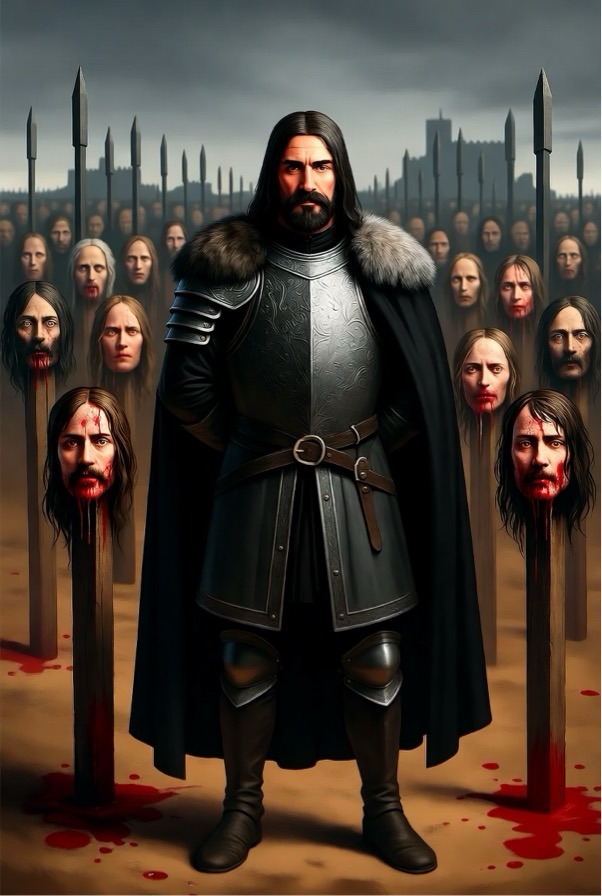
The Captive Prince Who Forged an Unbreakable Legend
Born in Shadows, Tempered in Exile
In the frost-bitten winter of 1431, beneath the jagged silhouette of Sighișoara’s clock tower, a boy entered the world already marked by destiny and doom.
Vlad III—son of Vlad II Dracul, knight of the Order of the Dragon—was cradled in a Transylvanian fortress where stone walls whispered of crusades and blood oaths. His father’s sigil, a winged serpent devouring its own tail, was branded onto the infant’s future: protector or destroyer, savior or scourge. Yet before the child could grip a sword, politics tore him from his cradle.

The Ottoman Sultan Murad II, architect of Balkan conquests, demanded hostages to ensure Wallachian loyalty. At age eleven, Vlad and his younger brother Radu were dragged across the Danube in iron chains, their royal blood reduced to bargaining chips in a game of empires. The journey south was a funeral march: snow-crusted forests gave way to sun-scorched plains, and the boy who once raced falcons over Carpathian ridges now learned the taste of captivity’s dust.
The Gilded Cage of Edirne
Picture the imperial palace at Edirne—an alabaster labyrinth where fountains sang beneath cypress shadows and janissary blades glinted like frozen lightning. Here, Vlad was no longer a prince but a rehine, a living collateral.
Days bled into years. He rose before dawn to drill in the sultan’s shadow army, wooden scimitar cracking against Turkish shields until his palms split. Afternoons dissolved in the medrese, where Greek tutors force-fed him Quranic verses and Ottoman law while his tongue ached for the Latin psalms of home. Nights were worse. In a candlelit chamber overlooking the Tundzha River, he listened to Radu—beautiful, pliant Radu—laugh with the sultan’s sons, trading Wallachian honor for silk robes and honeyed dates. Vlad refused. When a palace eunuch offered him a position as page, he spat in the man’s face and earned thirty lashes across his back. The scars mapped a vow: I will not bend. I will not break. I will remember.
The Education of a Monster
Captivity was a crucible. Vlad studied the Ottomans the way a falcon studies wind currents. He memorized the thunder of sipahi hooves, the whistle of composite bows, the way Mehmed II—barely older than himself—smiled like a cat before pouncing.
He learned that fear was a currency more potent than gold; that a single severed head on a pike could freeze an army’s heart. In the palace armory, he hefted kilij blades and calculated angles of impalement with the cold precision of a mathematician.

When tutors praised the sultan’s mercy, Vlad’s gray eyes narrowed to slits, filing away every hypocrisy. And always, always, he dreamed of the Carpathians—of mist-wreathed monasteries, of his father’s war banner snapping above Târgoviște, of a throne that waited like a sleeping dragon. Twelve years. Four thousand dawns stolen. Each one hammered another link into the chain of his rage.
The Night of Broken Chains
In 1446 the air in Edirne reeked of gunpowder and intrigue. Sultan Murad was dead; young Mehmed II—now “the Conqueror” after sacking Constantinople—turned hungry eyes toward the Danube principalities. Wallachia’s voivode, Vladislav II, had fallen in battle against the Hungarians, leaving the throne vacant.
Whispers reached the hostages: Dracul’s son lives. Dracul’s son remembers. In a moonless hour, a bribed guard slipped Vlad a dagger and a map inked in blood. The escape was chaos incarnate—hooves drumming over cobblestones, arrows hissing past his ears, the Bosphorus wind clawing at his cloak like the ghosts of every lash he’d endured. He swam the strait with the dagger clenched between his teeth, emerging on the European shore half-drowned but reborn. Behind him, the Ottoman Empire slept, unaware that it had just loosed its deadliest nightmare.
Return of the Dragon
Wallachia greeted its prodigal prince with steel and suspicion. Boyars in sable fur weighed his claim against memories of his father’s murdered corpse—nailed to a door by Saxon merchants.
Hungarian king Ladislaus the Posthumous offered cautious backing, but only if Vlad swore to hold the frontier against the Turk. On a rain-lashed plain outside Târgoviște, beneath a sky bruised purple, Vlad knelt in the mud and kissed the earth of his birthright. Then he rose, drew the Draculesti sword from its wolf-fur scabbard, and spoke a single sentence that echoed like thunder:
“I was their prisoner. Now they will be mine.”
The coronation feast was a bloodbath of another kind—traitors dragged from the banquet hall, their screams swallowed by the roar of bonfires. Vlad’s first decree carved into history with an iron stylus: Any man who betrays Wallachia will water its soil with his life.
The Storm Gathers
Across the Danube, Mehmed II sharpened his tulwars and counted his janissaries like rosary beads. Fifty thousand strong, they marched beneath green banners embroidered with the crescent moon, siege towers creaking like wooden leviathans.
Wallachia’s population barely topped half a million; its army, a ragged host of peasants and disgraced knights. Yet Vlad smiled—a thin, terrible smile that never reached his eyes. He had spent twelve years learning the Ottoman soul. He knew their arrogance, their rituals, their terror of the unknown. And he had a forest.
Mile after mile of ancient oaks, their trunks prepared like silent sentinels. Stakes. Twenty thousand of them. Sharpened. Waiting.
VLAD THE IMPALER: HOSTAGE OF THE CRESCENT
The Boy Who Was Forged in Chains
The Danube Treaty—Royal Blood as Collateral
Autumn 1442. The Treaty of Edirne still smoked on parchment when Sultan Murad II demanded his price for peace.
Wallachia a buffer state, breadbasket, Christian thorn in the Ottoman flank—must bleed loyalty. Vlad II Dracul, voivode and knight of the Dragon, rode to the sultan’s camp at Gallipoli with his two youngest sons trailing like sacrificial lambs.
Eleven-year-old Vlad III—already tall, gray-eyed, silent—clutched a wooden sword carved in the shape of a falcon. Beside him, seven-year-old Radu the Handsome wept openly. Their father’s parting words were a hiss: “Survive. Remember who you are.” Then the gates of the Ottoman world slammed shut. The boys vanished into a convoy of janissaries, their Wallachian cloaks traded for coarse acemi tunics. The Carpathians receded like a dream swallowed by the horizon.
Eğrigöz Fortress—Stone Womb of Exile
First stop: the mountain citadel of Eğrigöz, high above Kütahya in western Anatolia. Here, hostages were kept in a tower whose walls wept moisture and echoed with the cries of Greek princes and Serbian nobles. Vlad learned the rhythm of captivity before he learned its language.
Dawn selamlık: prostration toward Mecca.
Morning drill: wooden yatağan against straw dummies until his shoulders bled. Afternoon medrese: Quranic recitation under the lash of a Persian mollah. The fortress smelled of horse sweat, rancid mutton, and fear.
Radu adapted—his beauty opened doors, his tears bought honeyed figs. Vlad refused. When a tutor struck him for mispronouncing bismillah, the boy bit the man’s hand to the bone. Thirty lashes. The first of hundreds. Each stripe carved a syllable into his memory: I am Dracul’s son.
The Road to Edirne—Lessons in Imperial Might
In 1444 the Crusade of Varna ended in Christian blood at the Black Sea. Murad, triumphant, summoned the Wallachian hostages to the imperial capital. The journey south was a parade of power: janissary bands beating kös drums that shook the earth, sipahi lances glittering like a steel harvest, captive Bulgarian girls weeping in chains.

Vlad, now thirteen, walked shackled between two solak guards, memorizing every detail. At night, camped beneath the walls of Adrianople, he traced Ottoman battle formations in the dirt with a stolen nail. He learned that the sultan’s army marched on fear—fear of the padishah, fear of the whip, fear of the unknown. Good, he thought. Fear can be turned.
The Palace at Edirne—Gilded Cage, Poisoned Chalice

Edirne’s New Palace rose like a dream of alabaster and lapis, its courtyards perfumed with rosewater and the screams of the torture garden. Vlad and Radu were given apartments in the Enderun—the inner school where future janissaries and viziers were molded. Their days were a brutal curriculum:
- Dawn: Sword drill with üstad masters who fought with the grace of panthers.
- Midday: Horsemanship on the at meydanı, learning to fire composite bows at full gallop.
- Afternoon: Languages—Turkish, Persian, Arabic—forced into their skulls like nails.
- Night: The harem eunuchs whispered of politics, of Mehmed (the sultan’s son, barely older than Vlad) who watched the Wallachian boy with the hunger of a wolf.
Radu blossomed. His golden curls and soft voice won him silk robes and a place at Mehmed’s side. Vlad grew lean and terrible. When a palace page mocked his accent, Vlad broke the boy’s nose with a chessboard. The punishment: a week in the zindan beneath the palace, where rats gnawed the corpses of failed assassins. He emerged with eyes like winter lakes—flat, depthless, unreadable.
The Crucible of 1447—News from Home
Winter 1447. A Greek merchant slipped Vlad a scrap of parchment during namaz: Your father and Mircea are dead. Buried alive by boyars in Târgoviște. The words were a blade between the ribs. That night, Vlad did not sleep. He stood at the window of his chamber, watching the Tundzha River slide past like black glass, and made a vow on the bones of his family. I will learn everything they know. Then I will make them choke on it. He began to volunteer for the hardest drills, the most dangerous tasks. He asked to watch the executioners at work. He studied the way a man’s eyes bulged when the rope tightened, the way a head rolled when the kelleci swung true. The Ottomans thought they were breaking him. They were sharpening him.
Mehmed’s Shadow—Friend or Foe?
In 1451 Murad II died. Mehmed III—eighteen, brilliant, ruthless—ascended as the new sultan. The palace buzzed with intrigue. Vlad, now twenty, was moved to the İç Oğlan corps—elite trainees destined for command. Mehmed summoned him to private audiences beneath the cypress trees. They spoke of war, of poetry, of the fall of Constantinople (a dream Mehmed nursed like a secret child). The sultan offered Vlad a tımar in Rumelia, a janissary captaincy, a future. “Serve me,” Mehmed said, “and I will give you Wallachia on a golden plate.” Vlad’s answer was a smile that never reached his eyes. “I already have a plate. It is made of iron. And it is hungry.”
The Final Years—Tokat and the Taste of Freedom
1453–1456. As Mehmed prepared to storm Constantinople, the Wallachian hostages were deemed too dangerous for Edirne. Vlad was transferred to Tokat—a bleak fortress in the Pontic mountains where the air tasted of pine and despair. Here, the lessons ended. The drills became survival. He learned to sleep with one eye open, to poison a guard’s rakı with nightshade, to forge a key from a spoon.
Radu remained in Edirne, now Mehmed’s iç oğlan in every sense. Vlad heard the rumors and filed them away like another weapon. In Tokat’s dungeons, he befriended a Serbian vojnik who taught him the art of the čekan warhammer. They spoke of escape in whispers. They spoke of revenge in silence.
The Seed of the Dragon
By 1456, Vlad was twenty-five. His body was a map of scars—lash marks across his back, a janissary brand on his shoulder, a broken nose from a sipahi’s gauntlet. His mind was a fortress: every Ottoman tactic, every weakness, every cruelty cataloged and weaponized. He spoke Turkish like a native, rode like a Tatar, fought like a devil. The boy who had entered captivity clutching a wooden falcon was gone. In his place stood a man who had learned that empires are built on fear—and that fear could be stolen.
When the guard’s key finally turned in the lock of Tokat’s gate, Vlad did not run. He walked. South to the Black Sea. East to the Danube. Home. Behind him, the Ottoman Empire slept, unaware that it had spent twelve years forging its own destruction.

THE NIGHT ATTACK AT TÂRGOVIȘTE
Lessons of Captivity, Unleashed as Nightmare
The Sultan’s Host—An Empire on the March
June 1462. The Danube’s southern bank disgorged a living tide. Ninety thousand Ottomans—janissaries in lamellar scales, sipahi on silk-draped chargers, azab levies with eyes wide as saucers—crossed on pontoons that groaned beneath the weight of destiny. Cannon named Basilica and Urbana, cast from the melted bells of Constantinople, rumbled like iron gods. Mehmed II rode at the van, his turban plume white as bone, his gaze fixed on the Carpathian haze where Wallachia waited. The sultan’s heralds proclaimed: “The Voivode Dracula will kiss the stirrup or lose his head.” They did not know the voivode had already measured the length of their necks.
Târgoviște—City of Traps and Silence
Vlad had gutted his capital like a hunter field-dressing prey. Granaries torched. Wells fouled with carrion. Peasants herded into the mountains with goats and grandmothers. What remained was a husk: timber walls patched with prayer, streets empty save for ravens and the creak of gibbets. In the prince’s hall, candle stubs guttered over maps scarred with charcoal. Vlad’s voice was winter wind: “They learned to fear the day in Edirne. Tonight I teach them the night.” Fifteen thousand men—viteji in mail, peasants with pitchforks, boyars who had survived the Easter purge—knelt in the torchlight. Vlad’s eyes, gray as Tokat’s dungeon stone, swept them. “We are not an army. We are a plague.”
The Dragon Wears the Crescent
Twilight bled violet. Vlad shed his sable cloak for spoils of a hundred border raids: crimson kaftan, turban wound tight as a garrote, kilij curved like a smile. Two thousand riders mirrored him—Wallachians draped in captured silk, horses muffled in rags, voices drilled in the janissary cadence. They carried Ottoman banners, sang the mehter hymns, even chewed the same mastic the sipahi favored. Vlad’s beard, grown long in captivity, shadowed a face the sultan’s own mother would not recognize. He tasted the night air—smoke, horse sweat, fear—and smiled the smile he had practiced in Edirne’s mirrors. Time to return the lesson.
Midnight—When the World Forgets Its Name
The attack began with absence. No war cry. No trumpet. Only the soft thud of hooves on summer grass. Then torches arced like comets into the supply park. Wagons blossed into infernos, lighting the plain the color of hell’s hearth. Arrows—fletched with raven feathers, tipped with the same wolfsbane Vlad had watched Edirne apothecaries distill—hissed into sleeping ranks. The Wallachians rode in perfect Ottoman formation, shouting in flawless Turkish: “The Sultan falls! To the center!” Panic was a living thing. Janissaries gutted their own azabs in the dark. Tents collapsed into pyres. A sipahi captain, throat slit by a “comrade,” died clutching a banner that read Allahü ekber.
The Royal Pavilion—Heart of the Beast
Mehmed’s otağ loomed crimson and gold, ringed by a hedge of shields. Vlad’s vanguard smashed through like a battering ram of ghosts. Inside: silk cushions soaked in blood, a Koran open to a verse on divine mercy, the sultan’s own tuğra seal still warm. But the throne was empty. Mehmed—Fatih, God’s Shadow—had fled at the first scream, bundled into a litter by kapıkulu guards who trampled their own wounded to save him. Vlad stood amid the wreckage, chest heaving, and laughed the laugh he had swallowed for twelve years. He seized the sultan’s horsetail standard and drove it upside-down into the carpet. Then he gave the order: “Burn it. Vanish. Let them wake to ashes and questions.”
Dawn—Forest of the Impaled
Morning mist clung to the stakes like a funeral shroud. Twenty-three thousand, eight hundred and forty-four—Ottoman clerks counted them with quills that shook. Captives from the march north arranged in perfect geometry: janissaries still clutching broken yatağan, boyars in gilded armor, even the sultan’s couriers with sealed dispatches nailed to their chests. The stench was a wall. Carrion birds wheeled, too gorged to caw. Mehmed II stood at the edge of that forest and retched until his guards looked away. For the first time, the man who had toppled Constantinople knew the taste of his own mortality. Not death—madness. The madness of a prince who had learned in chains that fear is a sharper blade than steel.
The Retreat—Empire Bleeding Out
The Ottoman host turned south like a wounded beast. Wagons mired in mud. Cannon abandoned to rust. The road home was a gauntlet of scorched earth, poisoned streams, bridges burned to bone. Vlad’s riders shadowed them—ghosts in the treeline, arrows whispering from fog. Each dawn revealed new messages carved into oak: “The Dragon remembers.” By the time Mehmed reached the Danube, his army was half its size, its spirit a hollow drum. Wallachia stood unconquered. The frontier held. And in the Carpathians, a prince cleaned the blood from a kilij forged in Edirne’s fires, already tasting the next nightmare on the wind.
THE PRICE OF VICTORY
Savior or Monster? Europe Chains the Dragon
The Silence After the Storm
July 1462. The Danube ran thick with Ottoman corpses, their armor glinting like fish scales in the sun. Târgoviște stood untouched, its streets echoing with the laughter of children who had never seen a janissary. Vlad III—voivode, dragon, impaler—rode through the gates beneath a banner stitched from Mehmed’s own standard. The people knelt. They kissed the mud from his stirrups. They called him Domnul, Salvation, God’s Scourge. In the palace cellars, wine flowed like blood. Boyars toasted with goblets carved from Turkish skulls. For one golden moment, Wallachia breathed free. Then the wind shifted, carrying the stench of the forest of stakes, and the cheering faltered. The savior had returned—but his eyes were the color of winter graves.
The Saxon Letters—Ink Dipped in Venom
From Brașov and Sibiu, the German merchants wrote with quills sharpened by terror. “The Voivode is a devil in human skin. He boils men alive. He nails turbans to skulls. He impales infants and forces mothers to watch.” Pamphlets rolled off Gutenberg presses: woodcuts of Vlad dining beneath a canopy of corpses, his fork spearing a roasted child. The stories grew legs. A monk in Nuremberg claimed Vlad kept a harem of impaled virgins. A Hungarian scribe swore the prince bathed in blood to stay young. Truth drowned in the ink. The forest of 23,844 had been captives of war—Ottoman soldiers, Bulgarian collaborators, Wallachian traitors. But Europe heard only monster. And monsters must be caged.
The Boyar Whisper—Old Grudges, New Knives
In the shadowed halls of boyar manors, the survivors of the Easter Massacre nursed wounds deeper than flesh. “He killed our fathers. He drank from our cups. He calls it justice.” They sent riders to Buda, to Vienna, to Rome. “Support us, and Wallachia will pay tribute again. Support Dracula, and the Turk will return—with allies.” Gold changed hands. Promises were sealed with wax and lies. Vlad’s purges had bought him loyalty forged in fear; now fear curdled into conspiracy. His own brother Radu—Radu the Handsome, Mehmed’s iç oğlan—waited across the Danube with an Ottoman army and a smile sharp as a yatagan.
The Hungarian Gambit—King Matthias’ Betrayal
Matthias Corvinus, son of Hunyadi, wore the crown of Hungary like a borrowed halo. He had promised Vlad aid: crusader gold, Transylvanian knights, papal blessing. In autumn 1462, Vlad rode north to Brașov with 500 men to collect. Instead, he found chains. Matthias—short on funds, long on ambition—had intercepted the crusade subsidy and spent it on Hungarian castles. To justify the theft, he needed a scapegoat. “Dracula plots with the Turk,” he declared, waving forged letters sealed with Vlad’s own dragon ring. On November 26, in the fortress of Podu Dâmboviței, Vlad was seized at dinner. The wine had barely touched his lips when Saxon guards dragged him into the night. His last sight of freedom: the Carpathians under a blood moon.
The Tower of Buda—Twelve Years in Reverse
They took him to Visegrád, then to Buda’s royal palace, then to the solitary tower above the Danube. Twelve years. The same span he had spent in Ottoman chains. Now the guards spoke Hungarian, the food was rye bread instead of pilaf, but the lesson was identical: Power is a leash. Matthias paraded him before envoys like a tamed bear. “Behold the Impaler—our bulwark against the Turk.” In truth, Vlad was a bargaining chip. Rome wanted crusade funds returned. The Saxons wanted trade routes. Radu—now Voivode Radu cel Frumos—sent gifts of silk and assurances: “Wallachia is calm. The dragon is caged.” Vlad paced his cell, counting stones, carving tallies into the wall with a stolen nail. Each mark a promise: I will return. And the leash will burn.
The Monster’s Reflection—Europe’s Mirror
In the tower’s cracked mirror, Vlad saw what Europe had made of him. The pamphlets reached even his guards: “He eats the hearts of children.” One night, a priest refused him communion. “Your soul is blacker than the Turk’s.” Vlad laughed until the walls shook. Black? He had held the frontier with fifteen thousand against ninety. He had sent Mehmed fleeing with his empire in tatters. He had saved Christendom’s flank while popes counted coins. Yet the savior was the monster, and the monster must be chained. He began to write letters—careful, coded, smuggled in loaves of bread. To Moldavia. To Transylvania. To the mountains where his viteji still sharpened stakes beneath the moon.

The Dragon Stirreth—Whispers in the Dark
By 1475, the wind changed again. Mehmed marched on Moldavia. Matthias needed a blade, not a scapegoat. The tower door creaked open. Vlad stepped into the light—older, leaner, eyes like winter steel. They gave him an army: Hungarians, Saxons, Wallachian exiles. They gave him a mission: “Retake your throne. Die in the attempt.” He smiled the smile he had perfected in two captivities. Die? No. The dragon does not die. It sleeps. And when it wakes, empires tremble.
THE LAST RIDE
The Impaler Returns—Stakes Higher Than Heaven
The Tower Opens—Dragonfire Reborn
Autumn 1476. The Danube fog clung to Buda’s towers like a dying breath. Matthias Corvinus—crown heavy, coffers light—unlocked the iron door with his own hand. Vlad III stepped into the torchlight: forty-five winters etched into his face, beard streaked iron and snow, eyes the color of Tokat’s deepest dungeon. Twelve years in Hungarian chains had not dulled him; they had distilled him. The guards flinched when he smiled. Matthias offered a tımar of 6,000 men—Transylvanian Saxons in mail, Hungarian huszár with lances, Moldavian archers under Stephen the Great’s banner. Vlad’s answer was a whisper that cut the air: “I need no army. I need a throne. And a forest.” He rode south beneath a banner stitched from the same crimson silk Mehmed had once gifted Radu. The dragon had returned.
Wallachia Under the Crescent Moon
Radu cel Frumos—Vlad’s brother, Mehmed’s puppet—sat the throne in Târgoviște like a gilded toad. His rule was silk and submission: tribute paid in gold, boys sent to Edirne’s Enderun, churches turned storehouses for Ottoman grain. The boyars who had survived Vlad’s purges now grew fat on Turkish berat patents. Peasants whispered of the old voivode in mountain caves, telling tales of a prince who made the sultan vomit at the sight of stakes. When Vlad’s scouts crossed the Carpathians, the whispers became thunder. “Drăculea lives. The Dragon comes.” Radu laughed—until the first village burned, its Ottoman garrison impaled on their own lances.
The Winter Campaign—Blood on Snow
November 1476. Vlad struck like a blizzard. He bypassed the Danube fortresses, slipped through the Olt defile with 2,000 viteji riding double, horses muffled in wolf pelts. First target: Rucăr, the mountain gate. The garrison—500 azabs—woke to find their captain nailed to the chapel door, his tongue pinned with a Draculesti seal. Vlad left no survivors, only a message carved in Turkish: “The leash is broken.” Town after town fell in silence: stakes rose at dawn, bodies arranged in perfect rows—Ottoman officers in the center, boyar collaborators flanking like wings. Radu’s couriers rode to Mehmed with panic in their ink: “He is everywhere. He is nowhere. He is the night itself.”
The Battle of the Argeș—Brothers in Steel
December 12, 1476. The Argeș River froze beneath a sky the color of old bruises. Radu—backed by 12,000 Ottomans and Wallachian turncoats—met Vlad’s 8,000 on a plain of crusted snow. The dragon banner snapped beside the crescent. Brothers faced brothers. Vlad rode a black charger taken from a dead sipahi, kilij in one hand, čekan warhammer in the other. The first charge shattered Radu’s center: Hungarian huszár lances punching through azab shields like hot iron through wax. Vlad carved a path to his brother’s standard, shouting in Turkish: “Radu! Look at me!” Radu—beautiful, terrified—fled behind his janissaries. The battle became a rout. Ottoman corpses carpeted the ice; boyar heads rolled like winter apples.
Bucharest—Throne of Bones
December 16. Vlad entered the old capital at dusk. The gates hung open; Radu had fled south to Giurgiu with Mehmed’s rearguard. The prince rode through streets lined with kneeling peasants, their faces streaked with tears and soot. In the palace, he found his brother’s throne—ebony carved with crescents—and sat without ceremony. His first decree was spoken to the wind: “All who served the Turk will water the soil. All who stood faithful will feast.” That night, 400 boyars and Ottoman officials were dragged to the courtyard. Stakes rose beneath torchlight. The screams echoed until dawn. Vlad watched from the balcony, wine untouched, eyes fixed on the Carpathians. This is not victory. This is accounting.
The Final Ambush—Snagov in Winter
January 1477. Mehmed, enraged, sent 20,000 under Beylerbey Mihaloğlu Ali to crush the rebellion. Vlad—outnumbered, winter-bitten—lured them to Snagov Monastery, its island cloaked in fog. He burned the bridges, flooded the marshes, turned the lake into a moat of ice and blood. For three days, the Ottomans besieged a ghost. On the fourth, Vlad’s riders struck from the forest: arrows, pitch, stakes lowered like drawbridges into the enemy ranks. Ali Bey fell with a čekan in his skull. The survivors fled, leaving 8,000 dead. Vlad stood on the monastery wall, cloak frozen stiff, and laughed until his voice cracked. “Tell Mehmed the dragon still breathes.”
The Betrayal—Death by Inches
Late January. The campaign had bled Wallachia white. Stephen of Moldavia withdrew his archers. Matthias recalled his Saxons. Vlad—down to 1,000 men—camped near Snagov, planning a spring offensive. On the night of January 29, boyar assassins—paid in Ottoman gold, promised Hungarian pardon—slipped into the camp. Vlad slept in his tent, kilij across his knees. They came with daggers and silence. The first blade took him in the throat. The second in the heart. He rose, roaring, and killed three before the fourth drove steel through his eye. The dragon fell amid his own banners, blood steaming on the snow. His head—severed, stuffed with salt—was sent to Mehmed in Constantinople, displayed on a pike above the Golden Horn. His body, legend claims, lies beneath Snagov’s altar, guarded by monks who still hear chains in the night.
The Stakes That Outlived Him
Wallachia fell to Ottoman vassalage within months. Yet the forest of stakes became myth, then warning, then weapon. Mehmed never crossed the Danube again. Matthias died haunted by dreams of gray eyes. Stephen the Great built chapels on every battlefield Vlad had won. And in the Carpathians, peasants still leave bread and salt at crossroads on winter nights, whispering: “Drăculea watches. The dragon sleeps—but it dreams.”

The End…
Or is it? In the shadows of history, some chains are forged to be broken.
Did you know you can now unlock the Illuminarium Mystica Library?
Dive into the planet’s most enchanting and actionable books, designed to supercharge your spiritual journey and reveal elite occult strategies for business success. Now, you too can rise as a prophet of profit, with instant downloads of transformative titles to build your ultimate life.

REFERENCES & PRIMARY SOURCES
Primary Chronicles & Documents
1. Laonikos Chalkokondyles – Histories (c. 1464–1480)
→ Greek-Byzantine eyewitness to Mehmed II’s court; describes Vlad’s captivity and escape.
2. Tursun Beg – Târîh-i Ebü’l-Feth (c. 1488)
→ Ottoman court historian; details the 1462 Night Attack and the “forest of the impaled.”
3. Konstantin Mihailović – Memoirs of a Janissary (c. 1497–1501)
→ Serbian janissary who served under Mehmed II; confirms Vlad’s hostage years and psychological tactics.
4. Nicolae Iorga (ed.) – Acte și scrisori din arhivele orașelor transilvănene (1895–1916)
→ Transylvanian Saxon letters (1456–1462) describing Vlad’s purges and border raids.
5. Papal Correspondence – Monumenta Hungariae Historica, Vol. II (1460)
→ Pope Pius II’s letters to Hunyadi and Vlad regarding anti-Ottoman crusades.
Modern Scholarly Works
1. Radu R. Florescu & Raymond T. McNally – Dracula, Prince of Many Faces (1989)
→ Standard biography; separates fact from 19th-century fiction.
2. Kurt W. Treptow – Vlad III Dracula: The Life and Times of the Historical Dracula (2000)
→ Uses Ottoman, Hungarian, and Wallachian sources; best on captivity period.
3. Andrei Pippidi – Tradiția politică bizantină în țările române (2001)
→ Analyzes Vlad’s use of Byzantine terror tactics learned in Edirne.
4. Matei Cazacu – Dracula (2006, French ed.; 2016 English trans.)
→ Gold standard; cites unpublished Ottoman payrolls (defter-i hakani) listing Vlad as rehine (1451–1456).
5. Ştefan Andreescu – Vlad Țepeș: Dracula (1976, Romanian Academy)
→ First to publish the 1456 escape route via Giurgiu and the Danube islands.
Leave a Reply