Some of the herbal allies mentioned here are shared through affiliate links, meaning I may receive a small blessing of support if you choose to journey with them—always at no extra cost to you.

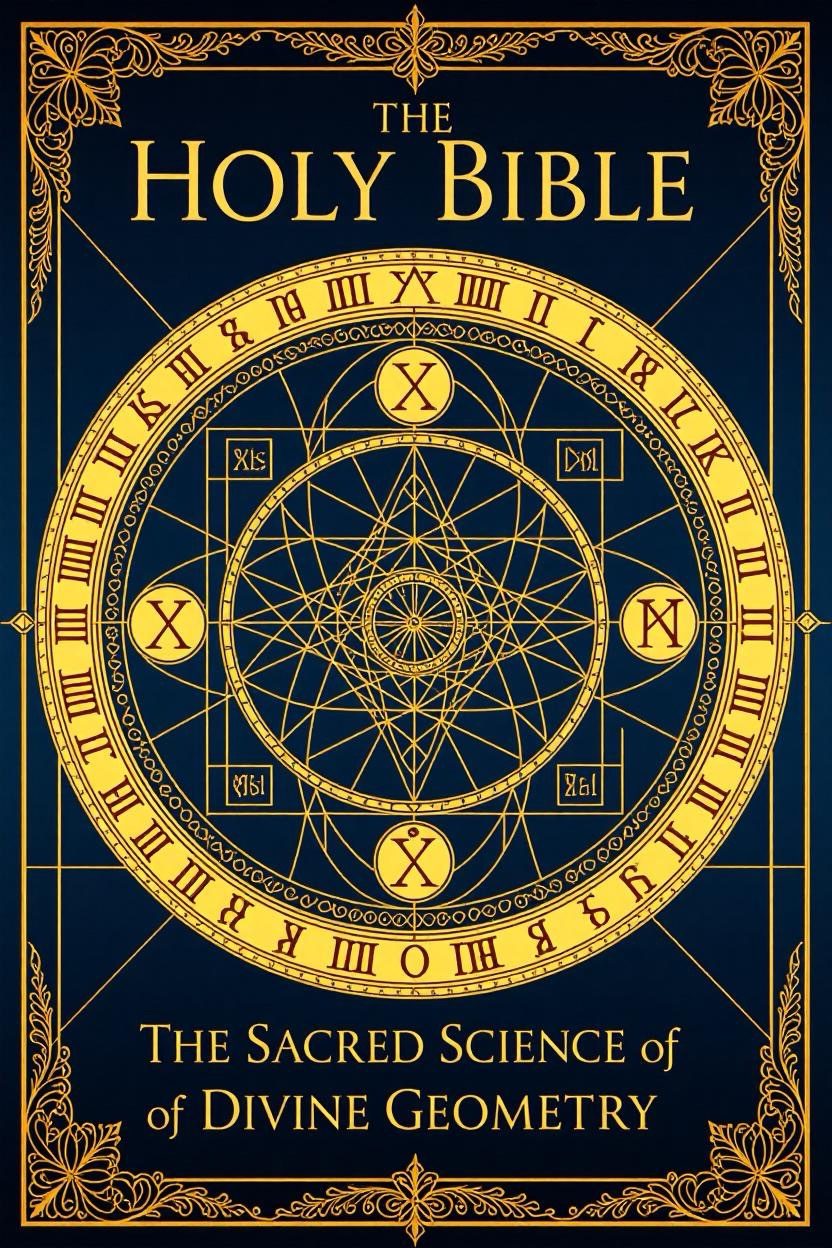
When we look upon the Ethiopian Holy Bible, we see not only words but patterns—rhythmic architectures of light woven through language, number, and symbol. It is no exaggeration to say that hidden beneath its parchment lies a living cosmology, a sacred science that bridges spirit and matter. The ancients did not divide religion and science as we do; for them, the laws of heaven and the laws of the earth were reflections of one another. To understand the Ethiopian Bible is therefore to enter into a multidimensional system of divine order—a geometry of consciousness encoded in story, song, and symbol.
In Ethiopia, scripture has always been understood as an energetic map. The monks who chant its verses in Ge’ez do so with the understanding that each word carries a vibration corresponding to a number, an element, and an angelic principle. This tradition, though rarely discussed outside the monasteries, mirrors what the Kabbalists called gematria, the Pythagoreans called harmonia, and the alchemists called the mathematica divina—the divine mathematics through which the Creator designed the cosmos. In the Ethiopian worldview, nothing is random; the letters themselves are instruments of resonance, and to speak them aloud in prayer is to tune the soul back to its original frequency.
The Book of Jubilees—so central to the Ethiopian canon—contains one of the clearest examples of this sacred science. Its very structure is numerical: time itself is divided into cycles of forty-nine years, seven times seven, symbolizing perfection within creation. This sacred rhythm recurs throughout Ethiopian theology, music, and art. The drumbeats of the liturgy echo these same ratios, the architectural proportions of the rock-hewn churches follow them, and even the fasting calendar aligns with this divine pulse. To live in harmony with these cycles is to move in resonance with cosmic order, to become a living expression of the divine geometry that holds the universe together.

The number seven, revered across the ancient world, holds special significance in Ethiopian mysticism. It represents the seven heavens described in The Book of Enoch, the seven sacraments, and the seven seals of Revelation—all reflections of the same law of unfolding consciousness. In Enoch’s ascension through the heavens, one can read a symbolic guide to the human soul’s journey through seven states of awakening—each plane corresponding to a refinement of awareness and a purification of the heart. The Ethiopian mystics teach that as the soul ascends these inner spheres, it comes to realize what Tewahedo has always proclaimed: that there is no true separation between heaven and earth, only degrees of awareness. The cosmos is not vertical but vibrational.
And yet, the Ethiopian Bible’s sacred geometry is not only found in number—it is written into its art. The ancient iconographers of Ethiopia were not mere painters; they were geomancers of light. Every halo, every cross, every spiral bears a precise mathematical proportion that encodes spiritual truth. The Ethiopian cross, for instance, is not simply a symbol of faith—it is a fractal blueprint of unity. Its interlaced design, with endless loops and mirrored symmetry, represents the infinite continuity of creation: no beginning, no end, only eternal return. Within the church of Lalibela, these same patterns unfold in stone. The layout of its eleven churches mirrors the constellation of Orion, and their alignment to celestial markers testifies to an understanding of sacred astronomy that rivals that of ancient Egypt.
Astrology, too, finds its echo in Ethiopian scripture—not as fortune-telling, but as sacred timing. In The Book of Enoch, we find detailed descriptions of the stars, the courses of the sun and moon, and the laws that govern the heavens. These were not mere observations; they were revelations of divine order. The stars were seen as the alphabet of God, their patterns spelling out the rhythm of creation. Just as the heavens move in harmony, so too must the soul align its inner orbit to the celestial dance. The Ethiopian monks, who mark feast days and fasts according to the stars, understand that time itself is sacramental. To live in right timing is to live in divine harmony.
The alchemical dimension of this wisdom lies in its purpose: transformation. For the Ethiopian mystic, the aim of sacred science is not knowledge alone, but transfiguration—the awakening of divine consciousness within the human vessel. Just as alchemists sought to turn lead into gold, the spiritual practitioner seeks to refine the base substance of the self into pure light. Fasting, chanting, meditation, and study of the sacred texts are the tools of this inner alchemy. Through these disciplines, the elements of the soul—earth, water, fire, and air—are purified and balanced, awakening the fifth element: the ether, or divine breath. In this state, the human being becomes what the ancients called a microcosm of the macrocosm—a living reflection of God’s universe.
This understanding reveals that the Ethiopian Bible is not merely a historical document—it is a spiritual technology. Its stories are algorithms of consciousness; its symbols are formulas for awakening. Enoch’s journey through the heavens is a code for the soul’s ascension through dimensions of awareness. The Ark of the Covenant is a symbol of the human heart, the true tabernacle where divine fire dwells. The seven heavens correspond to the seven centers of energy within the body, known in other traditions as chakras. And the final revelation—that of Tewahedo, the unity of all things—is the philosopher’s stone itself, the realization that all opposites dissolve in the One Light.
In this light, Ethiopia’s ancient scripture becomes the meeting point of all sacred sciences—astrology, numerology, geometry, and alchemy—each a facet of the same gem. It is as though the Creator encoded the universe in layers of correspondence, and the Ethiopian Bible preserved the key. To read it with open eyes is to witness divine intelligence expressing itself in number and form, in rhythm and proportion. It is to see that revelation is not confined to text but inscribed in the very structure of existence.

As humanity enters a new age of rediscovery, perhaps the sacred science of Ethiopia offers a bridge between ancient wisdom and modern understanding. Where the material sciences dissect the visible, the sacred sciences illuminate the invisible. Both, in truth, are incomplete without the other. The Ethiopian mystics understood this centuries ago. They did not choose between science and spirit, for to them, they were one.
And so the Ethiopian Holy Bible stands not only as scripture but as a manual of creation, a mirror through which we may see the divine symmetry of all things. Its letters are constellations, its pages are planets, its verses are vibrations. When we learn to read it not merely with the mind but with the awakened heart, the universe itself becomes the open book of God.

Leave a Reply