
Some of the herbal allies mentioned here are shared through affiliate links, meaning I may receive a small blessing of support if you choose to journey with them—always at no extra cost to you.

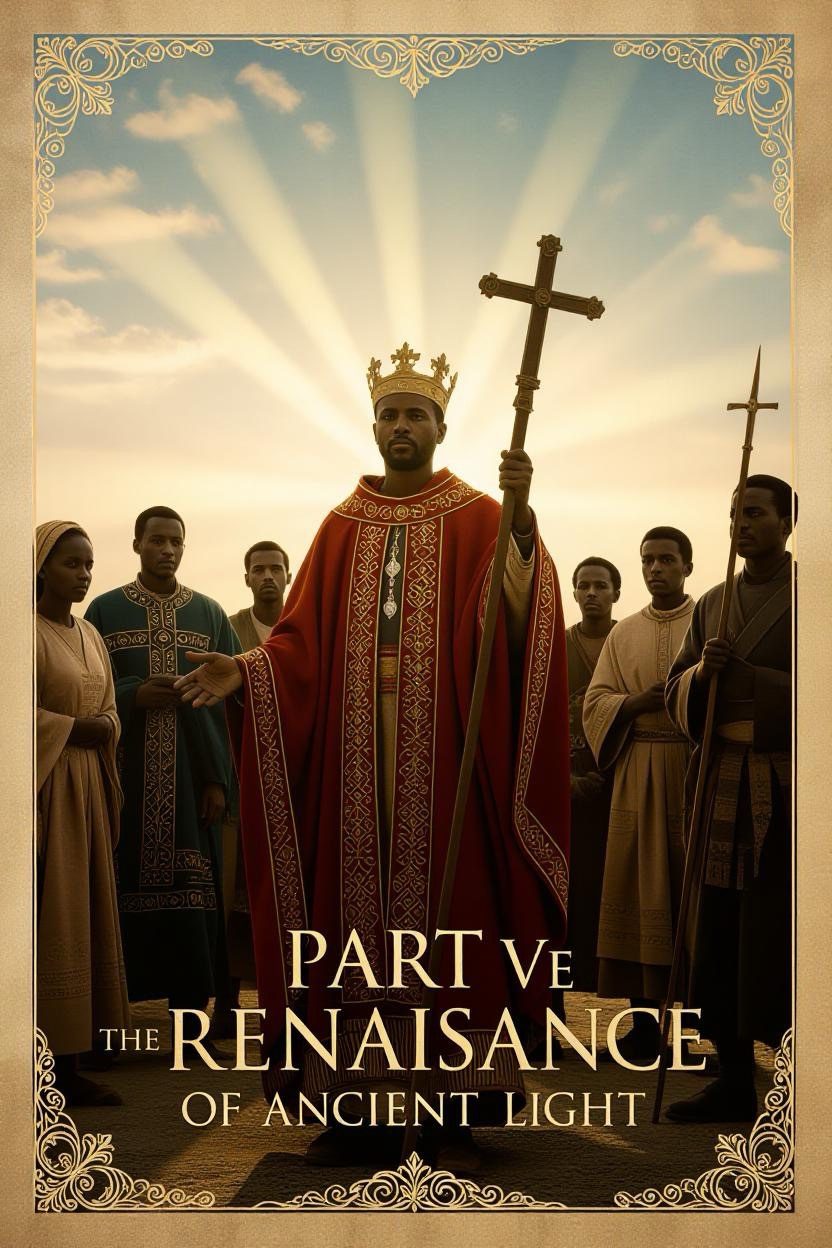
In a world that grows noisier by the day—where information multiplies yet wisdom seems to vanish—the Ethiopian Holy Bible reemerges like a forgotten beacon rising from the mists of time. Modern seekers, mystics, and scholars alike have begun to rediscover its ancient brilliance, drawn not only by its age but by its unbroken purity of vision. It calls to those who sense that something essential was lost along the path of civilization: a sacred wholeness, a consciousness of divine unity that once guided humanity’s relationship with the cosmos. As the Western mind begins to tire of fragmentation and the soul aches for meaning beyond doctrine, the Ethiopian Bible speaks again—its words no longer buried in monasteries but whispering across the world, calling the human spirit back home.
This renaissance of interest is more than academic curiosity—it is a spiritual reclamation. For centuries, the Ethiopian Church guarded its scriptures in silence, hand-copying them on parchment while the rest of the world mechanized its faith. But now, as translations and digitized manuscripts reach modern readers, a profound realization is dawning: that Ethiopia preserved not merely a different Bible, but an entirely different way of seeing. The texts that once seemed apocryphal or obscure—Enoch, Jubilees, The Shepherd of Hermas, The Book of Meqabyan—are being recognized for what they truly are: pieces of a vast cosmic puzzle. Together, they reveal a worldview that sees the divine not as distant, but interwoven into every aspect of creation, from the stars above to the soil beneath our feet.
Scholars of early Christianity now study the Ethiopian canon to understand what was lost when Western councils narrowed the Word into 66 books. Theologians trace the roots of Christ’s teachings not merely through Greek philosophy or Roman law but through the mystic Hebrew cosmology that Ethiopia never relinquished. Meanwhile, seekers of all paths—Sufi, yogic, esoteric, and scientific—find resonance in its ancient insights. They discover that the Ethiopian understanding of Tewahedo parallels the Vedantic realization of oneness, the Hermetic axiom “as above, so below,” and the quantum truth that observer and observed are inseparable. In this convergence, we see that the Bible of Ethiopia was never meant to belong to one religion—it was meant to belong to the soul of humanity.

Even within Ethiopia, a quiet reawakening stirs. The younger generations, once seduced by Western modernity, are returning to their sacred roots. Pilgrimages to Axum, Lalibela, and Lake Tana grow once again, as seekers stand barefoot upon the stones where their ancestors prayed, feeling that ancient pulse rising through the earth. They chant in Ge’ez—the same syllables sung by monks a thousand years ago—and the vibrations move through their bodies like memory itself. The liturgy, still conducted with drums, sistra, and incense, feels not like ritual but like alchemy: the transformation of sound and motion into divine presence. In this land where heaven has never been exiled, the old ways still hold the key to spiritual renewal.
Across the world, spiritual teachers and consciousness researchers are beginning to draw from these same sources. The Book of Enoch is now studied not as myth but as a coded map of consciousness, describing the ascension of awareness through celestial planes. The Book of Jubilees, once dismissed as a curious rephrasing of Genesis, is now read as an early attempt to align humanity with cosmic cycles—echoing modern understandings of sacred geometry and the harmonics of time. Even the Ethiopian liturgical chants, with their hypnotic rhythm and layered intervals, are being studied for their vibrational healing effects. It is as though the spiritual technology of antiquity, long hidden, is resurfacing just when humanity needs it most.
The Ethiopian Bible also reclaims Africa’s role as a cradle of wisdom, not merely of civilization. It reminds the world that Africa was not a passive recipient of faith but its original custodian. Long before Europe received the Gospel, Ethiopia lived it, embodying it in a uniquely holistic way—one that integrated spirituality, ecology, and community. The monasteries that dot the Ethiopian highlands were early models of sustainability, where prayer and labor, contemplation and cultivation, existed in sacred harmony. The monks saw no difference between tending crops and tending souls, between learning the stars and learning scripture. Their faith was the faith of wholeness.
Perhaps this is why the Ethiopian Bible feels so urgent today. It carries within it the antidote to modern disconnection—the cure for the disease of separation. Its vision of Tewahedo, unity through divine embodiment, speaks directly to the soul of our fragmented age. It tells us that enlightenment is not escape, but return; that salvation is not belief, but remembrance. In its quiet, ancient way, it proclaims what humanity has always known in its depths: that the sacred is not found by reaching upward, but by seeing clearly what is already here.

And so, as the light of Ethiopia’s Holy Bible spreads again across the world, it does not come as a relic but as revelation. It invites each of us to become living manuscripts—human parchments upon which divine truth can once again be written. Its pages, inked with the prayers of countless generations, call us not to worship history but to awaken to the eternal present.
The mystics of Ethiopia teach that every human heart contains its own Tabot—its own inner Ark of the Covenant—where the divine presence quietly dwells. When we open that inner sanctuary, the same light that illuminated the prophets shines within us. This is the secret Ethiopia has preserved for millennia: that the Holy Bible is not finished, because it is still being written through the lives of those who live it.
The renaissance of the Ethiopian Holy Bible, then, is not merely about rediscovering an ancient text—it is about rediscovering ourselves. It is a homecoming for the soul of humanity, a remembering of the unity that was never lost. And as this ancient light rises once more over the modern world, it reminds us of what the monks of Lalibela still whisper in prayer:
“The Word is not past.
The Word is not coming.
The Word is now,
and it lives in you.”

Leave a Reply