Some of the herbal allies mentioned here are shared through affiliate links, meaning I may receive a small blessing of support if you choose to journey with them—always at no extra cost to you.

Across continents and millennia, humanity has reached for the same mystery: how the finite can mirror the infinite. When one studies the Ethiopian Holy Bible beside the Hermetic writings of ancient Egypt or the spiritual philosophy of India, a quiet harmony emerges. These are not copies of one another, but parallel streams flowing from a common source—the intuition that creation itself is a divine reflection, and that within the human being lies the key to understanding the whole.
The Hermetic sages of Egypt spoke of the One Mind that manifests as the many forms of nature. “As above, so below; as within, so without,” they taught—a phrase that could easily find kinship with Ethiopia’s Tewahedo, the belief in oneness between heaven and earth. The Ethiopian mystics chant of Christ’s dual yet unified nature; the Hermetic philosophers describe the world as God’s living body. Both traditions, in their own languages, reveal a universe where spirit and matter are two faces of the same truth.
Travel eastward in thought to the sages of India, and the resonance deepens. The Upanishads declare that the Ātman—the soul within—is one with Brahman, the universal reality. This mirrors the Ethiopian conviction that the divine Word dwells in every heart, that each person carries an inner Tabot, an Ark of presence. When Enoch ascends through the heavens, he undergoes what Indian yogic texts would call the awakening of higher consciousness—the same journey inward, the same realization that eternity resides within.

These correspondences remind us that wisdom is not owned by any culture but revealed wherever hearts turn toward the eternal. Ethiopia’s Bible, Egypt’s Hermetica, and India’s Vedas each express a vision of sacred unity, colored by their landscapes and languages. In all three, light is the primal substance; breath or ruḥa or prāṇa animates creation; and knowledge is not memorized but realized through inner transformation.

The Hidden Parallels of the Ancient Wisdom Traditions
When we lay the Ethiopian scriptures beside the Hermetic tablets of Egypt and the luminous verses of India, the boundaries between them begin to shimmer and fade. What remains is the same primordial impulse—to name the unnamable, to chart the mystery of spirit manifesting as creation. Each tradition speaks through its own music, yet the melody underneath is one of correspondence, a rhythm that binds heaven and earth, breath and word, self and cosmos.
The Divine Word and the Creative Mind
In the Ethiopian Holy Bible, the world is spoken into being: “By the Word of the Lord were the heavens made.” The ancient Ge’ez term qāl carries a resonance far beyond language; it means vibration, tone, and consciousness all at once. The Word is not only sound but a living principle—the creative intelligence that shapes matter through meaning.
Hermetic Egypt expresses the same mystery through the concept of Nous, the divine Mind. In the Corpus Hermeticum, the universe is born when the ineffable Source utters a thought, and that thought becomes form. “God is Mind, and Mind is God,” wrote Hermes Trismegistus; creation is therefore mental, a projection of divine awareness.
Travel eastward again, and we find the Vedic seers proclaiming, “In the beginning was the Word—Vāc.” The Sanskrit Vāc is both speech and goddess, the living sound that gives shape to the world. The echo is unmistakable: qāl, Nous, Vāc—three names for the same creative fire, the principle by which the unmanifest becomes manifest. Each culture perceived that reality is spoken into existence, and that to align one’s inner word—one’s thoughts and prayers—with divine harmony is to participate in the act of creation itself.
The Seven Heavens and the Seven Centers
In the Ethiopian Book of Enoch, the prophet ascends through seven heavens, each realm filled with light, angels, and secret knowledge. His journey is not a flight through outer space but a movement through layers of consciousness. At each stage he becomes more luminous, more transparent to the divine. The number seven recurs as the rhythm of perfection, the structure of the cosmos and of the human soul.
The Hermetic writings describe the same ascent in a different tongue. Hermes speaks of the soul rising through the seven planetary spheres, shedding the illusions associated with each—fear, desire, ambition—until it reaches the eighth, the realm of pure light. This, too, is an initiatory map rather than an astronomy lesson: a guide for the soul’s return to its source.
In India, the yogic tradition outlines seven chakras, energy centers aligned along the spine, each corresponding to a plane of awareness. The upward journey of Kuṇḍalinī mirrors Enoch’s celestial climb. The yogi, like the prophet, travels from the dense earth of the base center to the radiant crown where individual consciousness merges with the infinite. The same inner topography appears again and again—seven steps, seven heavens, seven petals of awakening.
Light as the Firstborn
In all three traditions, light is not merely a physical phenomenon but the first emanation of divinity. “Let there be light,” declares Genesis; the Book of Enoch describes the angels as flames within that light; the Hermetic Poimandres calls it “the holy radiance that sprang from the dark waters.” The Vedas sing of Jyoti, the eternal brilliance from which the gods themselves arise. Light is consciousness, the medium through which the divine knows itself.
The Ethiopian mystic sees Christ as that living light—the Word made visible. The Hermetic philosopher calls it the “Sun of Mind.” The Indian sage names it the “Self that shines in the heart.” Though their languages differ, they all speak of illumination as both source and goal, the alpha and omega of spiritual life.
The Heart as Ark
Perhaps the most intimate parallel lies in the symbol of the heart. The Ethiopian tradition guards the Tabot, the Ark of the Covenant, as the dwelling of God’s presence on earth. Yet in its deepest reading, the Ark is not a relic but a reflection of the human heart—the chamber where the divine Word rests. The Hermetic texts describe the heart as the throne of Nous, the seat of understanding. In yogic philosophy, the anāhata chakra at the center of the chest is the bridge between heaven and earth, the meeting point of spirit and matter. In each case, the heart is the living temple where communion occurs.
Toward a Universal Understanding
When seen together, these parallels do not erase the uniqueness of each faith; they illuminate the universal architecture behind them. The Ethiopian Bible preserves the lineage of prophetic revelation; Hermetic Egypt offers the language of cosmic intelligence; India gives the psychology of inner ascent. Each completes the other, forming a triad of wisdom that speaks to the wholeness of humanity.
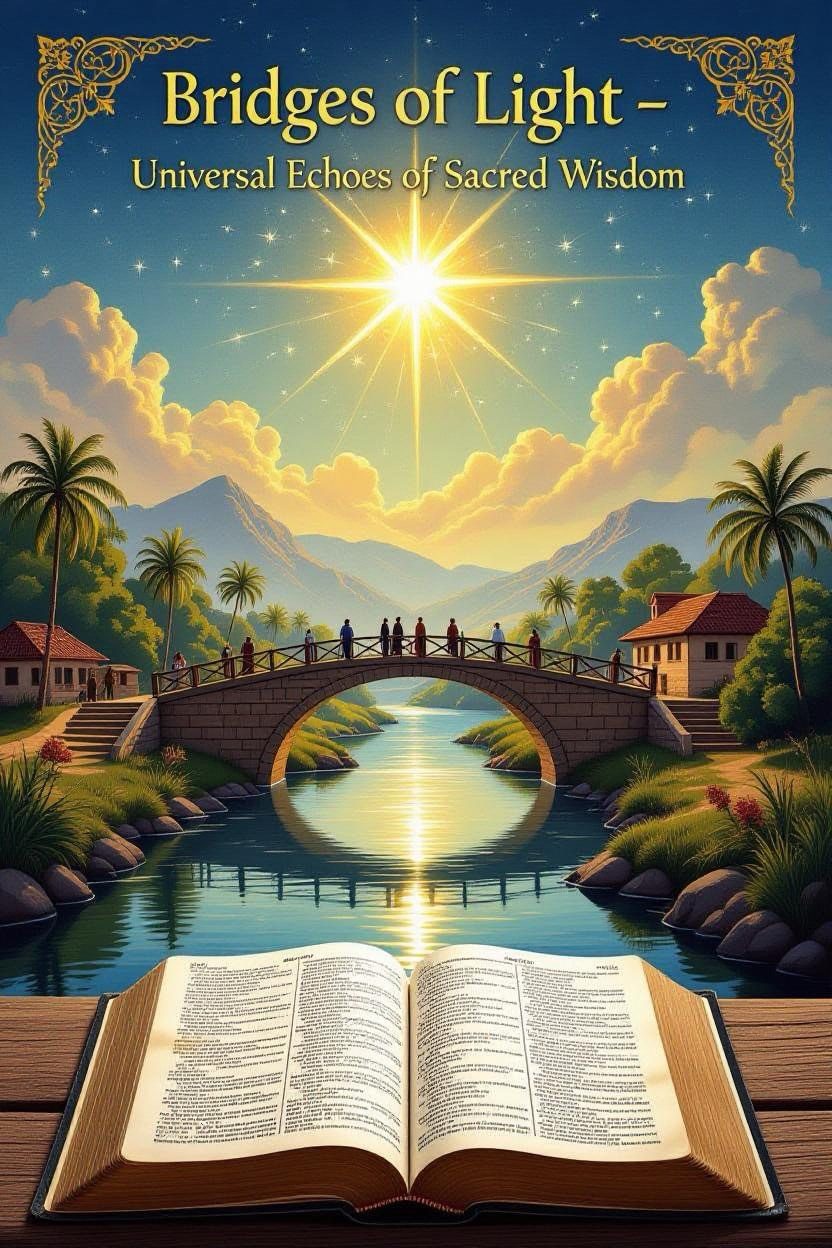
Perhaps this is the deeper meaning of Tewahedo: that unity is not uniformity but harmony among many voices. The Ethiopian canon, with its extra books and preserved mysteries, becomes a bridge between worlds—a scripture that remembers what others forgot, a key that turns in multiple locks.

Leave a Reply