
Some of the herbal allies mentioned here are shared through affiliate links, meaning I may receive a small blessing of support if you choose to journey with them—always at no extra cost to you.

The Ethiopian Holy Bible does not stand in isolation—it breathes as part of a vast, unseen lineage that winds through the deserts of Egypt, the caves of Qumran, and the mystery schools of the ancient world. In the West, religion often fractures into doctrines, each defending its boundaries of belief; but in the East—in the spiritual heart of Ethiopia—truth flows like a river with many tributaries. To understand the Ethiopian Bible is to sense its quiet conversation with forgotten mystics, Gnostics, and ascetic brotherhoods whose teachings flickered and vanished elsewhere, but whose light continued to burn in the highlands of Africa. Here, within the walls of monolithic churches carved from living rock, fragments of primordial wisdom still hum like ancient chords of the same song.

The roots of Ethiopian Christianity reach deep into the soil of Judaic mysticism. Long before the Gospel reached Rome, Ethiopia had already absorbed the spiritual breath of Israel. The Ark of the Covenant—revered in Ethiopian tradition as physically housed in Axum—serves not only as a national symbol but as a spiritual inheritance. This direct lineage carried with it the mystical traditions of temple worship, angelic hierarchy, and the sacred calendar that defined ancient Judaism. These traditions would later influence sects like the Essenes, that mysterious community along the Dead Sea whose scrolls—unearthed two millennia later—bear striking parallels to the Ethiopian scriptures. The Essenes spoke of cosmic cycles, angelic visitations, and divine unity; they practiced purification through fasting and lived in harmony with nature’s rhythms. These same principles, preserved within The Book of Jubilees and The Book of Enoch, are enshrined within the Ethiopian canon as central truths, not heresies.
Where the Essenes vanished under Roman conquest, Ethiopia became their living continuation. The desert mystics of Qumran sought refuge in secrecy, while the Ethiopian monks retreated into the mountains, carving sanctuaries into stone. Their monastic orders became living archives of ancient gnosis—the knowledge of direct experience with the divine. In the remote highlands, the pure transmission of mystical Christianity endured, unbroken by empire or council. The Ethiopian monk, wrapped in white and chanting in Ge’ez, carried forward the very essence that once animated the earliest followers of Christ: a spirituality of silence, fasting, and illumination, rooted not in creed but in revelation.
And yet, Ethiopia’s Bible goes even further. It does not reject Gnostic ideas of inner knowing but sanctifies them, grounding transcendence in unity rather than duality. While Gnostic sects often split matter from spirit, declaring the world a prison of the soul, the Ethiopian understanding—through Tewahedo—sees the world as the divine body itself, consecrated and alive. In this, Ethiopia quietly corrects the Gnostic impulse: it teaches that enlightenment does not come by fleeing the world but by seeing through it, by realizing its inherent holiness. This subtle shift transforms mysticism from escape to embodiment. In the Ethiopian path, asceticism is not rejection of creation but refinement of perception—a process of polishing the soul until it reflects the divine light hidden within all things.

The echoes of early Christianity are equally unmistakable. Long before the Roman Church codified its doctrines, the Ethiopian tradition embraced a form of Christianity steeped in Hebrew law and mystical symbolism. Christ was understood not as an external savior but as the bridge of unity between divine and human nature. This theology—rooted in the very name Tewahedo, meaning “made one”—reflects the mystical idea of union: the same core insight that would later reappear in the writings of the Christian mystics, the Sufis, and the Kabbalists. The Ethiopian Bible thus stands not only as a text but as a bridge—a link between the prophetic mysticism of the Old Testament, the visionary revelation of the New, and the esoteric wisdom of the world’s oldest spiritual currents.
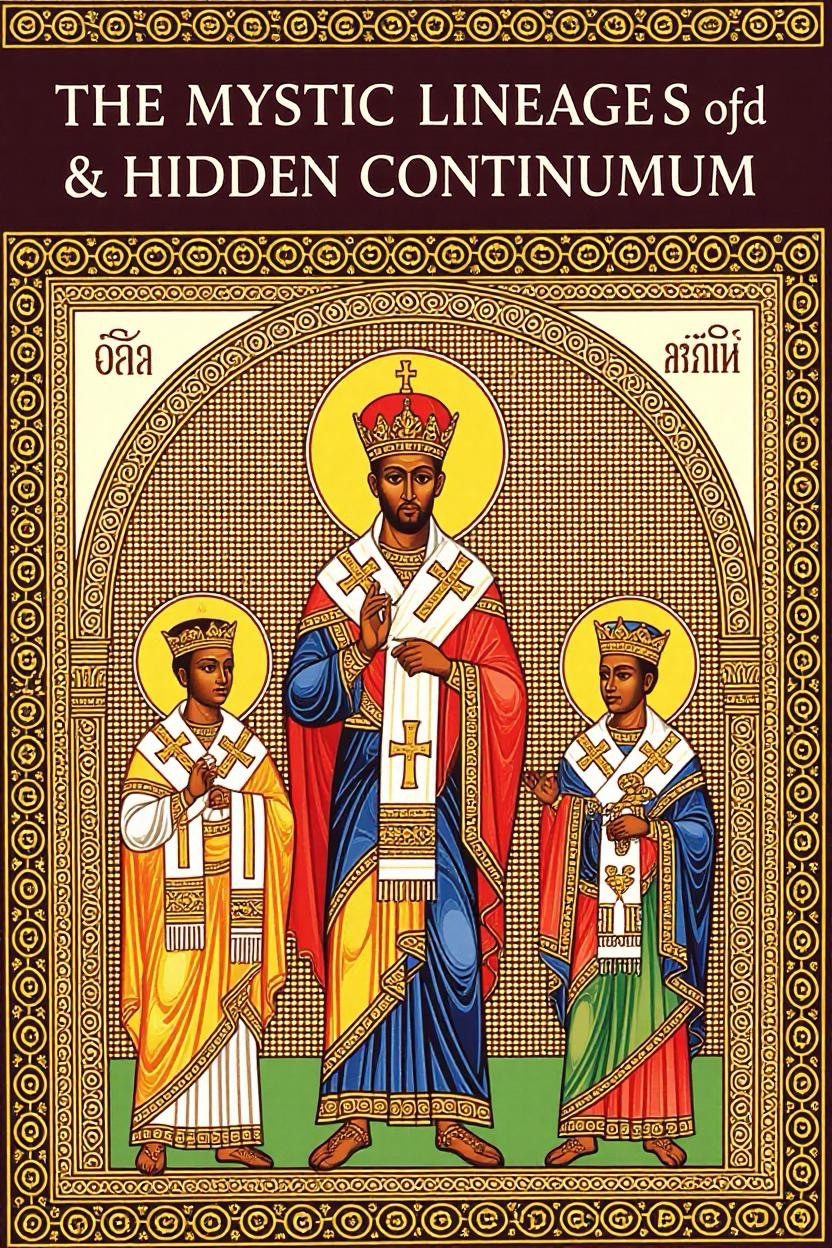
Even in its art and architecture, the Ethiopian Church preserves traces of this hidden continuum. The rock-hewn churches of Lalibela, carved from a single mountain as if sculpted by angels, form a labyrinth of symbolic geometry—a map of the heavenly Jerusalem mirrored upon earth. Their tunnels and chambers echo the initiatory passageways of ancient mystery schools; their altars align with the stars, as if the builders sought not merely to worship the heavens but to embody them. In the murals, one finds a mystical language of color and proportion—faces painted with wide, seeing eyes that gaze not outward but inward, revealing that divine sight is the inward awakening of the soul.
What emerges from this synthesis is a picture of a faith that did not forget its roots in the sacred sciences of the ancients. The Ethiopian Holy Bible and the Tewahedo faith preserve the union of law and light, mysticism and morality, heaven and earth. They remind us that enlightenment was never meant to divide but to unify—that every tradition, from the Hebrew prophets to the desert monks, once sang the same hymn of divine remembrance. Where other paths fragmented, Ethiopia remained whole. Its canon, untouched by the hands of empire, still carries within it the sound of the original breath.
And so, to study the Ethiopian Bible is to peer through the veils of history and glimpse a more ancient spirituality—one in which divine truth is not hidden but simply forgotten, awaiting rediscovery in the heart of each seeker. The words of Enoch, the cycles of Jubilees, the vision of Tewahedo—all whisper the same message: that the separation between humanity and the divine is an illusion sustained only by forgetfulness. Once remembrance returns, unity is revealed.

In this age of disconnection and division, the Ethiopian Bible stands as both relic and prophecy. It invites modern humanity to remember what was once known—that the sacred is not elsewhere, and that revelation is ongoing, eternal, alive within us. The mystics of Ethiopia did not seek to escape the world, but to awaken within it. They teach that the Kingdom of Heaven is not beyond the stars but here, in every breath, every heartbeat, every moment of awareness.
Thus, the Ethiopian Holy Bible endures not only as scripture but as transmission—a living current of divine consciousness flowing through time. It is the bridge that binds the prophets, the mystics, and the seekers of all ages into one eternal communion. It is the hidden Gospel of unity, the song of the soul remembering its source, the divine fire that has never ceased to burn in the heart of humanity.

Leave a Reply