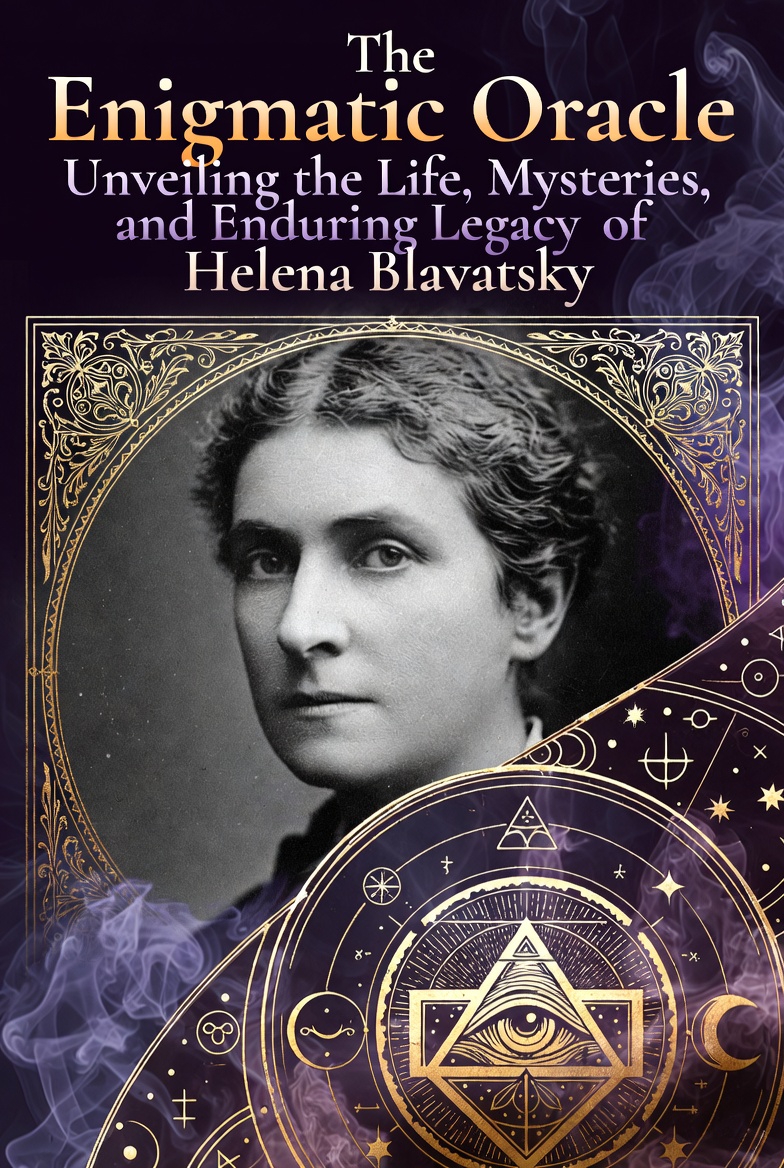
In the shadowy corridors of 19th-century mysticism, few figures cast as long and controversial a shadow as Helena Petrovna Blavatsky, the Russian-born occultist whose life was a whirlwind of adventure, revelation, and scandal. Often hailed as the “Mother of Modern Spirituality,” Blavatsky’s journey from a rebellious aristocratic child to the co-founder of the Theosophical Society reshaped the Western understanding of Eastern wisdom, blending ancient philosophies with bold new visions of human potential.
Her works, teeming with esoteric knowledge purportedly channeled from hidden masters, challenged the materialistic dogmas of her era and ignited a global movement that continues to influence New Age thought, interfaith dialogue, and even psychological explorations of the unconscious. Yet, her path was fraught with accusations of fraud and plagiarism, painting her as both enlightened sage and cunning charlatan. Through long wanderings across continents, profound spiritual awakenings, and prolific writings, Blavatsky sought to reveal what she called the “primeval truths” underlying all religions—a quest that demanded unwavering faith in the unseen and a defiance of conventional boundaries. As she herself proclaimed, “There is no religion higher than truth,” a motto that encapsulated her relentless pursuit of universal wisdom amid personal turmoil and societal skepticism.

A Rebellious Prodigy: The Formative Years of a Mystic in the Making
Born on August 12, 1831, in Yekaterinoslav (now Dnipro, Ukraine) within the vast expanse of the Russian Empire, Helena Petrovna von Hahn entered the world under circumstances that seemed to foreshadow her extraordinary destiny. The daughter of Colonel Peter von Hahn, a stern military officer of German descent, and Helena Andreyevna de Fadeyev, a novelist and descendant of Russian nobility, young Helena grew up in an aristocratic household marked by frequent relocations due to her father’s postings. From Odessa to Saint Petersburg, Astrakhan to Poltava, the family’s nomadic life exposed her to a tapestry of cultures and beliefs, igniting an early fascination with the mystical. Baptized into the Russian Orthodox Church, she was nonetheless drawn to the esoteric from childhood, displaying psychic sensitivities that manifested in visions, poltergeist phenomena, and an uncanny ability to commune with unseen forces. Described by relatives as a “petted, wayward, invalid child” and a beguiling storyteller, Helena was largely self-educated, devouring books on French literature, art, music, and horseback riding while nurturing a rebellious spirit that chafed against societal norms.
Tragedy struck early: her brother Sasha died at age two, and her mother succumbed to tuberculosis in 1842, leaving Helena and her siblings—sister Vera and brother Leonid—in the care of their maternal grandparents in Saratov. It was here, in her great-grandfather Prince Pavel Vasilevich Dolgorukov’s library—a treasure trove of esoteric texts amassed by the Freemason who had known occult luminaries like Alessandro Cagliostro and the Count of St. Germain—that Helena’s spiritual inclinations deepened. She encountered visions of a “mysterious Indian man,” later identified as Master Morya, one of the ascended masters who would guide her life’s work. This period also introduced her to Tibetan Buddhism through interactions with Kalmyk leader Prince Tumen, planting seeds of Eastern philosophy that would flourish in her later doctrines.
By her teenage years, Helena’s psychic abilities were evident: she astral traveled, experienced clairvoyance, and even befriended Freemason Alexander Vladimirovich Golitsyn, setting the stage for a life devoted to unveiling hidden truths. As she reflected in her writings, “The possible truths, hazily perceived in the world of abstraction, like those inferred from observation and experiment in the world of matter, are forced upon the profane multitudes, too busy to think for themselves, under the form of Divine revelation and scientific authority.” These early experiences forged a resilient, iconoclastic personality, one that would propel her into a marriage of convenience at age 17 to the much older vice-governor Nikifor Vladimirovich Blavatsky—a union she quickly fled, marking the beginning of her nomadic quest for enlightenment.

Wanderlust and Enlightenment: Epic Journeys in Search of Ancient Wisdom
Helena Blavatsky’s life after her ill-fated marriage in 1849 became a saga of ceaseless travel, spiritual quests, and encounters that blurred the lines between the mundane and the metaphysical, spanning continents and defying the conventions of her time. Fleeing her escorts en route back to her family, she arrived in Constantinople and embarked on a decade-long odyssey financed, in part, by her father, traversing Europe, the Americas, and Asia in pursuit of esoteric knowledge. In Turkey, Egypt, and Greece, she delved into ancient mysteries; in Paris, she met spiritist Victor Michal; and in England, she allegedly encountered Master Morya in person, who instructed her to journey to Tibet—a directive that would define her spiritual trajectory. Crossing the Atlantic in 1851, Blavatsky ventured to Canada, where she was robbed by Native Americans (an incident she attributed to the influence of Christian missionaries), then to New Orleans, Mexico, and the Andes, immersing herself in indigenous shamanic practices. By 1852, she had reached Ceylon and Bombay, following Morya’s guidance, though initial attempts to enter Tibet were thwarted. Undeterred, she survived a shipwreck near the Cape of Good Hope in 1854, worked in England during the Crimean War, and explored the American West—New York, Chicago, Salt Lake City, San Francisco—before sailing to Japan, Kashmir, Ladakh, and Burma. In 1856, accompanied by a Tartar shaman, she finally breached Tibet’s borders via Kashmir, reaching Leh and joining shamanic rituals, later returning through Madras and Java.
These travels were punctuated by paranormal experiences: poltergeists in Europe (1858–1860), Kabbalah studies in Serbia and Transylvania, and participation in the 1867 Battle of Mentana alongside Giuseppe Garibaldi, where she was wounded. A pivotal moment came in 1868 when Morya summoned her to Constantinople for a renewed Tibetan expedition with Master Koot Hoomi near the Tashi Lhunpo Monastery in Shigatse. There, she claimed to have learned the ancient language Senzar, translated sacred scriptures, honed psychic powers like telepathy and astral projection, and endured a transformative retreat from 1868 to 1870. Skeptics questioned these claims, citing a lack of verifiable evidence, yet Blavatsky’s demonstrated knowledge of Mahayana Buddhism lent credence to her narratives. Recovering from a severe spine injury in Tiflis in 1864, she adopted a son, Yuri, who tragically died young, and by the early 1870s, she had immersed herself in Spiritualism in New York, defending genuine phenomena while debunking frauds. As she wrote in her reflections on these journeys, “We are in the Kali Yuga and its fatal influence is a thousand-fold more powerful in the West than it is in the East; hence the easy preys made by the Powers of the Age of Darkness in this cyclic struggle, and the many delusions under which the world is now laboring.” These wanderings not only enriched her worldview but also prepared her for the monumental task of synthesizing global spiritual traditions into a cohesive philosophy, culminating in her arrival in America in 1873 and the forging of alliances that would birth a new esoteric movement.

Birthing a Movement: The Founding of the Theosophical Society and Its Revolutionary Vision
The culmination of Blavatsky’s spiritual odyssey materialized in 1875 with the establishment of the Theosophical Society, a groundbreaking organization that sought to bridge the chasms between science, religion, and philosophy through the lens of ancient occult wisdom. Settling in New York in 1873 amid the Spiritualist craze, Blavatsky befriended Colonel Henry Steel Olcott, a Civil War veteran, lawyer, and journalist intrigued by the paranormal. Together, they investigated mediums like the Eddy brothers, exposing charlatans while affirming genuine phenomena—not as communications from the dead, but as interactions with elementals or astral “shells.” This collaboration, joined by attorney William Quan Judge, led to the society’s formal inception on November 17, 1875, with Olcott as president, Judge as secretary, and Blavatsky as its intellectual powerhouse.
Theosophy, as Blavatsky defined it, was “Divine Knowledge or Science… ‘Divine Wisdom,’ (Theosophia) or Wisdom of the gods,” drawing from Neoplatonism, Hermeticism, Hinduism, and Buddhism to promote universal brotherhood without distinctions of race, creed, or color; the comparative study of religions, philosophies, and sciences; and the investigation of unexplained laws of nature and latent human powers. Challenging the monotheistic orthodoxies and materialistic scientism of the Victorian era, the society positioned itself as a custodian of primeval truths hidden in ancient texts. In 1879, Blavatsky and Olcott relocated to India, establishing headquarters in Adyar, Madras (now Chennai), where they became the first Westerners to formally convert to Buddhism in Ceylon (Sri Lanka) in 1880, inspiring the design of the Buddhist flag and fostering interfaith alliances. The movement expanded rapidly, attracting luminaries like Thomas Edison and Abner Doubleday, and by Blavatsky’s death, it boasted over 100,000 members worldwide. Yet, internal and external pressures mounted: accusations of espionage for Russia, bigamy from a brief 1874 marriage to Mikheil Betaneli, and the 1884 Coulomb Affair, where former associates Emma and Alexis Coulomb forged incriminating letters in a blackmail scheme. Blavatsky’s response was defiant, exposing the plotters and emphasizing her mission: “I was sent to prove the phenomena and their reality, and to show the fallacy of the spiritualistic theory of spirits.” Through these trials, the Theosophical Society endured, advocating vegetarianism, reincarnation, and pantheism—a “universal Divine Principle”—while empowering women in spiritual leadership and laying the groundwork for global humanitarian efforts.

Pillars of Esoteric Thought: The Profound Works That Redefined Spirituality
At the heart of Blavatsky’s legacy lie her monumental writings, which synthesized millennia of occult knowledge into accessible, albeit dense, tomes that continue to inspire and perplex seekers of truth. Her first major publication, Isis Unveiled (1877), a two-volume opus released by J.W. Bouton in New York, served as a scathing critique of Western materialism and a revelation of ancient wisdom traditions. Drawing from Egyptian mysticism, Eastern philosophies, and Hermetic lore, it argued for the unity of all religions under esoteric principles, opposing Darwinian evolution in favor of spiritual progression. Edited by Alexander Wilder, the book sold out its initial 1,000 copies in a week, proclaiming, “The origin of all religions—Judaeo-Christianity included—is to be found in a few primeval truths, not one of which can be explained apart from all the others, as each is a complement of the rest in some one detail.”
Eleven years later, in 1888, Blavatsky unveiled her magnum opus, The Secret Doctrine, a commentary on the purportedly ancient Book of Dzyan—a Tantric text she claimed was dictated by Tibetan masters. Divided into volumes on cosmogenesis and anthropogenesis, it outlined a cosmic evolutionary schema involving Seven Rays of creation, the energy of Fohat, seven planetary rounds, and seven root races of humanity, from ethereal beings on imperishable lands to the current fifth “Aryan” race, with future evolutions heralded by figures like Maitreya. Humans were depicted as multifaceted entities—physical, astral, and divine—governed by karma and reincarnation. Blavatsky asserted, “Maitreya is the secret name of the Fifth Buddha, and the Kalki Avatar of the Brahmins—the last Messiah who will come at the culmination of the Great Cycle.” These works, written during periods of ill health and exile in Europe (Naples, Ostend, London), redefined concepts of time, space, spirit, matter, life, death, God, the cosmos, and human purpose, positing a pantheistic unity where “nothing of that which is conducive to help man, collectively or individually, to live—not ‘happily’—but less unhappily in this world, ought to be indifferent to the Theosophist-Occultist.” Influenced by her alleged contacts with Masters Morya, Koot Hoomi, Hilarion, and Serapis, the texts blended Eastern and Western esotericism, critiquing sectarianism and materialism while advocating self-directed occult exploration. Though accused of plagiarism—borrowing from sources without attribution—defenders viewed her synthesis as a revival of lost wisdom, profoundly impacting fields from anthropology to cosmology.

Trials of a Trailblazer: Navigating Controversies, Fraud Allegations, and Unyielding Criticism
No examination of Helena Blavatsky’s life would be complete without confronting the storm of controversies that swirled around her, casting doubt on her claims while underscoring the revolutionary threat she posed to established orthodoxies. From the outset, her psychic demonstrations—materializing objects, producing Mahatma letters, and facilitating paranormal phenomena—drew accusations of fraud, culminating in the 1885 Hodgson Report by the Society for Psychical Research, which branded her a charlatan after investigating the Coulomb Affair. In that scandal, disgruntled associates forged letters implying Blavatsky’s involvement in deception, though she countered by exposing their extortion attempts in Cairo. Critics like William Emmette Coleman alleged plagiarism in her writings, pointing to uncredited borrowings, while her racial theories in The Secret Doctrine—positing hierarchical “root races”—reflected colonial Eurocentric biases now widely rejected as problematic. Internal manipulations were also rife: esoteric accounts suggest occult “imprisonment” by Anglo-Saxon brotherhoods in 1879 to curb her influence, followed by a pact with Indian occultists that shifted her toward Eastern agendas, all while health woes confined her to a wheelchair.
Blavatsky’s eccentricities, including her brief bigamy and alleged spying for Russia, fueled detractors who saw her as an unsafe guide, pervaded by personality flaws, sectarian animus, and unverifiable claims about astral planes and masters. Yet, even critics acknowledged her intuitive genius; as one observer noted, she was “more sinned against than sinning,” an unwitting medium exploited by unseen forces. In her defense, Blavatsky emphasized ethical occultism, warning, “How, then, can it be thought possible for a man to enter the ‘straight gate’ of occultism when his daily and hourly thoughts are bound up with worldly things, desires of possession and power, with lust, ambition, and duties which, however honorable, are still of the earth…?” These trials, including the 1883 Kiddle incident where a Mahatma letter mirrored a plagiarized speech, tested the Theosophical Society’s resilience, leading to splits after her death but also highlighting her role in bridging cultures. Balanced views recognize her contributions to depth psychology, influencing Carl Jung’s archetypes and collective unconscious through concepts like the astral plane as a realm of dreams and integration, even as empirical skepticism persists.
Eternal Echoes: The Indelible Legacy of a Spiritual Pioneer
Helena Blavatsky’s death on May 8, 1891, in London, marked not an end but a metamorphosis of her influence, as her ideas permeated the 20th century and beyond, earning her the moniker “fountainhead of modern occult thought.” Succumbing to health complications amid ongoing disputes, she left behind a Theosophical Society that evolved under successors like Annie Besant, whom she appointed to lead the European branch, fostering global branches dedicated to universal brotherhood and esoteric study. Her synthesis of Eastern and Western traditions popularized concepts like karma, reincarnation, chakras, and spiritual evolution in the West, inspiring movements such as Anthroposophy (founded by Rudolf Steiner, who praised her while correcting perceived distortions), Ariosophy, and the New Age paradigm. Figures like Alice Bailey, Mahatma Gandhi (whom she met), and W.B. Yeats drew from her doctrines, while her advocacy for women’s roles in spirituality and humanitarian causes echoed in interfaith initiatives and even the United Nations’ ethos.
Blavatsky’s legacy endures in the society’s active worldwide presence, challenging materialism and promoting unity: “For, while the heart is full of thoughts for a little group of selves, near and dear to us, how shall the rest of mankind fare in our souls? What percentage of love and care will there remain to bestow on the ‘great orphan’?” Though controversies linger—racial hierarchies, unverifiable claims—her redefinition of existence as an interconnected web of consciousness paved the way for psychological insights into the unconscious and collective archetypes. As scholars note, “Madame Blavatsky … stands out as the fountainhead of modern occult thought, and was either the originator and/or populariser of many of the ideas and terms which have a century later been assembled within the New Age Movement.” In an age still grappling with spiritual fragmentation, Blavatsky’s call to transcend delusions and embrace divine wisdom remains a beacon, reminding us that “our age, we say, is inferior in Wisdom to any other, because it professes, more visibly every day, contempt for truth and justice, without which there can be no Wisdom.”
The Illuminarium is calling you. Won’t you heed the call?
Dive into the planet’s most enchanting and actionable books, designed to supercharge your spiritual journey and reveal elite occult strategies for business success. Now, you too can rise as a prophet of profit, with instant downloads of transformative titles to build your ultimate life.

Leave a Reply