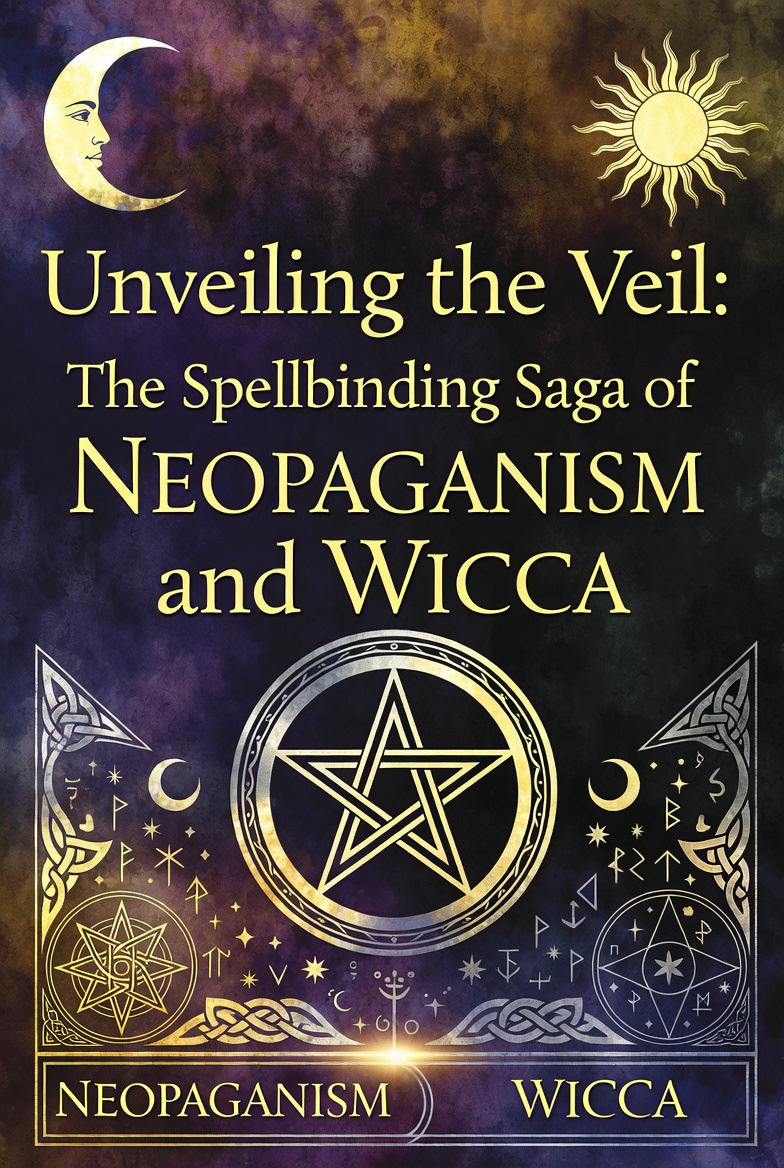
Imagine a world where the rustle of ancient oaks whispers secrets of forgotten gods, where the full moon’s glow ignites rituals of empowerment, and where the earth’s rhythms pulse through every spell and chant. This isn’t a fairy tale—it’s the vibrant reality of Neopaganism, with Wicca as its most enchanting jewel. In a society dominated by monotheistic traditions, Neopaganism dares to revive the polytheistic, nature-revering faiths of our ancestors. But how did this modern movement emerge from the shadows of history? Buckle up, dear reader, as we embark on a journey through time, myth, and magic that will leave you questioning the boundaries between the mundane and the mystical.

From Ancient Fires to Modern Flames: The Historical Roots of Neopaganism
Neopaganism isn’t a dusty relic; it’s a phoenix reborn from the ashes of pre-Christian Europe. Picture the druids of Celtic lore, cloaked in white, communing with sacred groves under starry skies. Or the Norse shamans invoking Odin amid thunderous storms. These ancient pagan practices—rooted in animism, where every rock, river, and tree held a spirit—were systematically suppressed during the spread of Christianity from the 4th century onward. By the Middle Ages, paganism was branded heresy, its followers persecuted in witch hunts that claimed tens of thousands of lives.
Yet, the embers never fully died. The 19th century Romantic movement, fueled by poets like William Wordsworth and scholars delving into folklore, sparked a revival. Think of it as a cultural rebellion against industrialization’s cold machinery. Enter the 20th century, where anthropologists like James Frazer in The Golden Bough (1890) argued that magic was the precursor to religion and science. This set the stage for Neopaganism’s formal emergence, a tapestry of reconstructed traditions blending ancient myths with contemporary spirituality.
Wicca, often synonymous with modern witchcraft, crystallized this revival. Founded in the 1950s, it drew from these historical threads but wove them into something entirely new. As historian Ronald Hutton notes in The Triumph of the Moon (1999), “Wicca was not a survival from the past, but a creation of the present.” This blend of old and new is what makes Neopaganism so irresistibly alive—it’s not about blind adherence to antiquity, but about adapting eternal wisdom to today’s world.

Gerald Gardner: The Enigmatic Architect of Wicca’s Dawn
No tale of Wicca is complete without the shadowy figure of Gerald Gardner, the man who pulled back the curtain on modern witchcraft. A retired British civil servant with a penchant for the occult, Gardner claimed initiation into a secret coven in the New Forest in 1939. Was it truth or clever fabrication? The debate rages on, but his impact is undeniable.
In 1954, after the repeal of Britain’s Witchcraft Act, Gardner published Witchcraft Today, boldly declaring: “The Witch-cult is the primitive religion of Western Europe: the oldest of all religions, which has survived in spite of persecution.” Drawing inspiration from Egyptologist Margaret Murray’s controversial “witch-cult hypothesis”—which posited that medieval witches were remnants of a pre-Christian fertility religion—Gardner crafted Wicca as a duotheistic faith honoring a Horned God and a Triple Goddess.
But Gardner wasn’t alone in his alchemy. Doreen Valiente, his high priestess, refined Wiccan liturgy and penned the iconic Wiccan Rede: “An it harm none, do what ye will.” This eight-word mantra, emphasizing ethical freedom balanced by non-harm, became the moral compass of the movement. Valiente later reflected, “Witchcraft doesn’t teach you to command others; it teaches you to command yourself.” Through Gardner’s lens, Wicca transformed from whispered folklore into a structured path of empowerment, rituals, and seasonal celebrations known as the Wheel of the Year.

The Heart of the Craft: Beliefs, Rituals, and the Magic Within
What draws seekers to Neopaganism’s embrace? At its core lies a profound reverence for nature, viewing the divine as immanent—present in every leaf, storm, and heartbeat. Wiccans celebrate eight sabbats, from the fiery passion of Beltane to the introspective hush of Samhain, aligning human life with the earth’s cycles. Magic isn’t about pulling rabbits from hats; it’s “the art of changing consciousness at will,” as occultist Dion Fortune famously quipped.
Quotes from modern luminaries illuminate this ethos. Starhawk, a pivotal figure in eco-feminist Wicca, writes in The Spiral Dance (1979): “The Goddess is alive. Magic is afoot.” Her words capture the movement’s blend of spirituality and activism, urging practitioners to heal the planet as they heal themselves. Scott Cunningham, in Wicca: A Guide for the Solitary Practitioner (1988), adds: “Magic is natural. It is a harmonious movement of energies to create needed change.” These insights reveal Wicca not as escapism, but as a toolkit for personal transformation and global harmony.
Intriguingly, Neopaganism rejects dogma, embracing eclecticism. Some draw from Celtic deities like Cernunnos, others from Egyptian or Greek pantheons. Rituals might involve casting circles, invoking elements, or herbal spellwork—all grounded in the principle of balance. As Valiente once said, “The old gods are not dead; they sleep within us, waiting to be awakened.”

The Modern Cauldron: Wicca’s Cultural Brew and Enduring Allure
Fast-forward to today, and Neopaganism bubbles over into pop culture like a potion gone wild. From the witchy aesthetics of Charmed to the pagan undertones in Harry Potter, Wicca has infiltrated mainstream consciousness. The 1960s counterculture amplified its growth, with figures like Alex Sanders founding Alexandrian Wicca, emphasizing ceremonial magic.
Yet, challenges persist. Misconceptions of Satanism—despite Wicca’s lack of a devil figure—fuel prejudice. Still, the movement thrives, with estimates of over a million practitioners worldwide. In an era of environmental crisis, Neopaganism’s earth-centered ethic resonates deeply. As environmental activist and Wiccan elder Selena Fox declares: “We are all connected in the web of life.”
What makes Wicca truly captivating? It’s the invitation to reclaim agency in a disenchanted world—to dance under the moon, whisper to the winds, and forge your own destiny. Whether you’re a skeptic or a seeker, Neopaganism whispers: Dare to believe in the magic that’s always been there.
So, reader, as the veil lifts, what ancient echo calls to you? The journey into Neopaganism isn’t just history—it’s an awakening. Light your candle, cast your circle, and let the adventure begin.
The Illuminarium is calling you. Won’t you heed the call?
Dive into the planet’s most enchanting and actionable books, designed to supercharge your spiritual journey and reveal elite occult strategies for business success. Now, you too can rise as a prophet of profit, with instant downloads of transformative titles to build your ultimate life.

Leave a Reply