
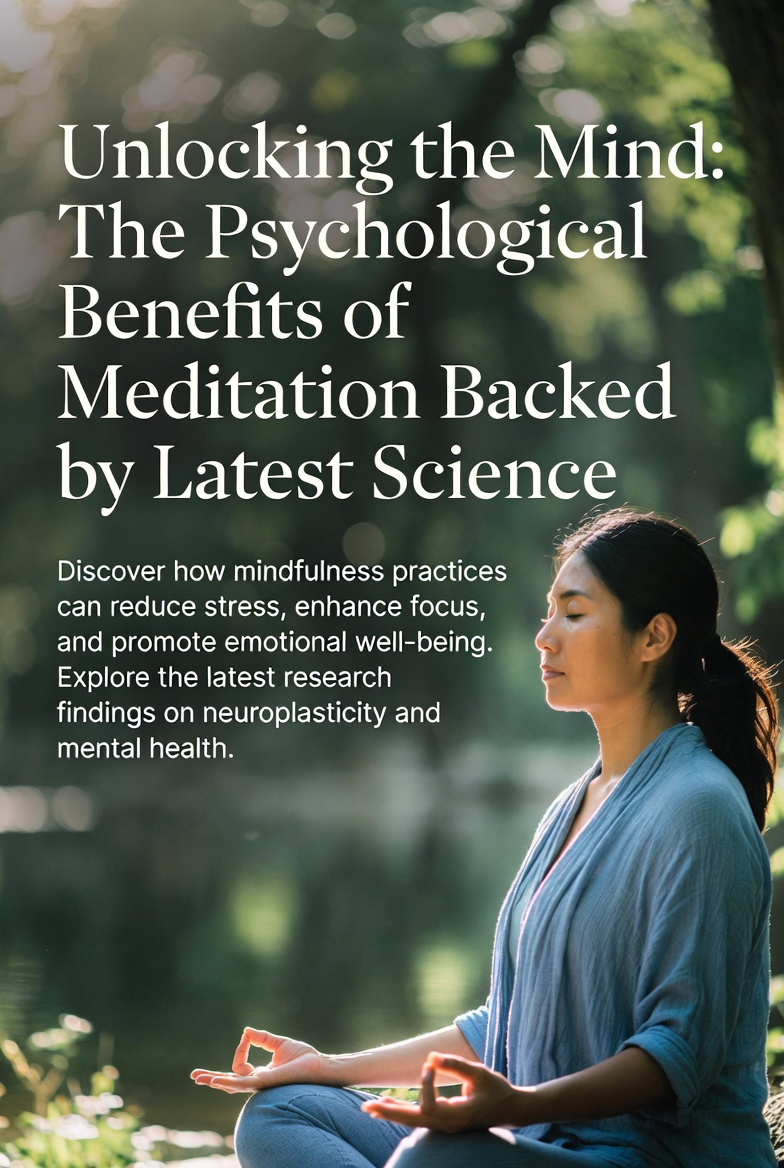
In a fast-paced world filled with constant distractions and stressors, meditation has emerged as a powerful tool for mental well-being. Rooted in ancient practices, meditation involves focusing the mind, often through breath awareness or mindfulness techniques, to achieve a state of calm and clarity. While anecdotal evidence has long touted its benefits, recent scientific research is providing concrete proof of its psychological advantages. From reducing stress to reshaping brain activity, studies from 2025 highlight how meditation can transform mental health. In this post, we’ll explore these benefits, drawing on quotes and findings from cutting-edge research.

Reducing Stress and Anxiety: A Proven Calm in the Storm
One of the most well-documented psychological benefits of meditation is its ability to lower stress and anxiety levels. Chronic stress can lead to a host of mental health issues, but mindfulness-based practices offer a natural antidote by promoting relaxation and emotional balance.
A 2025 study on mindfulness breathing meditation demonstrated significant reductions in perceived stress among participants. The research, involving a randomized controlled trial, found that after the intervention, the meditation group experienced a marked decrease in stress compared to controls. As the abstract states, “The results showed significant improvement in cognitive flexibility and reduction in perceived stress levels after the intervention in the mindfulness breathing meditation group compared to the active control group.” In the results section, it notes a specific drop: “The perceived stress level in the mindfulness breathing meditation group reduced significantly at the post-intervention (M diff = 9.00, SE = 1.72, p < .001) but not in the active control group.”
This aligns with broader findings from meditation apps, which have been shown to alleviate anxiety and stress through accessible, short sessions. According to research from Carnegie Mellon University, “Early findings suggest that even short, regular use can reduce depression, anxiety and stress while improving sleep.” These apps make meditation scalable, allowing users to practice for just 10 to 21 minutes a few times a week for measurable results.

Enhancing Cognitive Abilities: Sharper Focus and Flexibility
Meditation doesn’t just soothe the mind—it sharpens it. Recent studies reveal improvements in executive functions like attention, cognitive flexibility, and decision-making, which are crucial for psychological resilience.
The same 2025 mindfulness breathing study highlighted gains in cognitive flexibility, measured through tasks like the mix-saccade accuracy test. The discussion explains, “The improvement in mix-saccade task accuracy aligns with previous findings, suggesting that mindful breathing enhances amygdala and prefrontal cortex activity and connectivity, leading to improvements in cognitive flexibility and task-switching abilities.” Participants in the meditation group saw their accuracy rates increase significantly post-intervention.
A meta-analysis published in Scientific Reports in 2025 further supports this by linking mindfulness training to better interoception—the awareness of internal bodily sensations—which correlates with enhanced cognitive and emotional processes. The abstract concludes, “Improvements in self-reported interoception were similar in size to improvements in self-reported mindfulness and were related to improvements in psychological distress. These meta-analytic findings provide evidence that mindfulness-based interventions lead to adaptive changes in the subjective experience of interoception, perhaps contributing to improved mental wellbeing.”

Rewiring the Brain for Emotional Regulation and Memory
Science is now peering directly into the brain to show how meditation induces structural and functional changes, particularly in areas tied to emotions and memory. This provides a neurological basis for its psychological benefits.
Groundbreaking research from Mount Sinai in 2025 used intracranial EEG recordings to observe meditation’s impact on deep brain structures like the amygdala and hippocampus. Even a single 10-minute session of loving-kindness meditation altered beta and gamma brain waves, which are implicated in mood disorders. Lead researcher Ignacio Saez remarked, “We found that loving kindness meditation is associated with changes in the strength and duration of certain types of brain waves called beta and gamma waves. These kinds of brain waves are affected in mood disorders like depression and anxiety, so the possibility of being able to willfully control these through meditation is pretty amazing, and may help explain the positive impact that these practices have on individuals.” Co-researcher Christina Maher added, “It was quite amazing to uncover changes in brain wave activity in these key regions, even during first-time meditation.”
These findings suggest meditation can foster long-term emotional stability, reducing the risk of anxiety and depression by enhancing neural pathways for regulation.
Broader Health Ripple Effects: From Genes to Daily Life
Beyond core psychological benefits, meditation influences physiological aspects that feed back into mental health. For instance, meditation apps have been linked to lowering blood pressure and easing repetitive negative thinking. The CMU study notes, “Studies show they can lower blood pressure, ease repetitive negative thinking and even influence gene expression related to inflammation.” This gene-level impact could explain reduced inflammation-related stress, creating a virtuous cycle for mental well-being.
While most research emphasizes positives, it’s worth noting that a small percentage of practitioners may experience challenging effects, as per a 2025 ScienceDaily report, but these are typically transient and outweighed by benefits for the majority.
Conclusion: Embracing Meditation for a Healthier Mind
The latest scientific evidence from 2025 paints a compelling picture: meditation offers tangible psychological benefits, from stress reduction and cognitive enhancement to profound brain changes that support emotional health. As research continues to evolve, incorporating even brief daily practices—whether through apps or traditional methods—can lead to significant improvements in mental well-being. If you’re looking to boost your psychological resilience, starting with just 10 minutes a day could be the key. Backed by rigorous studies, meditation isn’t just a trend; it’s a science-proven path to a clearer, calmer mind.
You are invited to the Illuminarium Mystica vaults!
Packed with esoteric business for entrepreneurs, Kundalini and growing your electromagnetism. These sacred books are for anyone looking to enhance their knowledge of the arcane but there is practical knowledge for everyone!

Leave a Reply