
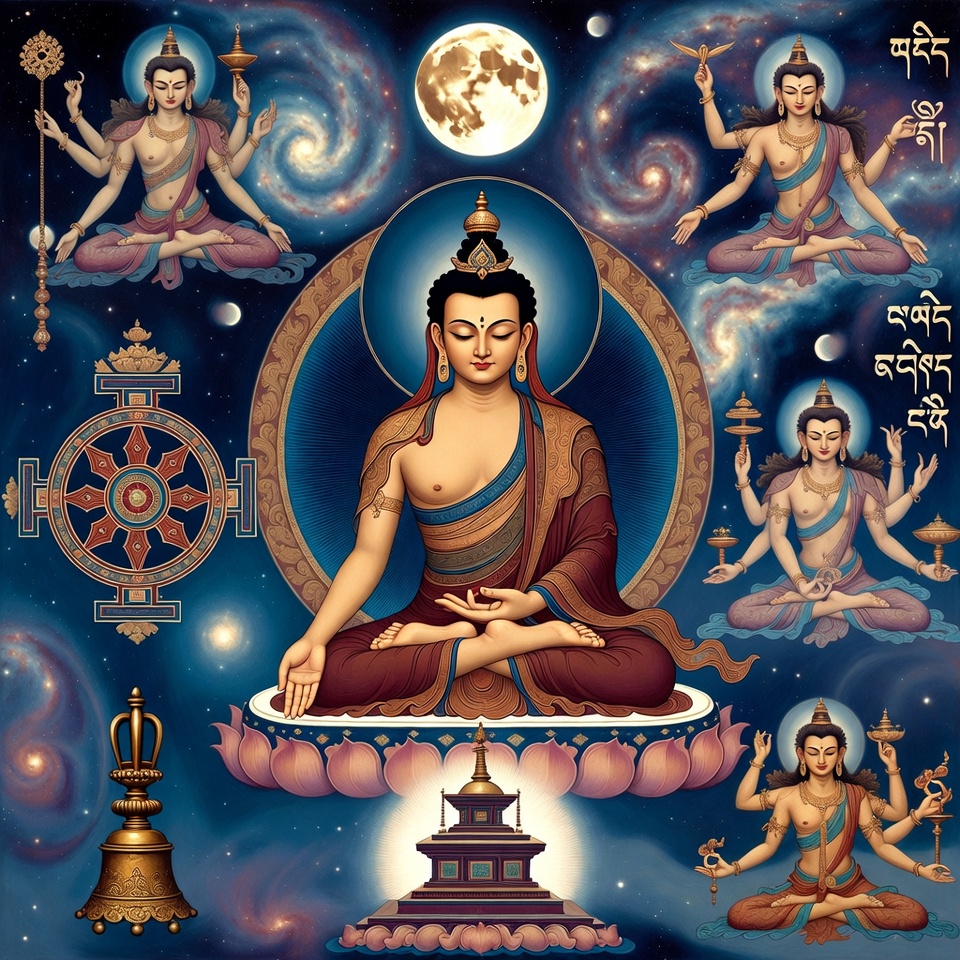
In the shadowed corridors of spiritual history, where ancient whispers echo through the ages, Esoteric Buddhism emerges as a radiant enigma, a path less traveled that promises not just enlightenment but a profound transformation of the very fabric of existence. Far from the serene, meditative practices often associated with mainstream Buddhism, this esoteric branch—also known as Vajrayana or Tantric Buddhism—delves into the arcane, harnessing rituals, symbols, and secret teachings to accelerate the journey toward awakening. It’s a tradition shrouded in mystery, guarded by vows of secrecy, and infused with the potent energy of the Tantras, sacred texts that reveal methods for transcending ordinary reality. At its core lies the concept of Buddha nature, the innate luminosity present in every sentient being, waiting to be ignited like a dormant flame. And woven into this tapestry is the Secret Doctrine, a profound esoteric framework that unveils the hidden laws of the universe, connecting the microcosm of the human soul to the macrocosm of cosmic evolution. This blog post invites you on a mesmerizing exploration, peeling back layers of symbolism and ritual to reveal how Esoteric Buddhism offers a radical blueprint for spiritual liberation in an increasingly chaotic world.

The Eternal Spark Within: Embracing Buddha Nature in Esoteric Realms
Buddha nature, or Tathagatagarbha in Sanskrit, stands as the foundational pillar of Esoteric Buddhism, a luminous essence that permeates all beings, asserting that enlightenment is not something to be attained from without but realized from within, like uncovering a diamond buried in mud. In the Tantric traditions, this concept is elevated to a dynamic force, not merely a passive potential but an active, radiant energy that can be awakened through esoteric practices such as deity yoga, mantra recitation, and intricate visualizations. Imagine, if you will, the human mind as a vast ocean, its surface roiled by waves of illusion and suffering—samsara—while deep below lies the unchanging, pure essence of Buddha nature, untouched by the storms above. The Tantras teach that by engaging in these secret rites, practitioners can dive into this depths, dissolving the veils of ignorance and ego to merge with this inherent purity. This is no abstract philosophy; it’s a lived experience, where the adept confronts their shadows, transforms poisons like anger and desire into wisdom, and ultimately realizes that every moment, every sensation, is an expression of this divine spark. Drawing from ancient Tibetan and Indian lineages, Esoteric Buddhism posits that Buddha nature is universal, extending even to the most deluded beings, offering a message of radical hope: no one is beyond redemption, and the path to Buddhahood can be swift, not spanning eons but achievable in a single lifetime through the Vajrayana’s accelerated methods. Yet, this realization demands unwavering commitment, as the Tantras warn of the perils of misuse—powerful energies that, if mishandled, can lead to greater entanglement rather than liberation, underscoring the tradition’s emphasis on guru-disciple transmission and ethical vows.

Shadows of the Ancients: Decoding the Secret Doctrine in Buddhist Esotericism
The Secret Doctrine, often evoked in esoteric circles as a compendium of hidden wisdom, finds profound resonance within Esoteric Buddhism, serving as a bridge between the exoteric teachings of the Buddha and the profound, occult truths reserved for the initiated. In this context, it refers not merely to Helena Blavatsky’s seminal work, which synthesizes Eastern mysticism with Western occultism, but to the core esoteric principles embedded in Buddhist Tantras—principles that reveal the interconnectedness of all phenomena through cycles of creation, preservation, and dissolution, mirroring cosmic rhythms that govern both the universe and the individual soul. Blavatsky herself drew heavily from Tibetan Esoteric Buddhism, describing the Secret Doctrine as the “accumulated Wisdom of the Ages,” a veiled narrative that aligns with the Tantric view of reality as a multifaceted illusion, or maya, underpinned by ultimate emptiness (shunyata) infused with compassionate energy. Within the Tantras, this doctrine manifests as guarded teachings on the subtle body—channels (nadis), winds (pranas), and drops (bindus)—that form the energetic architecture for advanced meditations, allowing practitioners to manipulate these forces to purify karma and accelerate enlightenment. It’s a doctrine steeped in symbolism: mandalas as cosmic blueprints, deities as archetypes of enlightened qualities, and rituals as alchemical processes that transmute base human instincts into divine attributes. The secrecy is not arbitrary; it’s a protective measure, ensuring that such potent knowledge doesn’t fall into unprepared hands, where it might foster delusion or harm. Esoteric Buddhism, through this lens, becomes a revolutionary force, challenging dualistic thinking by asserting that samsara and nirvana are not opposites but two sides of the same coin, with the Secret Doctrine providing the key to flipping that coin at will. Practitioners are thus invited into a grand cosmic drama, where personal awakening contributes to the evolution of all sentient beings, echoing Blavatsky’s theosophical vision of root races and spiritual hierarchies, yet grounded in the practical, experiential path of the Tantras.
Rituals of Transformation: The Tantras as Gateways to Ultimate Reality
The Tantras, those enigmatic scriptures that form the heart of Esoteric Buddhism, are not mere texts but living transmissions of power, designed to shatter conventional perceptions and propel the seeker into direct communion with the divine. Originating in India around the 7th century and flourishing in Tibet, these teachings encompass a vast array of practices, from elaborate empowerments (abhiseka) to the use of mudras (hand gestures) and yantras (sacred diagrams), all aimed at harnessing the Tantric principle of using desire as a path to transcendence rather than an obstacle to overcome. Unlike the more ascetic paths of Theravada or Mahayana, the Tantras embrace the full spectrum of human experience, teaching that even passions like lust and wrath can be vehicles for wisdom when approached with skillful means (upaya) and insight (prajna). This radical inclusivity is what makes them fascinating—and controversial—drawing on the Buddha nature to affirm that all phenomena, sacred or profane, arise from the same enlightened ground. The Secret Doctrine weaves through these texts, revealing layers of meaning: on the surface, poetic hymns and rituals; deeper, instructions for inner alchemy that align the practitioner’s energy with cosmic forces. Consider the practice of deity yoga, where one visualizes oneself as a wrathful or compassionate Buddha-figure, dissolving the ordinary self into emptiness and re-emerging as an embodiment of enlightenment—this is Tantra in action, a method to actualize Buddha nature swiftly and profoundly. Yet, the path is fraught with challenges; the Tantras demand purity of intention, often under the guidance of a qualified lama, to navigate the psychic landscapes they unveil, where visions of bliss and terror intermingle. In essence, they offer a blueprint for living enlightenment, transforming mundane activities into sacred acts, and ultimately leading to the great perfection (Dzogchen) or mahamudra, states where the veil between self and universe dissolves entirely, revealing the boundless radiance of reality.

Echoes of Eternity: The Lasting Allure of Esoteric Buddhism Today
As we navigate the complexities of modern life, Esoteric Buddhism and its Tantric heritage continue to captivate, offering timeless tools for inner revolution in an era dominated by external distractions. The integration of Buddha nature and the Secret Doctrine provides a holistic framework, reminding us that true power lies not in domination but in harmonious alignment with the universe’s hidden rhythms. In a world grappling with existential crises, these teachings encourage a reevaluation of reality, urging practitioners to see beyond the material veil to the interdependent web of existence, where every action ripples through the cosmos. The Tantras, with their emphasis on direct experience over dogma, invite a personal quest for truth, fostering resilience, compassion, and wisdom amid uncertainty. Whether through silent meditation on one’s innate purity or the vibrant rituals that awaken dormant energies, Esoteric Buddhism stands as a beacon for those seeking depth in a superficial age, promising not escape but profound engagement with life’s mysteries. As the ancient sages knew, the journey inward is the greatest adventure, and in embracing these esoteric paths, we unlock the potential to transform not just ourselves but the very world around us.

Journey into the Great Perfection: Unveiling Dzogchen Practices in Esoteric Buddhism
In the profound depths of Tibetan Esoteric Buddhism, Dzogchen stands as the pinnacle of spiritual realization, a path that transcends conventional efforts to reveal the innate perfection already inherent in every being’s nature. Often translated as “Great Perfection” or “Great Completeness,” Dzogchen is not merely a set of techniques but a direct confrontation with the primordial purity of mind, echoing the core Buddhist principle of Buddha nature—the luminous, unchanging essence that resides within all sentient beings, obscured only by transient delusions and habitual patterns. This tradition, deeply rooted in the Nyingma school and influenced by ancient Bon practices, embodies the Secret Doctrine’s hidden wisdom, where the universe’s ultimate reality is seen as an indivisible union of emptiness and luminosity, a spontaneous presence that defies intellectual grasping. As the highest vehicle in the ninefold classification of Tibetan teachings, Dzogchen offers a radical shortcut to enlightenment, promising liberation in a single lifetime for those with the capacity and guidance. It challenges practitioners to abandon fabrication and striving, instead awakening to rigpa, the pure awareness that is the ground of all existence, where samsara and nirvana dissolve into one seamless continuum. Through its esoteric transmissions, passed down from primordial buddhas like Samantabhadra to human masters such as Garab Dorje and Padmasambhava, Dzogchen unveils a blueprint for transcending the illusions of ego and duality, aligning the individual with the cosmic flow of compassionate energy. In an age of distraction and disconnection, exploring Dzogchen practices invites a profound inner revolution, where the ordinary mind’s turbulence gives way to an effortless abiding in the great perfection, fostering not just personal freedom but a ripple of awakening that benefits all beings.

The Primordial Ground: Understanding Rigpa and Buddha Nature in Dzogchen
At the heart of Dzogchen lies the recognition of rigpa, the pristine awareness that forms the foundational essence of mind, a concept intimately tied to Buddha nature as the innate potential for enlightenment present in every sentient being from beginningless time. This rigpa is not something to be cultivated or achieved but rather uncovered, like peeling away layers of clouds to reveal the ever-present sky, embodying the Secret Doctrine’s assertion that ultimate reality is a self-perfected state beyond creation or destruction. In Dzogchen philosophy, the primordial ground possesses three inseparable qualities: purity, akin to emptiness (shunyata) free from all defilements; spontaneity, manifesting as luminous clarity that gives rise to all appearances without effort; and compassion, the responsive energy that connects all phenomena in a web of interdependence. Practitioners are guided to realize this ground through direct experience, transcending the conceptual frameworks of lower vehicles by acknowledging that dumbfoundedness—an unawareness of phenomena’s void nature—obscures rigpa, imputing habits, karmic potentials, and disturbing emotions onto the alaya consciousness, the storehouse of mental imprints. The path begins with settling the mind into its natural state, quieting the ceaseless chatter of thoughts to access the subtle intervals between sensory cognitions, where rigpa’s threefold nature—primal purity, spontaneous establishment, and responsiveness—emerges. This realization aligns with the Buddha nature doctrine, affirming that enlightenment is not a distant goal but an immediate reality, where the microcosm of individual awareness mirrors the macrocosm of universal wisdom. By dissolving the veils of ignorance, Dzogchen practices awaken this inherent luminosity, transforming ordinary perceptions into expressions of divine play, and underscoring the tradition’s esoteric depth: only through empowered transmission from a qualified guru can one truly glimpse this unconditioned state, avoiding the pitfalls of self-deception and ensuring the integration of wisdom with compassionate action in daily life.
Cutting Through Illusions: The Practice of Trekchö and Its Transformative Power
Trekchö, often rendered as “cutting through” or “thoroughly severing,” represents one of the core Dzogchen practices, a method designed to directly reveal the primordial purity (kadak) of mind by slicing through the solidity of conceptual tensions and habitual grasping, allowing practitioners to abide in the naked freshness of rigpa unspoiled by past, present, or future thoughts. Rooted in the Secret Doctrine’s emphasis on non-dual reality, this practice eschews contrived meditation techniques, instead encouraging a spontaneous release into naturalness, where the mind is left in its unaltered state like a vast, open space accommodating all phenomena without attachment. The process unfolds through stages: first, receiving the pointing-out instruction from a guru, a direct introduction that unveils the nature of mind in an instant, much like a mirror reflecting its own clarity; then, sustaining this recognition by relaxing body and mind, widening the gaps between mental events, and allowing thoughts to self-liberate as they arise, akin to waves dissolving back into the ocean. In Dzogchen’s Mengakdé series of secret instructions, trekchö is supported by the four ways of leaving things in simplicity—non-meditation, non-distraction, non-fabrication, and non-striving—fostering stability where pristine awareness becomes a constant undercurrent, diminishing obscurations and revealing the unity of awareness and phenomena. This practice ties profoundly to Buddha nature, as it affirms that the mind’s innate purity is ever-present, requiring only the cessation of dumbfoundedness to shine forth, transforming disturbing emotions into wisdom energies and ordinary experiences into opportunities for liberation. Advanced practitioners may integrate supportive methods like sky gazing, where one fixates on the expanse of the heavens to merge inner and outer space, or dark retreats in total isolation to navigate the bardos of existence, honing the ability to recognize rigpa amid sensory deprivation. Ultimately, trekchö serves as the foundation for deeper realizations, paving the way for enlightenment by eradicating the root of samsara—unawareness—and awakening the compassionate responsiveness inherent in all beings, a testament to Dzogchen’s efficiency in achieving buddhahood within this very lifetime.

Leaping Over Boundaries: Tögal and the Visions of Spontaneous Presence
Building upon the stability of trekchö, tögal—translated as “direct crossing,” “leapover,” or “direct transcendence”—emerges as the advanced Dzogchen practice that harnesses the spontaneous presence (lhündrup) of rigpa, mobilizing the heart essence of wisdom to manifest visionary experiences that dissolve karmic visions and lead to the attainment of the rainbow body, a profound symbol of ultimate realization where the physical form transforms into light. This esoteric technique, steeped in the Secret Doctrine’s alchemical transformation of energies, involves working with the subtle body’s channels, winds, and drops to evoke the clear light (ösel), revealing the interdependence of emptiness, mind, and appearances through four progressive visions: the direct experience of reality’s nature as dots and rays of light; the expansion of these manifestations like a waxing moon; awareness reaching its pinnacle in deities and buddha fields; and finally, the dissolution into the ground luminosity, akin to a waning moon reabsorbing into emptiness. Practitioners, having received empowerment and maintained vows, engage in postures and gazes that activate the central channel, allowing the innate luminosity of Buddha nature to radiate outward, purifying the elements of body and mind as represented in cycles like Zhitro, which features 100 peaceful and wrathful deities symbolizing the bardo states. Unlike trekchö’s emphasis on cutting through, tögal actively leaps over conventional stages, integrating dream yoga to master the dreaming bardo, phowa for conscious transference at death, and trul khor for harmonizing breath and movement, all while viewing the mind as the vital wind pervading the body. This practice underscores Dzogchen’s non-gradual approach, where delusions are seen as emanations of pristine awareness, and their recognition leads to instant liberation, fostering states of bliss, clarity, and non-conceptual wisdom that extend into post-meditation life. The culmination in rainbow body exemplifies the tradition’s promise: for those of superior capacity, full enlightenment manifests without residue, contributing to the Secret Doctrine’s vision of cosmic evolution by embodying the three kayas—dharmakaya as emptiness, sambhogakaya as luminous enjoyment, and nirmanakaya as compassionate emanation—thus benefiting infinite beings through sight, sound, or touch alone.
Foundations of the Path: Guru Yoga, Preliminaries, and Esoteric Transmissions
No exploration of Dzogchen practices would be complete without acknowledging the indispensable role of the guru and the rigorous preliminaries that prepare the ground for profound realization, ensuring that the practitioner accumulates merit, purifies obscurations, and aligns with the lineage’s unbroken transmission of the Secret Doctrine. Devotion to the spiritual master forms the bedrock, as seen in guru yoga, where one visualizes the teacher as the embodiment of all buddhas, merging one’s mind with theirs to receive blessings and direct introductions to rigpa, a process that mirrors the Buddha nature’s responsive compassion awakening through relational interdependence. Outer preliminaries contemplate the preciousness of human life, impermanence, samsaric sufferings, and karmic causality to cultivate renunciation and ethical discipline, while inner ones include taking refuge, generating bodhichitta, Vajrasattva purification to cleanse negativities, mandala offerings for merit, and chöd to cut through ego-clinging. These are complemented by tantric empowerments from Mahayoga and Anuyoga, involving deity yoga, mantra recitation, and energy work with subtle winds and channels, all under the guidance of a qualified lama to uphold samaya vows of purity and secrecy. The esoteric transmission occurs in ritual spaces, often through terma revelations like the Longchen Nyingthig or Namchö cycles, hidden treasures unearthed by tertöns such as Dudjom Lingpa or Jigme Lingpa, preserving the pristine wisdom from Padmasambhava’s era. This preparatory framework, drawing from the nine yanas, transforms the practitioner from an ordinary state to one receptive to Dzogchen’s subtlety, where calm abiding (shamatha) quiets the mind and insight (vipashyana) penetrates its nature, leading to the effortless abiding that characterizes the great perfection. In this way, Dzogchen integrates the full spectrum of Buddhist paths, elevating them to reveal the innate Buddha nature without fabrication, and reminding us that true mastery arises not from solitary effort but from the profound guru-disciple bond that echoes the universe’s interconnected harmony.

Echoes in the Modern World: Dzogchen’s Timeless Relevance and Potential Pitfalls
As we delve deeper into Dzogchen practices, their enduring allure in contemporary times becomes evident, offering a sanctuary of inner peace amid external chaos, while cautioning against the perils of approaching such potent teachings without proper foundation or guidance. In an era marked by stress, anxiety, and digital distractions, Dzogchen’s direct path to pristine mind provides tools for reclaiming well-being, transforming turbulent emotions into radiant wisdom and fostering compassion that extends beyond self to global interconnectedness, aligning with the Secret Doctrine’s call for spiritual evolution in degenerate ages. Masters like Yongey Mingyur Rinpoche and Sogyal Rinpoche have adapted these practices for Western audiences, emphasizing their universality beyond cultural bounds, with potential for flourishing in diverse settings through retreats, dream yoga for subconscious exploration, and integration into daily activities like mindful presence during work or relationships. Yet, the tradition warns of pitfalls: without preliminaries, one risks delusion or energetic imbalances; misuse of advanced techniques like tögal or dark retreats can exacerbate mental instability; and breaking samaya vows invites obstacles, underscoring the need for ethical integrity and guru oversight. Ultimately, Dzogchen invites a life of effortless authenticity, where realizing Buddha nature liberates not just the individual but contributes to collective awakening, echoing the rainbow body’s dissolution as a metaphor for transcending materialism. By embracing these practices with humility and diligence, practitioners can navigate the bardos of living, dreaming, and dying, achieving the great perfection that has illuminated sages across millennia, and illuminating our own paths in this ever-unfolding cosmic dance.
You are invited to the Illuminarium Mystica vaults!
Packed with esoteric business for entrepreneurs, Kundalini and growing your electromagnetism. These sacred books are for anyone looking to enhance their knowledge of the arcane but there is practical knowledge for everyone!

Leave a Reply