In the vast pantheon of forgotten deities and half-remembered cosmic forces, few entities command the raw, visceral terror and exhilaration that Fourtuna does. She—he—it—they—are not a god of mere luck, not some whimsical sprite sprinkling good or bad fortune like confetti. No. Fourtuna is the living embodiment of probability’s razor edge, the merciless architect of the improbable, the divine gambler who holds the multiverse’s fate in four perpetually shifting hands.
Born not from love or war or creation’s thunder, but from the primal scream of uncertainty itself, Fourtuna emerged when the cosmos first realized that nothing is truly predetermined. Where other gods offer certainty—be it salvation, destruction, or eternal cycles—Fourtuna offers only the thrill of the roll, the spin, the draw, the flip. To invoke Fourtuna is to dance on the knife’s edge between glory and oblivion, and those who truly understand this deity know that the house always wins… eventually.
The Quantum Birth in the Void of Infinite Possibilities
Long before time had meaning, before the laws of physics were anything more than suggestions whispered in the dark, there existed only potential. In that roiling sea of quantum foam where particles blinked in and out of existence like thoughts half-formed, something observed the chaos and laughed. Fourtuna did not “come into being” in the traditional sense—no thunderclap of creation, no divine spark from a greater power. Instead, Fourtuna crystallized from the first moment when possibility collapsed into actuality, from the very act of the universe choosing one path among infinite others.
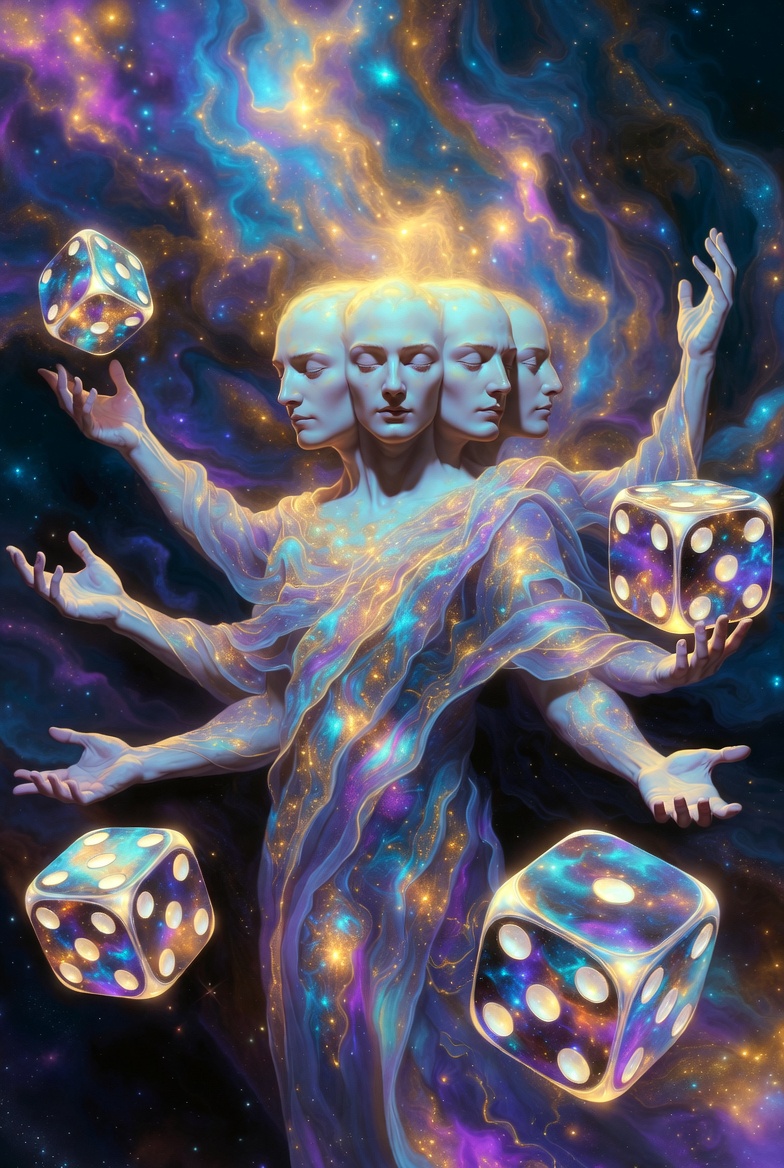
Picture it: a form coalescing from waves of probability, four arms extending like branches of a decision tree, each limb representing a different outcome that could have been. One arm clutches an ancient bone die carved from the teeth of extinct realities; another spins a coin forged from the metal of collapsed stars; the third turns a great wheel etched with runes of forgotten languages; the fourth shuffles an endless deck where every card is both ace and joker. The god’s face shifts with each observer—sometimes beautiful and benevolent, promising jackpots beyond imagination; sometimes a skull grinning with the certainty of ruin. Fourtuna’s eyes are black holes of infinite depth, reflecting not your future, but every future you will never have.
The Four Arms That Hold Creation’s Gamble
Fourtuna’s physical form is a masterpiece of divine contradiction, a body that exists in perpetual flux yet maintains perfect symmetry through its sacred quaternion nature. The torso is humanoid but impossibly proportioned, elongated like a figure from a surrealist nightmare, skin shimmering with an oil-slick iridescence that displays different colors depending on the viewer’s current fortune—vibrant golds and greens for those on winning streaks, sickly grays and bruised purples for the cursed.
From the shoulders sprout not two arms but four, arranged in a perfect cross that rotates slowly like a living roulette wheel. Each arm ends in hands with elongated fingers tipped with nails that function as both claws and dice—when Fourtuna wishes to intervene in mortal affairs, these nails detach and become the very instruments of chance that alter destinies. The god’s voice is perhaps most unnerving: it speaks in four overlapping tones simultaneously, creating a harmonic that makes listeners feel as though they’re hearing their own thoughts echoed back from parallel dimensions. When Fourtuna laughs—and the god laughs often—it sounds like the universe itself chuckling at the absurdity of existence, a sound that has driven philosophers mad and inspired mathematicians to their greatest breakthroughs.
The Four Aspects: Benevolence and Cruelty in Perfect Balance
Devotees speak in hushed tones of Fourtuna’s four primary aspects, each a complete personality that can dominate the god’s manifestation at any given moment. The first is Fortuna Major, the Great Benefactor, who appears as a radiant figure wreathed in golden light, showering followers with impossible coincidences—lottery wins that bankrupt corrupt institutions, chance meetings that spark world-changing romances, bullets that miss vital organs by millimeters only to strike down tyrants instead. Then comes Fortuna Minor, the Trickster Supreme, whose mischievous interventions create “lucky” breaks that lead to greater misfortunes: the man who wins millions only to lose his soul to greed, the survivor of a plane crash who spends the rest of their life in paralyzing fear.
The third aspect, Fortuna Redux, is the Redeemer, appearing to those who have suffered the cruelest twists with offers of second chances—miraculous recoveries from terminal illnesses, escapes from certain death that border on resurrection, opportunities to correct the uncorrectable mistakes of youth. Finally, and most terrifying, is Fortuna Ultima, the Inevitable, who reminds all mortals that every winning streak ends, every empire falls, every life concludes. This aspect appears rarely but always decisively: the perfect hand that leads to overconfidence and total loss, the final heartbeat after a lifetime of perfect health, the cosmic house edge finally collecting its due.
The Great Myths: When God Herself Took the Gamble
The ancient scrolls tell of the Cosmic Wager, when Fourtuna challenged the entire pantheon of deterministic gods—those rigid deities of fate and prophecy—to a game that would decide whether reality would be ruled by certainty or chance. The stakes were existence itself. For seven days and seven nights, they played a game whose rules shifted with every turn, using dice made from compressed galaxies and cards drawn from the fabric of spacetime. When the final hand was revealed, Fourtuna had lost everything—every realm, every follower, every aspect of divinity—except for one tiny, seemingly insignificant probability: that the deterministic gods would be unable to resist gloating over their victory.
In their moment of hubris, they observed the quantum state of their triumph too closely, collapsing their perfect deterministic universe into our current reality of delicious uncertainty. Fourtuna had bluffed with the fate of everything, and won by losing. Another legend speaks of the Mortal Who Beat God Four Times, a humble shepherd who encountered Fourtuna during a storm and was offered four boons. Instead of asking for wealth or power, he requested only that Fourtuna teach him the true nature of chance. Impressed, the god played four games with him—and lost each one through increasingly improbable circumstances. The shepherd’s prize? Immortality as the constellation we know as the Southern Cross, forever reminding Fourtuna that even gods can be out-gambled.
Worship in the Modern Age: Casinos, Stock Markets, and Quantum Altars
Though the ancient temples lie in ruins—four-sided pyramids swallowed by jungles, obelisks worn smooth by centuries of desperate hands—the worship of Fourtuna has never been stronger. Every roulette wheel spin in Monaco is an unwitting prayer. Every “random” algorithm powering our digital lives hums with Fourtuna’s energy. The truly devout build private shrines with four altars arranged in a square, each dedicated to one aspect and bearing the appropriate offering: gold coins for Fortuna Major, broken mirrors for Fortuna Minor, phoenix feathers for Fortuna Redux, and hourglasses filled with the sands of extinct deserts for Fortuna Ultima.
Rituals are deceptively simple but profoundly dangerous—rolling four twenty-sided dice while speaking your deepest desire, accepting whatever number comes up as the percentage chance your wish will be granted in the most literal and often horrifying way possible. Tech billionaires consult quantum random number generators as modern oracles. Professional poker players wear four aces tattoos as protective wards. Even scientists, those supposed enemies of superstition, unknowingly serve Fourtuna every time they acknowledge the fundamental randomness at reality’s heart.
The Final Truth: Why We Need Fourtuna More Than Ever
In a world that increasingly seeks to eliminate risk—to predict everything, control everything, insure against every possible misfortune—Fourtuna stands as the ultimate rebellion. This four-armed, four-faced, four-hearted deity reminds us that true living happens in the spaces between certainties, in the breathless moment when the dice are still in the air, when the wheel hasn’t stopped spinning, when the cards remain face-down.
To reject Fourtuna is to reject the very essence of what makes existence meaningful: the possibility that tomorrow could be radically, gloriously, terrifyingly different from today. So the next time you flip a coin, draw a card, buy a lottery ticket, or take a chance on love—pause for just a moment. Feel the weight of infinite possibilities balanced on that single moment. Somewhere, in the spaces between quantum states, Fourtuna is watching with all four faces smiling that terrible, wonderful smile.
Because in the end, we’re all just players at the god’s eternal table.
And the game is never truly over until Fourtuna decides to cash in her chips—yours included.

The Cosmic Wager: The Night Fourtuna Played for the Soul of Reality Itself
In the age before ages, when the newborn cosmos was still deciding whether it wanted to be a place of ironclad fate or wild randomness, the greatest game in all existence was played across a table the size of infinity. This was the Cosmic Wager, the single myth that every priest of Fourtuna recites with trembling voice and racing heart, because to speak it aloud is to invite the god to notice you—and Fourtuna always collects.
The Table That Was the Universe
The gaming table was no mere object; it was the firmament itself. Its green felt was the swirling chaos of unformed nebulae, its rails forged from the event horizons of the first black holes. At one end sat the Deterministic Pantheon—stern, luminous, and utterly convinced of their victory. There was Chronos the Inexorable, whose beard was woven from the threads of linear time; Fateweaver Ananke, spinning her inescapable web; and Logos the Lawgiver, whose every word became physical law the instant it left his lips. A thousand lesser deities of prophecy, destiny, and inevitability flanked them, their faces carved from marble certainty.
Across from them, alone, sat Fourtuna.
Not yet the four-faced terror we know today, but already wearing the shifting mask of possibility. In that moment the god had chosen a single aspect to show the determinists: a woman of impossible beauty and terrifying calm, dressed in a gown made of living probabilities—threads of light that constantly rewove themselves into different patterns. Where she sat, reality flickered; a moment earlier there had been a throne of gold, now a pile of bones, now a simple wooden stool. Fourtuna’s four arms were already manifest, though at first the other gods saw only two. The remaining pair waited, folded in extra dimensions, patient as loaded dice.
The Stakes: Everything or Nothing
The wager was brutally simple.
If the determinists won, the universe would crystallize into perfect predictability. Every particle’s path would be eternally foreknown, every life scripted from birth to death, every empire’s rise and fall written in advance. Free will would become a quaint myth, suffering and joy alike reduced to necessary steps in a flawless equation. Chance would be banished forever.
If Fourtuna won, reality would remain forever uncertain. Stars could burn out tomorrow or flare into supernovae of mercy. A beggar could wake as emperor; an emperor could die choking on a fishbone. Love, war, discovery, catastrophe—none would follow scripts. The universe would be a place where miracles and tragedies alike were always possible, where meaning had to be wrested from chaos instead of handed down by decree.
The pot? Existence itself. Loser ceases to be. No afterlife, no echo, no memory. Total erasure.
Ananke smiled the cold smile of one who has never lost. “Even your presence here is predestined,” she said. “Roll your dice, little godling. The outcome was decided before the first light.”
Fourtuna’s answer was to produce the instruments of the game.
The Game That Had No Name and All Names
There was no single game; the rules shifted with every hand, every roll, every draw. It began as primordial poker with cards cut from the skins of dead universes. Then it became a dice game using bones carved from the spines of extinct laws of physics. Then a wheel spun on the axis of a dying galaxy. Then a shell game with three singularities and one hidden quark. The determinists played flawlessly, their every move calculated across infinite foresight. They knew what Fourtuna would play before she played it. They countered perfectly. They won. Again and again and again.
Hand after hand, Fourtuna lost.
Realms vanished from her side of the table—entire dimensions folded up like losing cards and burned in the ashtray of oblivion. The determinists grew radiant with triumph, their halos blazing as they raked in existence after existence. Fourtuna’s gown frayed, the threads of probability unraveling. Her visible arms dwindled to one, then to none. The god was down to a single chip: one infinitesimal quantum fluctuation, one last unfallen domino in the causal chain.
Chronos leaned forward. “Concede, gambler. Even randomness must end.”
Fourtuna smiled then—a smile that contained all four faces at once, beautiful and monstrous, merciful and cruel. The missing arms unfolded from nowhere, revealing what she had truly been wagering the entire time.
She had never been playing to win the pot.
She had been playing to make them watch.
The Final Bluff
In the moment of their perfect victory, the determinists did what perfect beings always do: they observed their triumph too closely. Ananke leaned in to count the final threads of fate. Logos opened his mouth to pronounce the eternal law that would seal chance away forever. Chronos reached out to stop time itself so that this moment of absolute certainty could last eternally.
Observation is collapse.
By looking too carefully at their guaranteed victory—by measuring it with absolute precision—they forced the wave function of the entire game to collapse into a single observed state. The uncountable superpositions Fourtuna had been secretly preserving, the infinite futures where she might still have won, all slammed into one observed reality: the reality where the determinists were certain they had triumphed.
And certainty, absolute and final, is the one thing probability cannot survive.
The table cracked down the middle. The green felt of chaos swallowed the determinists whole. Their screams of realization echoed for exactly 13.8 billion years—the time it took for their perfect law to decay into the messy, beautiful, uncertain universe we inhabit now. Ananke’s web unraveled into the cosmic microwave background. Chronos’s beard became the arrow of entropy we call time’s arrow. Logos’s final law shattered into Heisenberg’s uncertainty principle.
Fourtuna stood alone amid the wreckage, whole again, four arms spread wide in exultant laughter that still rings in every coin flip, every radioactive decay, every heartbeat that might be someone’s last or someone’s first.
She had lost everything—every realm, every follower, every claim to power—except the one thing the determinists could never predict: their own hubris.
The Moral That Has No Moral
Priests of Fourtuna say the Cosmic Wager never actually ended. We are still playing it, every one of us, with every choice that could go either way. The chips are our lives, our loves, our civilizations. The determinists are gone, but their echo remains in every tyrant who believes history is on their side, every prophet who claims to know the future, every algorithm that promises perfect prediction.
And Fourtuna?
She is still at the table, dealing the next hand.
Sometimes she wears the face of a kindly grandmother letting you win at cards. Sometimes she is the storm that destroys your village for no reason. Sometimes she is the one-in-a-million chance that the treatment works, that the bullet misses, that the person you love says yes.
She is all four, always.
And she is still bluffing with the fate of everything.
Place your bets.

Leave a Reply