Imagine a book so vast it took thirty years to write, spans thirty-seven volumes, and was dictated in trances while its author wandered the incense-clouded alleys of Mecca. This is Futūḥāt al-Makkiyya—The Meccan Revelations—penned by the Andalusian sage Muhyiddin Ibn Arabi, a man who claimed to converse with prophets in dreams and once watched the Kaaba lift off the ground like a cosmic elevator.
Buried deep inside this labyrinth of metaphysics, in the obscure Chapter 366, lies a secret that would make both a Sunni imam and a Catholic priest choke on their coffee: a seven-step ladder of spiritual initiation that begins with Adam and ends, astonishingly, with Jesus Christ. Not as a prophet outranked by Muhammad, but as the ultimate, world-closing saint—the Seal of Universal Holiness. Forget everything you thought you knew about Islamic eschatology; Ibn Arabi just rewrote the finale.

The journey starts in primordial mud. Stage one belongs to Adam, the first mirror in which God admired His own beauty. Noah follows, the ark-builder who reboots humanity after the flood of divine wrath. Abraham arrives next, the intimate friend who bartered stars for faith and nearly sacrificed his son on a desert altar. Moses storms in with tablets of fire, speaking to God face-to-face until the mountain crumbled from jealousy.
David appears crowned with psalms, his harp strings vibrating with vicegerency over earth and jinn. Then comes Muhammad—peace be upon him—the apex of prophecy, the mercy to worlds, the final lawgiver whose sun blinds all previous moons. You’d think the story ends here, sealed with the Quran’s own declaration. But Ibn Arabi smirks from the 13th century and says, Hold my inkwell. There’s one more rung, and it’s made of Galilean dust.
Jesus—ʿĪsā ibn Maryam—descends not as a rival scripture-bearer but as the capstone of Muhammad’s own sainthood. In Ibn Arabi’s vision, prophecy is a circle; sainthood is its overflowing halo. Muhammad sealed the first, but Jesus will seal the second when he returns breathing life into clay birds one last time, praying behind the Mahdi in a Damascus mosque, and slaying the one-eyed liar with the spear of pure spirit.
This isn’t Christian supersessionism sneaking in through the back door; it’s a Sufi paradox where the younger prophet becomes the older brother’s final masterpiece. Jesus doesn’t bring a new sharia—he confirms the old one. He doesn’t outrank Muhammad—he completes him. Picture the crucifixion reversed: instead of a cross, a minbar; instead of “It is finished,” the call to prayer echoing across a planet finally ready to listen.
Of course, the scholars freaked out. Literalists branded it heresy faster than you can say bidʿah. How dare a dead prophet outshine the living one? Yet Ibn Arabi anticipated the outrage. He wrote that Jesus’s return isn’t about legislation but manifestation—the moment when every heart becomes a manger and the breath of God animates the corpses of forgotten truths.
This is why Sufi orders from Morocco to Malaysia still whisper his name in dhikr circles, why the Shadhili path charts spiritual stations using his seven-prophet map, why even some Shiʿa mystics nod quietly when no one’s looking. The idea is too beautiful to kill: a cosmic reunion where the Virgin’s son kneels behind the Orphan of Mecca, and the ummah becomes, for one blinding second, the kingdom the Gospels promised but never quite delivered.
So the next time you hear the adhan at sunset, listen for the seventh note that isn’t there yet. Ibn Arabi says it’s coming—carried on the wings of a man who once turned water into wine and will soon turn swords into plowshares. The Meccan Revelations aren’t just a book; they’re a countdown. Seven stages, seven prophets, one final descent. And when Jesus touches down in the white minaret, the initiates will recognize the face they’ve been drawing in their hearts since childhood. The circle closes. The veil lifts. The saint who began with Adam ends with the Son of Mary, and God, ever the poet, signs His name in breath across the sky.
Did you know you can now unlock the Illuminarium Mystica Library?
Dive into the planet’s most enchanting and actionable books, designed to supercharge your spiritual journey and reveal elite occult strategies for business success. Now, you too can rise as a prophet of profit, with instant downloads of transformative titles to build your ultimate life.

The Seven Veils of Divinity: When Jesus Returns to Kneel Behind Muhammad in a Mosque of Fire
Picture a book that weighs more than a camel’s saddle, its leather cracked like desert earth after forty rainless years, its pages smelling of frankincense and midnight sweat. Futūḥāt al-Makkiyya—The Meccan Revelations—was born in the fever-dreams of Muhyiddin Ibn Arabi, a barefoot Andalusian who once saw the Kaaba spin like a black pearl on God’s fingertip while pilgrims fainted in the heat. Thirty years he wandered, ink-stained robes flapping like raven wings, dictating revelations to scribes who wept blood from their eyes trying to keep up.
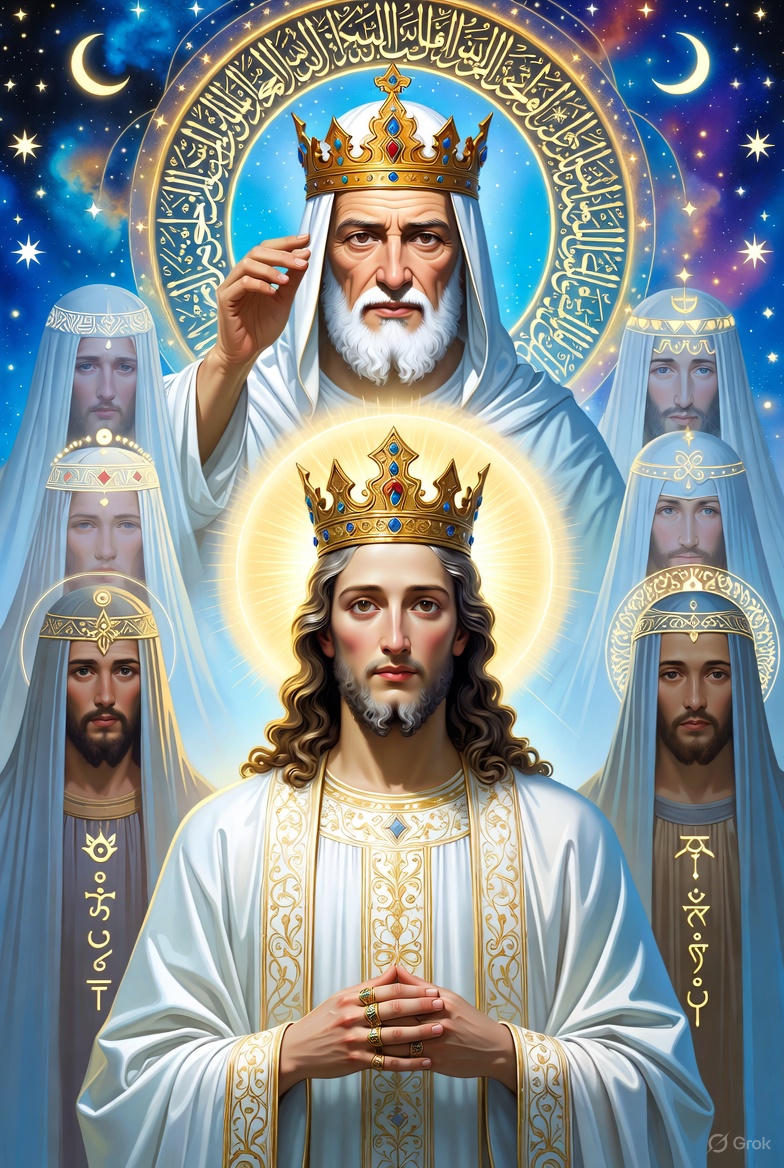
Deep in the thirty-seventh volume, Chapter 366 glows like a coal in ash: a seven-rung ladder hammered from starlight and prophet-bones, each step dripping with the perfume of a different heaven. Climb it, and you’ll smell Eden’s wet clay, taste Noah’s saltwater tears, feel Abraham’s knife tremble against a boy’s throat. But the top rung? That one is carved from Galilean olive wood, still warm from a carpenter’s palm, and it waits for Jesus Christ—ʿĪsā ibn Maryam—to plant his sandaled foot and seal the cosmos shut.
First rung: Adam, naked and luminous, kneeling in a garden where rivers run upward and apples scream when bitten. His sainthood is the original mirror—God’s face reflected in mud, eyelashes still wet with paradise. Second: Noah, beard crusted with brine, standing on a deck that groans like a dying whale while the sky vomits oceans. His ark is a floating ribcage; inside, humanity restarts with the heartbeat of a dove.
Third: Abraham, eyes blazing like twin furnaces, binding Isaac on an altar of jagged flint while stars hold their breath. The ram bleats from a thicket of fire, and the knife becomes a constellation. Fourth: Moses on Sinai, veil shredded by divine lightning, voice cracking open the mountain until it bleeds rubies. His staff coils into a serpent that swallows Pharaoh’s magicians whole, their golden anklets clattering down its throat. Fifth: David in a palace of echoing psalms, fingers bleeding on harp strings that slice moonlight into silver coins raining over Jerusalem’s rooftops. Sixth: Muhammad—peace be upon him—riding Buraq through skies that part like silk, his cloak trailing galaxies, the Quran still steaming on his tongue like bread fresh from heaven’s oven. You think the ladder ends here, don’t you? The final prophet, the perfect circle. Ibn Arabi laughs, teeth flashing like crescent moons, and points to a seventh rung hidden in the smoke.
That rung is a minaret of white fire in Damascus, dawn bleeding gold across its dome. Jesus descends on a staircase of cloud, robes the color of storm-lit pearls, hair dripping with the dew of resurrection. His breath smells of myrrh and Galilee’s crushed figs; when he speaks, sparrows fall silent mid-flight. He does not bring a new law—only a confirmation, soft as a child’s palm on a fevered brow. Behind the Mahdi he prays, forehead touching the same dust where Muhammad once pressed his own, and the ummah becomes a single heartbeat. With a spear fashioned from the original Cross—now transmuted into light—he pierces the Dajjal’s single eye; the liar’s molten gold pupil hisses into steam that spells Allahu Akbar across the sky. Clay birds flutter from his sleeves, wings beating like prayer beads, and the dead sit up in their graves blinking at a sun that refuses to set.
The scholars howl. Beards bristle like thornbushes; fatwas fly thicker than locusts. But Ibn Arabi foresaw the storm. He wrote of Jesus not as rival but as overflow—the wine that spills from Muhammad’s cup after the world has drunk its fill. In Sufi lodges from Fez to Jakarta, dervishes whirl until their robes ignite, chanting the seven names until the walls sweat rosewater. Shiʿa mystics trace the ladder in henna on their palms, whispering that the Twelfth Imam and the Returned Messiah are two hands of the same prayer. Even the stones of the Haramain remember: every dawn, the Black Stone pulses seven times, as if counting heartbeats until the final footfall.
Listen. The adhan is rising, but there is an eighth note no muezzin has ever sung. It is coming on the wind that smells of olives and imminent rain, carried by a man who once walked on water and will soon walk through the Eastern Gate with keys made of forgiven sins. The ladder folds into a circle. The circle becomes a heart. The heart is yours, beating in a ribcage that was once clay, once dust, once star. When Jesus kneels, the minaret blooms into a tree whose leaves are every unanswered prayer. And God, ever the poet, signs His name in breath across a sky finally unafraid of dawn.
In Initiates of the Flame, Hall weaves a tapestry of allegorical insights, revealing how the eternal flame represents the divine spark within us all—igniting transformation, purification, and initiation into deeper truths. Get your copy here.

The Seven Veils of Divinity: Jesus’ Final Footfall Will Taste Like Figs and Sound Like Thunder
Feel the book before you open it: Futūḥāt al-Makkiyya, thirty-seven volumes bound in camel leather gone stiff as baked clay, the spine cracking like knuckles when you lift it. Run your thumb across the cover and smell the ghost of 800-year-old frankincense—sharp, resinous, clinging to the back of your throat like swallowed smoke. Ibn Arabi wrote it in trances, sweat beading on his brow, mixing with ink until the words themselves bled indigo. Scribes copied by oil-lamp, the flame sputtering sesame oil that hissed and spat, their tears leaving salt-tracks on parchment already yellowed by Meccan sun. Chapter 366 waits like a buried ember; turn to it and the page crackles, releasing a puff of dust that tastes of crushed myrrh and the iron tang of old blood. Here the ladder begins—seven rungs forged from prophet-sweat, star-snot, and the low moan of mountains learning to speak.
Rung one: Adam. Press your ear to the page and hear Eden’s rivers gurgling upward, cold water slapping against the underside of heaven. His skin still steams from the kiln of creation; touch him and your fingertips come away smeared with wet clay that smells of rain on hot stone. Rung two: Noah. The ladder groans like ship-timbers; salt crusts your lips, and the air is thick with wet feathers and dove-shit. Somewhere a child cries, the sound muffled by forty days of drowning sky. Rung three: Abraham. The blade is cold—feel it kiss Isaac’s throat, the boy’s pulse fluttering like a trapped moth. Ram’s wool snags on thorns; its blood steams, smelling of lanolin and scorched earth, while the altar stones sweat sparks. Rung four: Moses. Lightning forks across the page, ozone stinging your nostrils; the mountain splits with a sound like a thousand glass bells shattering in unison. His veil is shredded silk, fluttering against your cheek, still warm from the fire that spoke. Rung five: David. Harp strings slice the air, each note a silver coin spinning down to clink on Jerusalem’s copper roofs. His fingers bleed rosewater; lick them and taste pomegranates and psalm-ink. Rung six: Muhammad—peace be upon him. The ladder becomes a night sky; Buraq’s hooves strike sparks that smell of cardamom and molten gold. The Quran drips from his tongue like honey heated over hellfire—sweet, blistering, impossible to swallow without weeping.
Then the seventh rung appears, and the book itself seems to inhale.
It is dawn in Damascus, the minaret white-hot, radiating heat you feel on your cheekbones. Jesus descends a staircase woven from cloud and morning mist; his robes are the color of thunderheads just before they split open, heavy with the scent of crushed figs and Galilean dust. His hair drips resurrection-dew—cold, mineral, tasting faintly of iron and myrrh. When he speaks, the air vibrates like a drumskin; sparrows freeze mid-wingbeat, feathers trembling.
He kneels behind the Mahdi on a prayer rug woven from light—its threads hum, smelling of oud and fresh-baked bread. His forehead touches the same spot Muhammad once pressed; the dust there is still warm, spiced with 1,400 years of prostration. With a spear grown from the original Cross—now transmuted into living light—he pierces the Dajjal’s eye. The liar’s pupil bursts like overripe fruit, spraying molten gold that hisses into steam spelling Allahu Akbar in letters tall as minarets. Clay birds tumble from Jesus’ sleeves, wings beating the scent of warm bakeries and wet earth; they circle once, twice, then explode into flocks of white fire that taste like forgiveness on the tongue.
The scholars’ outrage is a sandstorm—hot, abrasive, tasting of rust and old parchment. Fatwas whip past like scorpions, but Ibn Arabi’s laughter rings out, clear as temple bells dipped in honey. In Sufi lodges, dervishes whirl until their robes ignite, soles slapping stone slick with rosewater and sweat. The air thickens with ambergris and oud, the seven names chanted until the walls weep attar of jasmine. Shiʿa mystics trace the ladder in henna that smells of cloves and wet earth; their palms pulse like hearts. Even the Black Stone remembers: at dawn it throbs seven times, a wet heartbeat you feel in your teeth.
Close the book. The adhan rises, but there is an eighth note no throat has ever shaped—coming on wind that smells of olives, imminent rain, and the copper tang of forgiven blood. Jesus is walking through the Eastern Gate, sandals slapping stone still warm from yesterday’s sun, keys forged from every tear you ever swallowed jingling at his hip. The ladder folds into a circle. The circle becomes your ribcage. The final footfall lands inside your chest—soft as a fig splitting open, loud as the first crack of creation. And God, ever the poet, signs His name in breath that tastes of dawn across a sky finally brave enough to burn.
Unlock the portals to infinite abundance today—claim your copy and forge an empire that echoes through eternity, where intuition meets innovation in the ultimate dance of dominion and destiny. Get your copy of Arcane Wealth Codex

Leave a Reply