Imagine finding a 1,700-year-old manuscript that claims to contain the secret post-resurrection teachings of Jesus, complete with cosmic passwords, glowing diagrams, and step-by-step rituals that promise to catapult your soul past hostile archons straight into the Treasury of Light.
That manuscript exists. It’s called the Books of Jeu (pronounced roughly “Zhay-oo” or “Yay-oo”), and it might just be the strangest, most intoxicating piece of Christian esoterica ever unearthed.

A Scottish Explorer Walks into an Egyptian Tomb Shop…
In 1769, a tall, red-haired Scotsman named James Bruce was poking around the ruins near Thebes (modern Luxor) when someone slipped him a battered papyrus codex written in Coptic. Bruce, already famous for tracking down the source of the Blue Nile, tossed it into his luggage and brought it home. When he died in 1794, the book ended up gathering dust in Oxford’s Bodleian Library. For almost a century, nobody realized what they had.
Then, in the 1890s, German scholar Carl Schmidt cracked it open and nearly dropped his monocle. Inside were two previously unknown Gnostic gospels: the First and Second Books of Jeu, plus a couple of bonus treatises. Overnight, the quiet Scottish explorer became the accidental godfather of one of the wildest spiritual texts in history. The manuscript is now known simply as the Bruce Codex.
So… Did Jesus Actually Write This?
Short answer: No.
Long answer: Definitely not, but the author really, really wanted you to think he did.
The Books of Jeu were composed around 200–250 CE, probably in Greek, by an anonymous Gnostic mystic (or small circle of mystics) in Roman Egypt. Like dozens of other “secret gospel” texts from the period, they use the literary trick of pseudepigraphy: “Hi, we’re the disciples, and the risen Jesus just spent several cosmic hours explaining the true structure of the universe to us. Please keep this quiet.”
Orthodox Christianity branded this stuff heresy and tried to erase it. Luckily for us, the desert is great at preserving banned books.

What’s Actually Inside?
Think of it as a combination of:
- A multidimensional map of 60+ heavenly “treasuries”
- A grimoire of unpronounceable divine names (think 40-consonant-long magic words made of pure vowels)
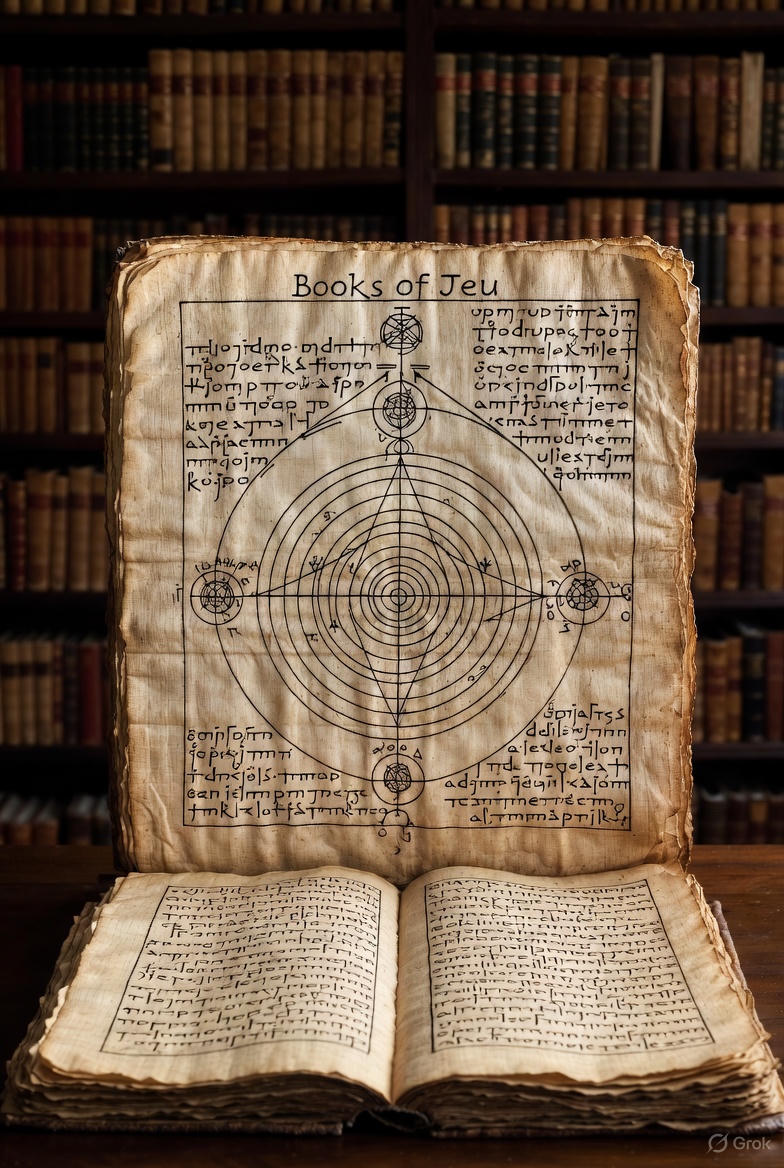
- 26 intricate mystical diagrams that look like someone gave Mandelbrot’s set a Gnostic makeover
- A complete initiation system with seals, ciphers, and chants designed to let your soul slip past the celestial border patrol after death
The star of the show is Jeu himself, an enigmatic being who is the first emanation of the unknowable Father and the architect of all higher realities. (No relation to the modern word “Jew” – the similarity in English spelling is pure coincidence.)
The Rituals Still Work (Apparently)
Here’s where it gets spooky.
People who actually perform the rituals in Book 1 – tracing the diagrams in the air, intoning the bizarre vowel-chants, visualizing the seals – frequently report the same thing modern readers have told me this week: sudden rushes of joy, spontaneous smiles, a feeling of “something clicking open” inside the chest or head.
One person wrote to me after listening to an audio version while following along:
“Every time I said the names exactly as instructed, this ridiculous grin spread across my face. I wasn’t trying to feel anything. It just… happened. Repeatedly.”
That’s not scholarly detachment. That’s the sound of an ancient technology still booting up 1,800 years later.
The Verdict
The Books of Jeu are not historically authentic words of the man from Nazareth.
They are, however, authentically ancient, authentically Gnostic, and – if thousands of years of mystical testimony are worth anything – authentically powerful.
Somewhere in Upper Egypt, an anonymous genius (or group of geniuses) sat down and wrote what is essentially a user manual for hacking the afterlife. They hid it behind layers of secrecy, wrapped it in the authority of a resurrected Jesus, and trusted that only the right kind of crazy person would ever dare to use it.
James Bruce accidentally carried that manual out of the sands.
Two centuries later, people are still smiling in spite of themselves when they speak the old words.
Maybe the real treasure of light was the uncontrollable happiness we found along the way.
(If you want to try it yourself, Charlotte Baynes’ 1933 translation and Violet MacDermot’s 1978 version are both public domain. Just… maybe don’t read the great all-powerful name out loud until you’re sure you’re ready.)

Leave a Reply