In an age where ancient stories are dismissed as dusty relics and modern life feels like a chaotic scramble for meaning, Joseph Campbell emerges not merely as a scholar of myths but as the profound cartographer of the human spirit. Born in 1904 and passing in 1987, Campbell spent his life diving into the world’s mythologies—from the epic cycles of ancient Greece and India to the tribal lore of Native Americans and the heroic tales of medieval Europe—revealing a startling truth: beneath the surface differences of culture, religion, and era lies a universal pattern he famously called the “monomyth” or the Hero’s Journey.
Some of the herbal allies mentioned here are shared through affiliate links, meaning I may receive a small blessing of support if you choose to journey with them—always at no extra cost to you.

This isn’t some academic abstraction; it’s a blueprint for how every individual, whether a farmer in rural Kansas or a tech entrepreneur in Silicon Valley, navigates the trials of existence. Campbell’s genius was in showing that myths aren’t fairy tales for children but psychological roadmaps, encoded wisdom from our ancestors about confronting the unknown, transforming suffering into growth, and discovering a deeper connection to the cosmos. In a world fractured by ideological echo chambers and superficial distractions, ignoring Campbell means wandering blindfolded through life’s labyrinth; listening to him, however, equips us with the torch of timeless insight, illuminating paths to personal fulfillment and collective harmony.
Campbell’s importance explodes into clarity when we grasp how his work bridges the chasm between the sacred and the secular, the ancient and the contemporary, proving that humanity’s deepest questions—Who am I? Why do I suffer? What is my purpose?—have been answered not by philosophers in ivory towers but by storytellers around campfires for millennia. His seminal book, The Hero with a Thousand Faces, published in 1949, dissects this monomyth into stages: the call to adventure, the refusal, the supernatural aid, the threshold crossing, the belly of the whale, the road of trials, the ultimate boon, and the return. Sound familiar?
It should—George Lucas openly credited Campbell for shaping Star Wars, where Luke Skywalker’s arc mirrors the journeys of Odysseus, Buddha, and King Arthur. But Campbell’s influence ripples far beyond Hollywood; psychologists like Carl Jung built on his ideas to explore the collective unconscious, while therapists today use the Hero’s Journey in counseling to help patients reframe trauma as initiation. In education, his frameworks teach critical thinking by revealing how myths shape identity and society; in business, leaders invoke his principles for innovation, viewing market disruptions as “calls to adventure.”
Even in spirituality, Campbell’s non-dogmatic approach—encouraging followers to “follow your bliss”—frees people from rigid doctrines, urging a personal quest for transcendence. Why listen? Because in an era of mental health crises, where one in five Americans battles anxiety or depression, Campbell offers a narrative therapy that transforms victims into heroes, reminding us that dragons aren’t external monsters but inner fears to be slain, and that every crisis is a portal to rebirth.
To dismiss Campbell as outdated is to ignore the empirical evidence of his enduring relevance, substantiated across disciplines and cultures, where his ideas predict and explain human behavior with uncanny accuracy. Neuroscientists have linked myth-making to brain functions in the default mode network, responsible for self-reflection and imagination, echoing Campbell’s assertion that stories are evolutionary tools for survival and adaptation.
Anthropological studies of indigenous societies confirm his monomyth in rites of passage worldwide, from Amazonian shamanic visions to African initiation ceremonies, proving myths aren’t cultural quirks but hardwired responses to universal life stages. In literature and film, from The Matrix to The Lion King, his pattern dominates because it resonates with our psyche—data from screenplay analyses show over 80% of blockbuster heroes follow it implicitly. Socially, amid rising polarization, Campbell warns against “mythological illiteracy,” where people cling to tribal myths without seeing the shared human thread, fostering empathy; ignore him, and we perpetuate division; heed him, and we build bridges.
His PBS interviews with Bill Moyers, The Power of Myth, viewed by millions, sparked a global conversation on meaning, influencing everyone from Oprah Winfrey to Jordan Peterson. People should listen because Campbell doesn’t preach answers—he awakens the seeker within, substantiated by countless testimonies of lives transformed: addicts finding recovery through archetypal redemption, artists breaking creative blocks via the “refusal of the call,” executives discovering ethical leadership in the “boon.” In a disposable culture of quick fixes and viral trends, Campbell endures as the antidote, a voice insisting that true wisdom is eternal, urging us to live mythically, heroically, fully alive.

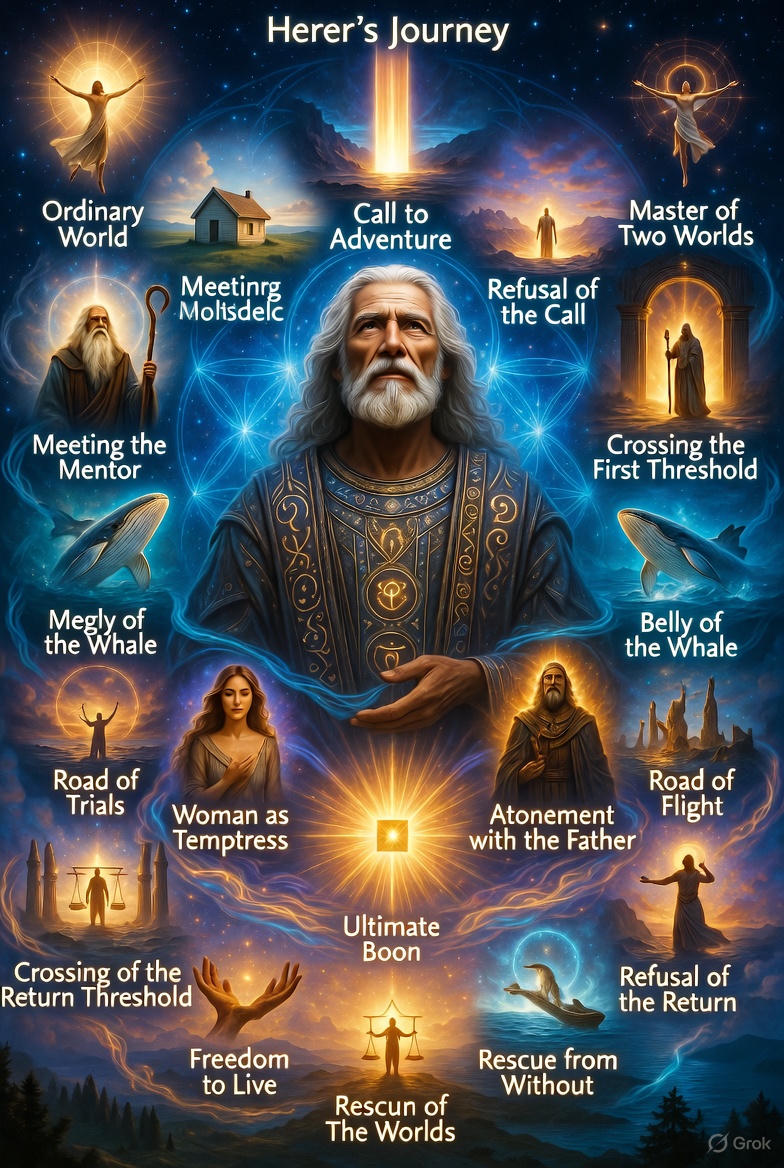
The Hero’s Journey Unpacked: Joseph Campbell’s 17-Stage Map to Becoming Fully Human
Joseph Campbell did not invent the Hero’s Journey—he discovered it, like an archaeologist unearthing a fossil that proves every dinosaur shared the same skeleton. Hidden inside the Iliad, the Mahabharata, the Popol Vuh, and your favorite streaming series is a single narrative pulse that beats in seventeen distinct phases, each one a psychological rite of passage that every person, knowingly or not, enacts across a lifetime. What follows is not a checklist for screenwriters but a living anatomy of transformation, a spiral staircase that begins in the familiar and ends in the transcendent, then circles back to gift the world with what was won. To walk these stages is to stop sleepwalking through existence and to start living mythically, which is to say, consciously, courageously, and with the full voltage of your being switched on.
The journey ignites in the Ordinary World, a deceptively stable cocoon where the future hero is embedded in routine, family, tribe, and unspoken rules. Luke milks blue bantha on Tatooine; Dorothy tends Aunt Em’s farm; you clock in at the job that pays the bills but quietly starves the soul. This is the baseline of comfort and constriction, the gravitational pull of the known that must be shattered for growth to occur. Campbell stresses that the Ordinary World is never truly ordinary—it is pregnant with latent destiny, riddled with symbolic clues (a recurring dream, a childhood wound, a book that won’t leave the nightstand) that the psyche plants like breadcrumbs leading to the threshold. Ignoring these omens is the first act of cowardice; honoring them is the first act of faith.
Then comes the Call to Adventure, a thunderclap that ruptures complacency. A letter arrives from Hogwarts; a mentor dies and leaves a cryptic map; a diagnosis upends the five-year plan. The Call is rarely convenient and never gentle—it is the universe whispering, then shouting, “Your old story is over; a larger one awaits.” Campbell observed that the Call often arrives disguised as crisis: layoffs, divorce, exile, the midnight realization that the ladder you’ve climbed leans against the wrong wall. The psyche stages these upheavals because the ego will not volunteer to die; it must be dragged, kicking and screaming, toward rebirth. In modern terms, think of the whistleblower who leaks the memo, the immigrant who boards the night bus, the artist who deletes the safe portfolio and uploads the raw, unfiltered truth. The Call is the moment the soul overrides the personality’s risk-assessment software.
Terror follows in the Refusal of the Call, the almost universal reflex to slam the door on destiny. Moses pleads inadequacy; Jonah books passage to Tarshish; you hit snooze on the alarm that is your own becoming. Campbell called this “the refusal of the summons,” a protective mechanism rooted in fear of the unknown, fear of incompetence, fear of what friends will say at Thanksgiving. The Refusal is not moral failure; it is diagnostic. It reveals the precise location of the inner dragons—self-doubt, perfectionism, the need to be the “good child.” Paradoxically, the longer the Refusal lasts, the louder the Call grows: the layoff becomes a foreclosure, the ignored symptom metastasizes, the unspoken truth festers into depression. The universe, Campbell reminds us, is not mocked; it escalates until the ego capitulates or calcifies.
Salvation arrives with Meeting the Mentor, the archetypal wise guide who hands over the first magical tool. Obi-Wan gives the lightsaber; Glinda the ruby slippers; the therapist the interpretation that unlocks decades of frozen grief. Mentors need not be human—sometimes they are books, songs, psychedelic journeys, or the sudden inner voice that says, “You already know what to do.” Campbell emphasized that the mentor’s role is not to walk the road for the hero but to confirm that the road exists. In a culture addicted to gurus, this stage is easily perverted; the true mentor points away from themselves and toward the hero’s own authority. When Yoda tells Luke, “You must unlearn what you have learned,” he is performing psychic surgery, excising the Refusal’s scar tissue.
Equipped but still trembling, the hero takes the Crossing of the First Threshold, stepping irreversibly into the Special World where the old rules dissolve. Bilbo leaves the Shire; Neo swallows the red pill; you quit the soul-crushing job without a parachute. This is the point of no return, the airplane door sealing at 30,000 feet. Campbell likens it to the sperm penetrating the egg—violent, necessary, irreversible. The threshold is guarded by Threshold Guardians, literal or figurative bouncers testing worthiness: the border patrol agent, the skeptical investor, the inner critic screaming, “Who do you think you are?” Defeating them is rarely about brute force; it is about alignment—proving that the Call was not egoic fantasy but soul imperative.
Now begins the Belly of the Whale, a womb-tomb of apparent defeat that feels like regression but is actually incubation. Jonah swallowed; Pinocchio inside Monstro; the addict hitting rock bottom in a motel bathroom. Campbell borrowed the image from global myths of descent into the underworld, emphasizing that the hero must be digested by the dragon before becoming the dragon-slayer. This is the dark night of the soul, the ego’s crucifixion, the moment every success manual skips. Yet it is here, in total disorientation, that the old self liquefies and the new self gestates. Neurobiologically, it maps to the default mode network going offline, allowing radical rewiring. Spiritually, it is the death that precedes resurrection. Without the Belly, the later victories are hollow; with it, they are alchemical.

Emerging half-digested but strangely luminous, the hero enters the Road of Trials, a gauntlet of escalating tests that forge competence and character. Harry faces the Triwizard tasks; Katniss survives the arena; you iterate the startup through a dozen near-bankruptcies. Each trial targets a specific deficiency—courage, cunning, compassion—until the hero becomes a Swiss Army knife of the soul. Campbell noted that allies and enemies appear in equal measure: the fellowship forms, betrayals sting, comic relief prevents despair. Failure is mandatory; the Road is less a meritocracy than a refinery, burning away what cannot endure the ultimate ordeal. Modern equivalents include PhD defenses, chemo cycles, custody battles—any crucible that demands you level up or log out.
Deep in the Special World, the hero Meets the Goddess, an encounter with unconditional love that restores wholeness. This is not always romantic; Luke merges with the Force on Dagobah; the Buddha touches the earth; the burnout executive reconnects with the child who once painted for joy. Campbell, influenced by Jung, saw the Goddess as the anima, the inner feminine that balances the hero’s masculine striving. In a patriarchy that demonizes vulnerability, this stage is revolutionary: permission to receive, to rest, to integrate shadow and light. The Goddess bestows a second gift—self-acceptance—without which the later boon is hoarded rather than shared.
Yet paradise is provisional. The Woman as Temptress stage (Campbell’s phrasing is dated but the archetype endures) dangles the seduction of stasis. Stay in the lotus-eating resort; marry the prince and forget the kingdom; take the buyout and coast. It is the ego’s last-ditch effort to abort the mission, offering comfort in exchange for conscience. Odysseus tied to the mast; the monk offered kingship by Mara; the activist courted by corporate greenwashing. Recognizing temptation as such—often cloaked in reasonableness—is the final exam in discernment. Passing it requires the maturity to say, “Not yet; the work is unfinished.”
The journey crescendos in the Atonement with the Father, a confrontation with the ultimate source of power and terror. Darth Vader, the Wicked Witch, the abusive parent, the internalized tyrant—whatever holds the keys to the hero’s freedom. Campbell framed this as reconciliation, not necessarily literal embrace but the integration of the father’s authority into the hero’s own. Luke refuses to kill Vader and claims his own Jedi knighthood; Simba roars atop Pride Rock after facing Mufasa’s ghost. Psychologically, it is the moment the super-ego is dethroned and repurposed. Spiritually, it is the death of the false god and the birth of authentic sovereignty.
With the tyrant transmuted, the hero seizes the Ultimate Boon, the elixir that justifies the entire quest. The Holy Grail, the Golden Fleece, the cure, the breakthrough algorithm, the reconciled family—whatever heals the wasteland. Campbell warned that the boon is never for the hero alone; hoarding it breeds dragons. Frodo must carry the Ring to Mount Doom, not wear it. The boon’s true power lies in its capacity to regenerate the community, which is why patents expire, open-source thrives, and every recovered addict sponsors another.
But the Special World will not release its prize easily. The Refusal of the Return tempts the hero to stay in the mountaintop clarity, the ashram, the corner office with the view. Campbell saw this as enlightened selfishness—why descend into the mess of ordinary life? Yet the monomyth demands circulation; enlightenment that does not serve is illusion. The Buddha descends from the Bodhi tree; Prometheus steals fire for humanity; the whistleblower publishes the files. The Refusal is overcome by a deeper Call, now outward: the realization that the Ordinary World is starving without the boon.
Escape becomes the Magic Flight, a breathless dash with pursuing forces nipping at the heels. Indiana Jones outrunning the boulder; the Hebrews fleeing Pharaoh; the startup racing to ship before the patent trolls sue. Campbell delighted in the comic absurdity of these chases—outrunning fate on a stolen motorcycle with the elixir in a lunchbox—reminding us that transcendence retains a sense of play. Often, Rescue from Without intervenes: eagles arrive, the cavalry crests the hill, the viral tweet mobilizes the crowd. The hero learns that grace is communal; no one bootstraps eternity.
Re-entering the atmosphere of the Ordinary World via the Crossing of the Return Threshold is its own ordeal. The boon looks different under fluorescent lights; colleagues want spreadsheets, not salvation. Campbell called this “the two-worlds montage,” where the hero must translate the ineffable into policy, poem, or prototype without diluting its essence. Veterans struggle with this; so do visionaries. The threshold now guards against reverse contamination—ensuring the Special World’s wisdom is not smothered by the Ordinary World’s cynicism.
Finally, the hero becomes Master of Two Worlds, fluent in both the material and the mythic, able to code-switch between boardroom and dreamtime. Jesus heals on the Sabbath; Da Vinci paints and engineers; the single mother advocates for policy while braiding her daughter’s hair. This is not balance but synthesis—the left brain and right brain, the ego and the Self, in dynamic communion. Campbell saw it embodied in the bodhisattva who renounces nirvana to teach, or the shaman who hunts by day and journeys by night.
The journey culminates as Freedom to Live, the rare state of non-anticipatory being. No longer enslaved by fear of death or hope of reward, the hero inhabits the eternal now. Campbell’s own deathbed words—“I’m not afraid; I’m curious”—exemplify this. It is not resignation but participation, the realization that every breath is a micro-journey: call, refusal, mentor, threshold, boon, return. The circle closes, yet it is a spiral; each completion seeds a larger adventure.
To map your own life onto these seventeen stages is to discover that you are not a passive consumer of culture but its co-author, that your resume gaps and heartbreaks are plot points, that the dragon you dread is the disguise of your own magnificence. Campbell’s genius was to democratize the epic: the monomyth is not reserved for demigods but encoded in every human psyche, waiting to be activated. Listen to him, walk the stages, and you do not merely survive—you become the living proof that myths are not relics but rehearsals for the only story that matters: yours, fully awakened, fully offered, fully alive.

Leave a Reply