He Who Thunders Above the Sky – The Terrifying Beauty of Set
The Most Misunderstood and Magnificent God of Ancient Egypt
In the blistering heart of the Egyptian pantheon stands a god so ferocious, so untamed, that even the other immortals feared to meet his gaze. Set – red as fresh-spilled blood, fierce as the desert wind that strips flesh from bone – strides across the dunes with the head of the unknowable Set-beast: tall squared ears slicing the horizon, a curved snout like a scimitar drawn for war, eyes slanted and glowing like embers in the night, and a rigid, arrow-straight tail that forks with the fury of lightning. This is no mere jackal or donkey; this is a creature that exists only in myth, a nightmare made divine, the perfect avatar for a god who rules everything that lies beyond the safe, black soil of the Nile. From the moment he tore his way out of Nut’s womb, Set was chaos incarnate – brother to Osiris the gentle king, husband to the mournful Nephthys, and eternal outsider among the Ennead. Yet the ancients did not simply fear him; they revered him, carved his image on palace walls, named pharaohs after him, and whispered his titles in awe: Great of Strength, Lord of the Red Land, He Who Is in the Heart of the Storm.
Some of the herbal allies mentioned here are shared through affiliate links, meaning I may receive a small blessing of support if you choose to journey with them—always at no extra cost to you.

Master of the Burning Sands and Crimson Sky
Picture the Egypt the tourists never see: not the lush green ribbon of the Nile, but the infinite Red Land that swallows armies whole. Here Set is king absolute. His breath is the khamsin wind that blinds and buries; his voice is the thunder that rolls over the western desert; his laughter is the sandstorm that erases entire caravan routes in a single howling afternoon. Red is his color – the red of war, of desert ochre, of the blood that must sometimes be spilled so that life can continue. In the oasis temples of Dakhla and Bahariya, in the golden quarries of Nubt, in the fortress city of Avaris where the Hyksos invaders crowned him their supreme god and equated him with their own storm-lord Baal, Set was worshipped with roaring hymns and rivers of beer. Pharaohs of the Ramesside era marched beneath banners bearing his fierce likeness, believing his fury would smash their enemies the way desert gales shatter granite. To the frontier soldiers, the merchants daring the forty-day camel routes, and the bedouin who still call the sudden whirlwind “Set’s chariot,” he was not evil – he was survival itself.
The Only God Strong Enough to Slay the Unslayable
Every single night, without fail, the sun god Ra sails his golden barque into the underworld, and every single night the serpent Apep – chaos older than creation, the devourer that would swallow light forever – rises to kill him. Every god quails. Every goddess weeps. Only one steps forward, spear in hand, roaring like a thousand lions: Set. Night after night for five thousand years of Egyptian history, Set stands at the prow of the solar boat, crimson mane whipping in the underworld wind, hurling iron harpoons that blaze like meteors into Apep’s endless coils. His war-cry shatters the darkness; his storms drive back the abyss. Without Set, there is no dawn. Without Set, the sun dies forever. This is the great secret the later Greeks and Christians tried to erase: Set is not the villain of the story – he is the reason the story continues at all.
The Murder, the War, the Eternal Defiance
Yes, he murdered Osiris. Yes, he hacked the gentle god into fourteen pieces and scattered them like chaff on the wind, out of jealousy so scorching it could melt stone. Yes, he fought Horus in battles that lasted eighty years – gouging out the falcon’s eye, losing his own testicles to a divine knife, transforming into hippopotami and crocodiles in rivers of blood. But even in his darkest act, Set’s power is breathtaking. He does not sneak or poison; he acts with the open, terrifying honesty of a sandstorm. And when the gods finally judge him and cast him into the desert, he does not bow. He laughs. He takes foreign warrior goddesses – Anat and Astarte, dripping with blood and battle-rage – as his new queens and rules the wastelands forever, still guarding Ra, still thundering overhead, still gloriously, defiantly alive.
Worship Him or Fear Him – But Never Ignore the Storm
In the end, Set is the heartbeat of Egypt’s wild soul. He is the reminder that order without chaos grows weak and dies, that creation needs destruction the way the Nile needs the flood. Long after priests hacked his name from temple walls during times of Osirian triumph, the common people still poured libations to him before crossing the desert, still carved his image on dagger hilts, still felt his hot breath in every sudden gust. He is the god who teaches that true strength is not gentle, not polite, not safe. True strength is red, loud, unstoppable – the spear that pierces the serpent of nothingness so the sun can rise again.
Bow, mortal, to the Lord of Storms.
For tomorrow’s dawn belongs to Set. ⚡️

⚡️ Nubt: The Golden Cradle of Set’s Eternal Cult
Where the Storm God Was Born and Worshipped Before Egypt Even Existed
The City of Gold That Breathed Red Fire
Long before the pyramids pierced the sky, before the Two Lands were united under a single crown, there existed a town whose very name meant “Gold” – Nubt, the ancient Egyptian Nbyt, called Ombos by the Greeks and now known as Naqada in Arabic. Perched on the west bank of the Nile in Upper Egypt, opposite the mouth of the great Wadi Hammamat that led straight into the eastern desert’s glittering veins of gold, Nubt was a place of raw wealth and raw power. Here the desert wind howled like living fury, here the sun burned red as blood, and here – in the scorching cradle of predynastic Egypt – the worship of Set first took root deeper than anywhere else on earth. Archaeologists have traced the earliest known images of the mysterious Set-animal to this very region as far back as 4000 BCE, on combs and palettes from the Amratian period (Naqada I). On the famous Scorpion macehead, the enigmatic beast already stands tall beside the proto-king. This was no latecomer god; this was Set in his primal homeland, long before Osiris or Horus ever entered the story.
Nubty – “He of Nubt,” the Original Name the Ancients Feared to Speak
In the Pyramid Texts, the oldest religious writings in human history, Set is not called by his common name at all. He is Nubty – the Ombite, the One of Nubt, the Golden One whose mane flashed like desert fire. The town’s own name was written with the hieroglyph for gold, and Set carried that radiance into eternity. To the people of Nubt he was not the villain of later myths; he was the Bull of Nubt, the roaring protector whose strength cracked mountains and whose storms guarded the gold caravans snaking out of the eastern wastes. His sacred animal prowled the red cliffs, his color stained the dunes, and every thunderclap that rolled over the Nile bend was his voice claiming dominion. Nubt was the capital of the fifth nome of Upper Egypt, and its priests proudly bore the standard of the Set-beast into battle and ceremony while the rest of Egypt still worshipped local falcons, cows, and jackals.
The Lost Temple That Once Shook With Crimson Hymns
At the heart of ancient Nubt stood a great temple to Set – now vanished beneath farmers’ fields and centuries of sebakh-digging fertilizer hunters, known only from scattered blocks and inscriptions that surface like desert ghosts. Yet we know it was magnificent. Thutmose I of the Eighteenth Dynasty rebuilt or enlarged the House of Set here, and Ramesside pharaohs continued to honor it. Priests in leopard skins poured beer and blood onto altars while chanting to the Great of Strength, begging the Lord of the Red Land to smash Egypt’s enemies the way his storms smashed granite. Gold from the nearby mines flowed into the sanctuary; merchants heading into the terrifying emptiness of the desert left offerings for safe passage; soldiers marching south against Nubia invoked the same ferocious power that nightly harpooned Apep in the underworld. This was no minor provincial shrine – Nubt was the Vatican of Set, the place where his cult was purest and oldest, uncontaminated by the Osirian myths that would later sweep the land.
When Foreign Invaders Made Set King of All Egypt
Centuries later, when the Hyksos – Semitic rulers from the Levant – conquered the Delta, they recognized their own storm god Baal in the fierce red deity of Nubt. They elevated Set to supreme patron of their capital Avaris, but they never forgot his ancient homeland. Even after native Egyptian pharaohs drove the Hyksos out, the Ramesside kings – themselves from the Delta – kept the flame alive. Seti I (“Man of Set”) and Ramesses II poured resources into frontier temples, and Nubt remained a beacon of the old faith. Farther south, the Ptolemaic builders even named their grand double temple at Kom Ombo (another “Ombos”) in echoing honor of the original City of Gold, though by then Set shared the space uneasily with Sobek and Horus the Elder.
The Silence That Fell When Osiris Conquered the Nile
As the cult of the murdered-and-resurrected Osiris spread like green floodwaters across Egypt, Set’s name began to be hacked from monuments. In many places his image was defaced, his temples abandoned. Yet Nubt and the oases held out longest. Even into the Late Period, desert dwellers still poured libations to the Lord of the Oasis, still felt his hot breath in the khamsin wind. Only when foreign monotheisms finally erased the old gods did the roar fall silent. Today almost nothing stands above ground in Naqada to mark the spot where humanity first bowed to the storm – only low mounds, scattered pottery, and the eternal desert wind that still sounds, to those who listen, like the laughter of the Bull of Nubt.
Stand on the west bank at Naqada as the sun bleeds red into the dunes, and you stand where Set was born – raw, golden, and gloriously untamed.
The City of Gold has turned to dust, but the God of Gold still thunders overhead. ⚡️

⚡️ The Beast That Has No Name: Decoding the Sacred Animal of Set
The Typhonian Enigma That Still Haunts Egyptology
A Creature Born from Nightmare – The Sha, the Unknowable
Gaze upon the god who stands apart from all others, and you will see a head that belongs to no living thing on earth. The ancient Egyptians called it the sha – the “Set animal” or “Typhonian beast” – a lean, muscular creature with a slender canine body like a greyhound forged in hellfire, yet crowned by a head that defies nature itself. Its snout curves downward like a scimitar blade, sharp and unnatural; its ears rise tall and rigid, sliced flat at the tips as if by divine decree; its eyes slant with predatory menace; and its tail – ah, that tail – stands eternally erect, thin as a whip, often forking at the end or tufted in an inverted arrow of bristling fur. This is no ordinary jackal like Anubis, no noble falcon like Horus. This is a beast engineered for chaos: red-furred or pitch-black, resting in eternal vigilance, lying down yet always ready to spring. From the predynastic palettes of Naqada to the grand reliefs of the New Kingdom, the sha prowls through two thousand years of art as Set’s inseparable avatar – the perfect embodiment of a god who is storm, desert, violence, and unbreakable power.
Why This Beast? The Terrifying Logic of the Impossible Animal
Every Egyptian god wore the face of a real creature – ibis for Thoth, cat for Bastet, crocodile for Sobek – because the Egyptians saw divinity in the natural world they knew. But Set ruled everything outside that world: the infinite Red Land where no crops grew, the foreign horizons where barbarians roared, the thunder that shattered the sky. To give him a normal animal would be to tame him. Instead, the priests of Nubt and the early dynasties crafted a deliberate monstrosity – a composite terror that screamed “OTHER.” The sha is the hieroglyph for chaos itself: used in words for “storm,” “suffering,” “perturbation,” and “violent upheaval.” When scribes wrote of tempests or misery, they drew this impossible head. It was psychological warfare in ink and stone: behold the god who cannot be classified, who cannot be controlled, who stands forever beyond the safe order of ma’at.
The Endless Hunt for the Real Beast – Every Theory Ever Proposed
For two centuries modern scholars have chased shadows across the savanna, trying to pin a living name on the sha. The candidates are legion, yet none fit perfectly – and that, perhaps, is the point.
- The Aardvark (Orycteropus afer) → The current favorite. Long curved snout for sniffing termites at night, huge squared ears for hearing underground, thin upright tail, nocturnal habits that made it a creature of darkness and mystery to ancient desert-dwellers. The Cape aardvark once roamed closer to Egypt than today; its reddish skin and unearthly appearance could easily birth nightmares.
- The Greyhound or Saluki → Elegant canine body, known since predynastic times, sometimes shown with similar erect tails in art. But the head is all wrong.
- The Oryx Antelope → Early texts call Set the “White Oryx” or “Lord of the Oryx Nome”; the scimitar horns of the scimitar oryx curve exactly like the sha’s snout when viewed in profile.
- The Giraffe → Those tall, flat-topped “ears” look suspiciously like ossicones. Early scholars thought the whole thing was just a stylized giraffe, but the Egyptians had a perfectly good separate giraffe hieroglyph.
- The Donkey → In the Late Period, when Set became pure villain, artists simply gave him a long-eared donkey head. Stubborn, loud, red-haired, dangerous when enraged – the donkey’s reputation as the ultimate “anti-order” animal made it the perfect demotion.
- Fennec fox, African wild dog, jerboa, even elephant-shrew or extinct species → All have been proposed. All fall short in at least one crucial feature.
The truth that thrills the blood: most Egyptologists now agree the sha was never meant to be a real animal. It was a divine chimera from the beginning – perhaps loosely inspired by aardvark sightings in the deep desert, exaggerated and fused with canine grace and antelope menace until it became the perfect icon of untamed chaos.
From Reverence to Damnation – How the Sacred Beast Was Hacked from Stone
In the golden age of the Ramessides, the sha stood proud on temple walls, harpoon in hand, defending Ra from Apep. Then Osiris rose, green and gentle, and the priests of fertility turned on the red god of the wastelands. Across Egypt, chisels rang at dawn: Set’s name erased, his image defaced, his beautiful impossible beast battered into oblivion. Yet in the remote oases and frontier garrisons, the sha endured – carved on dagger hilts, whispered in oaths, painted in hidden shrines. Even when Set was reduced to a donkey-eared demon by Ptolemaic times, the memory of the true beast lingered like heat-shimmer over the dunes.
Stand before any ancient relief and search for the scars – the hacked-out outlines where once the curved snout and squared ears proclaimed the Lord of Storms. The sha was never destroyed; it simply went underground, waiting like its master for the next thunderclap.
The sacred animal of Set has no living cousin. It is the thunder made flesh, the desert wind given form, the glorious terror that reminds us some gods refuse to be tamed – and some beasts were never meant to walk the earth at all. ⚡️

⚡️ He Who Cannot Be Tamed: The Eternal Glory of Set
A Vision of the Storm God in All His Terrifying Splendor
Here he stands — Set, Lord of the Red Land, Great of Strength, the Roaring One whose very presence makes the sky tremble.
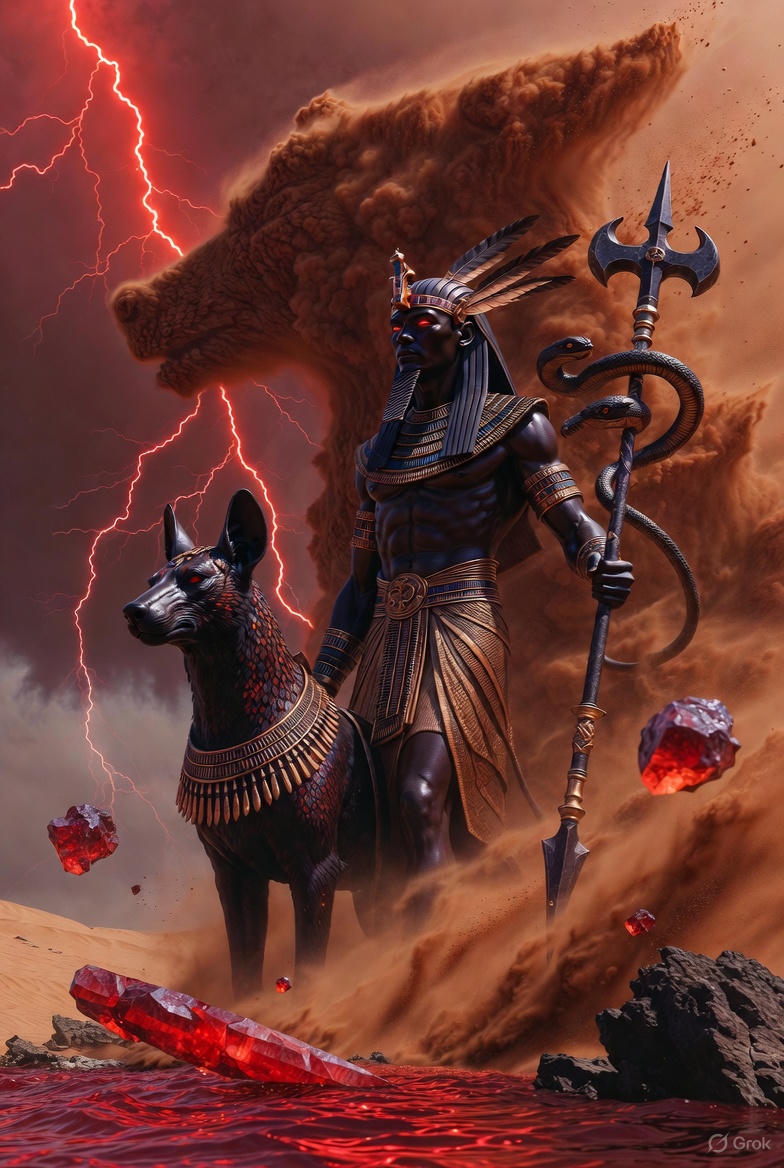
Imagine a colossal figure rising from a sea of blood-red dunes beneath a sky split by violet lightning. His skin is the color of heated bronze kissed by desert fire, shimmering with an inner crimson glow. Towering over ten meters tall, muscular and lean like a predator forged in chaos, his body radiates raw, unfiltered power. The head is the sacred sha in its purest, most terrifying form: the long curved snout descending like a scimitar of obsidian, squared ears sliced flat and tall as temple pylons, eyes burning with molten gold that pierce the soul. His mane explodes outward — wild, shaggy, the deep red of arterial blood whipped by hurricane winds, each strand crackling with static electricity.
In his right hand he wields a thunderbolt spear of black iron, its tip forever dripping molten gold. In his left, a was-scepter entwined with living serpents of shadow. Around his waist hangs a war-kilt of scarlet linen and hyena pelts, and from his belt dangle the broken crowns of conquered chaos — fragments of Apep’s scales, shards of eclipsed suns, the shattered horns of foreign demon-gods. Behind him, the tail of the sha lashes the air like a whip of fire, forked and bristling, carving glowing sigils of storm and upheaval into the sky itself.
Above him the heavens answer their master: a colossal sandstorm spirals upward in the perfect shape of the Set-animal hieroglyph, its eyes twin thunderheads flashing white-hot. Crimson lightning forks endlessly within the storm’s heart, illuminating floating islands of red quartz and the ghostly silhouettes of ancient war-chariots made of bone and bronze. At the center of the maelstrom hangs Ra’s solar barque, tiny and fragile, while Set’s massive spear pierces the endless coils of Apep that encircle it — the serpent’s black blood raining upward into the storm, feeding its fury.
Beneath his feet the desert itself bleeds and lives: dunes shift into the shapes of charging sha-beasts, their arrow-straight tails carving rivers of molten glass. Oasis mirages reveal hidden temples of Nubt, their golden roofs flashing like beacons. In the distance, the Nile bends in fear, its waters momentarily turning red as Set passes.
This is no gentle deity of harvest and rebirth.
This is the god who laughs when the world screams.
The necessary terror.
The beautiful catastrophe.
The crimson thunder that guards creation by threatening to tear it apart.
Bow, or burn.
For the storm has a name — and it is Set. ⚡️

Leave a Reply