Some of the herbal allies mentioned here are shared through affiliate links, meaning I may receive a small blessing of support if you choose to journey with them—always at no extra cost to you.

The Early Diversity of a Christianity: A Religion of Many Faces
When Christianity first emerged in the first century, it was far from the unified religion we recognize today. Small communities of believers were scattered throughout the Mediterranean, each interpreting Jesus’s teachings through different cultural and philosophical lenses. Some remained deeply Jewish in their customs, while others were influenced by Hellenistic mystery traditions that emphasized spiritual rebirth and divine knowledge.
Among these early influences were the Essenes, an ascetic Jewish sect that lived communally near the Dead Sea. They practiced purification rituals, daily meditation, and awaited the arrival of a divine teacher. Many scholars suggest that both Jesus and John the Baptist shared ideas with the Essenes—especially their focus on baptism, inner purity, and mystical union with the Divine. This mystical orientation laid the groundwork for what would later evolve into Gnostic Christianity, a spiritual path rooted in direct experience rather than dogma.
Gnostic Christianity: The Inner Path to Divine Knowledge
Gnosticism (from the Greek gnosis, meaning “knowledge”) represented a deeply mystical and introspective form of early Christianity. To the Gnostics, salvation came not through external authority or blind faith, but through awakening the divine spark within. The material world, they believed, was the imperfect creation of a lower being—the Demiurge—while the true God existed beyond all form and illusion.
Gnostic texts such as The Gospel of Thomas, The Gospel of Mary Magdalene, and The Pistis Sophia reveal a vision of Christ as a spiritual guide teaching self-realization. In The Gospel of Thomas, Jesus declares, “The Kingdom of God is within you and all around you.” This message captures the Gnostic conviction that enlightenment is an inner awakening, not a reward bestowed by church or state.
This inner path stood in stark contrast to what became Orthodox Christianity, which emphasized obedience to established doctrine and the authority of the Church hierarchy. As Gnostic movements spread, Church leaders saw them as a direct challenge to emerging orthodoxy—and moved swiftly to suppress them.

Orthodox Christianity: Order, Unity, and Institutional Power
Orthodox Christianity developed as a response to the chaos of early theological diversity. Seeking to unify believers under one “true” doctrine, early Church Fathers such as Irenaeus and Tertullian worked to define orthodoxy and label competing interpretations as heresy. Orthodoxy emphasized faith in the resurrection, sacraments, and the authority of bishops—values that reinforced structure, unity, and social cohesion.
While this solidified Christianity’s identity, it also came at a cost: mystical, esoteric voices like the Gnostics were silenced, their texts banned or destroyed. For nearly 1,600 years, much of this suppressed wisdom remained buried—until the discovery of the Nag Hammadi Library in 1945, which unearthed dozens of lost Gnostic scriptures and reignited interest in Christianity’s hidden roots.
Constantine and the Roman Transformation of Christianity
The most dramatic turning point in Christian history came in the fourth century with Emperor Constantine the Great. Before his reign, Christians were often persecuted by the Roman Empire. But in 313 CE, Constantine issued the Edict of Milan, granting religious tolerance across the empire. Soon after, he adopted Christianity as his imperial faith—transforming it from a persecuted sect into the empire’s unifying religion.
Constantine’s vision for Christianity was as much political as it was spiritual. He convened the Council of Nicaea in 325 CE to establish official doctrine and settle disputes about the nature of Christ. The resulting Nicene Creed defined Jesus as both fully divine and fully human—a cornerstone of Orthodox belief.
This merging of Church and State created the foundation for Christendom: a unified religious-political order that dominated Europe for over a millennium. Yet it also marked the institutionalization of faith, where spiritual authority shifted from individual revelation to centralized power. What had begun as a mystical movement became an imperial religion—its mysteries replaced by creeds, its prophets replaced by priests.
Martin Luther and the Reformation: The Return to Inner Faith
More than a thousand years later, another revolution reshaped Christianity: the Protestant Reformation. In 1517, Martin Luther, a German monk and theologian, nailed his Ninety-Five Theses to a church door in Wittenberg, denouncing the corruption of the Catholic Church—particularly the sale of indulgences and the claim that salvation required priestly mediation.
Luther’s radical assertion was that faith alone (sola fide) grants salvation, and that every believer has direct access to God through scripture and conscience. In essence, Luther reintroduced a spark of the Gnostic spirit into Christian thought: the idea that divine truth is experienced personally, not dictated by authority.
The Reformation broke the Church’s monopoly on spiritual interpretation, giving rise to countless denominations and eventually to the modern landscape of Christian pluralism. It also laid the foundation for religious freedom, literacy, and the individual conscience—values that continue to shape Western spirituality.
The Enduring Tension Between Orthodoxy and Gnosis
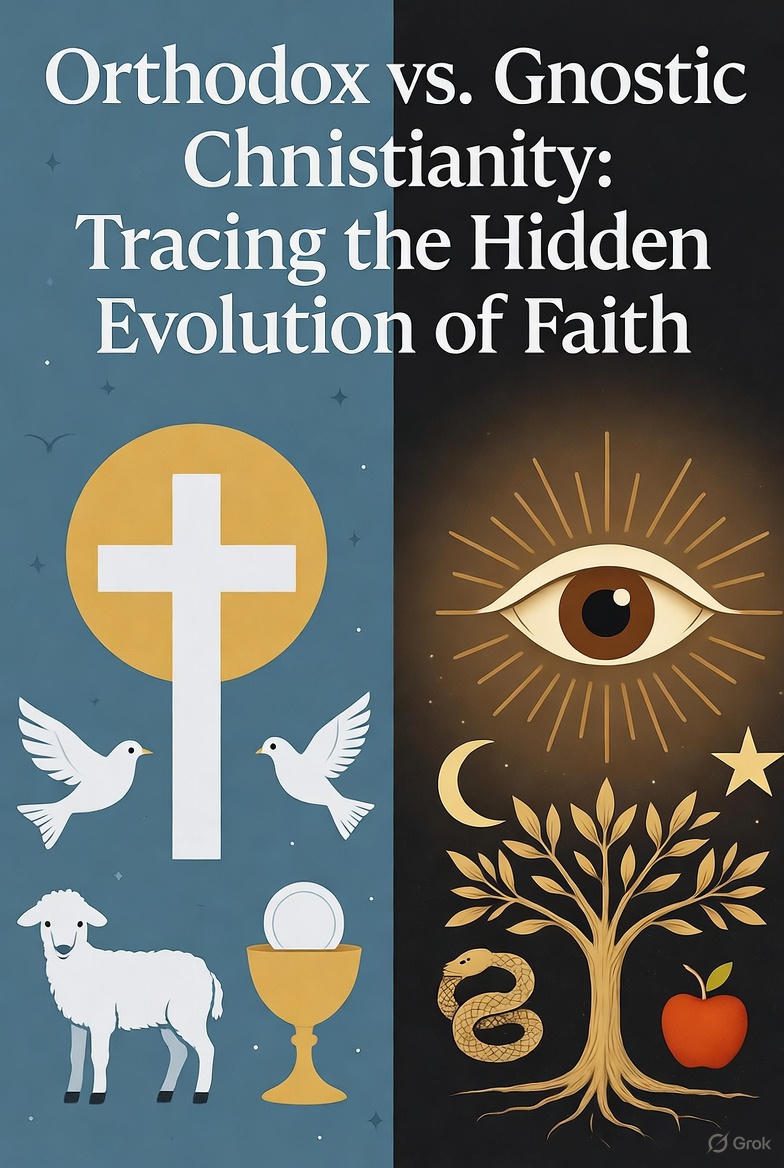
Today, the ancient tension between orthodox and gnostic Christianity still echoes in the modern spiritual landscape. Orthodoxy emphasizes tradition, community, and continuity—anchoring believers in shared ritual and moral order. Gnostic or mystical spirituality, by contrast, calls seekers inward, toward direct communion with the Divine and personal transformation.
Both paths are vital. Orthodoxy preserves structure and sacred heritage; Gnosis keeps the flame of revelation alive. Together, they form the two poles of the Christian mystery—the outer and inner paths to the same ultimate truth.
As we rediscover the lost wisdom of the Essenes, the mysticism of the Gnostics, and the reforming spirit of Martin Luther, we come closer to understanding that Christianity’s true evolution has always been about balancing the authority of the Church with the freedom of the soul. The journey from dogma to direct experience—and back again—is the eternal rhythm of the Christian spirit.

Buy now on Amazon
Leave a Reply