Some of the herbal allies mentioned here are shared through affiliate links, meaning I may receive a small blessing of support if you choose to journey with them—always at no extra cost to you.

Buy now on Amazon
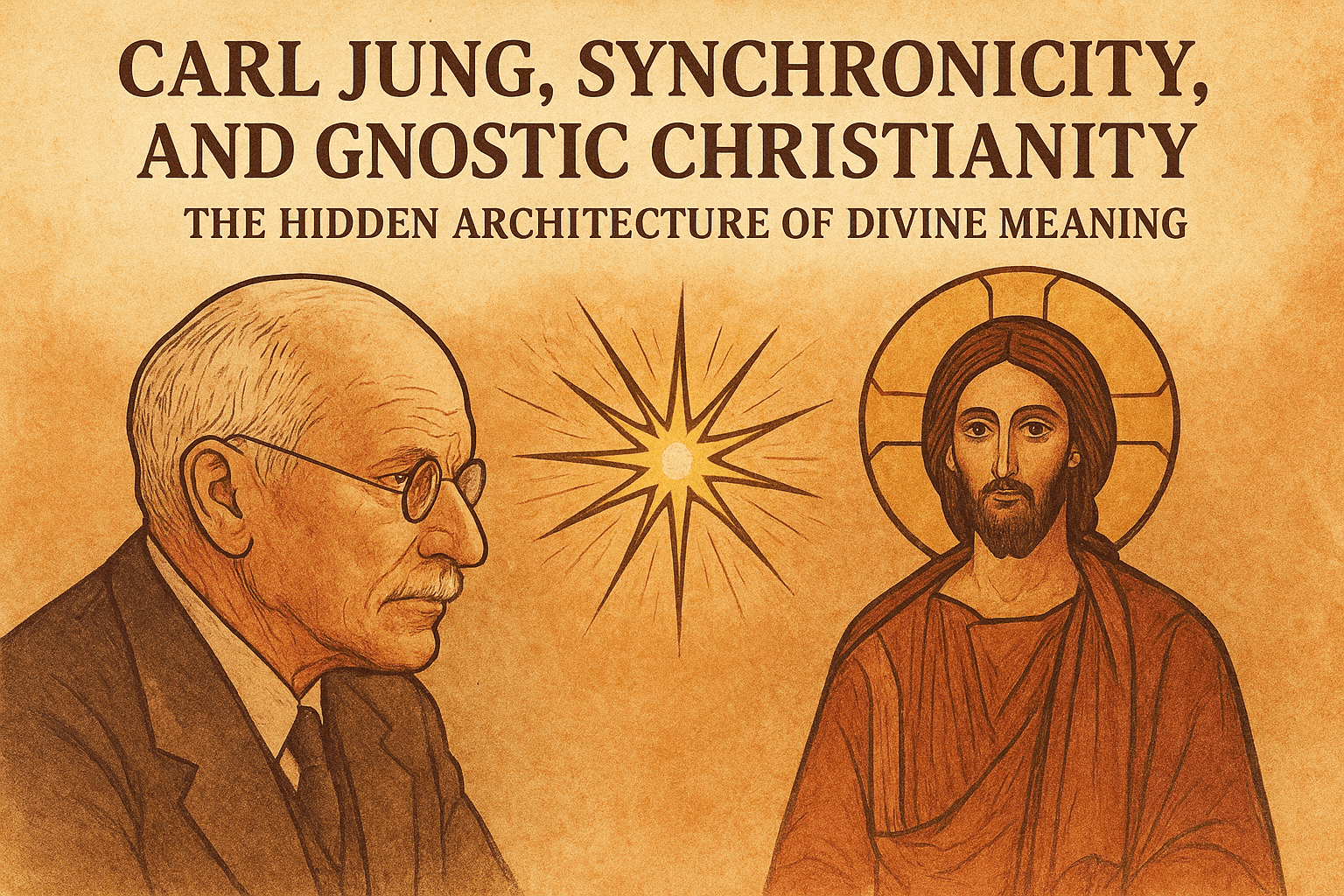
In a world driven by algorithms, logic, and cause-and-effect reasoning, few thinkers dared to suggest that the universe might also be speaking in symbols — that meaning itself could be the true fabric of existence. Yet Carl Gustav Jung, the great depth psychologist and spiritual explorer, did precisely that. His notion of synchronicity — those mysterious coincidences that seem too purposeful to be random — opened a door between psychology and mysticism, between the human mind and the living cosmos. When we encounter synchronicity, Jung taught, we glimpse the secret unity of inner and outer worlds. This is not superstition but revelation: an invitation to rediscover a world infused with divine intelligence, much like the mystical vision held by the early Gnostics who sought direct knowledge (gnosis) of the God within.
Carl Jung stood as a bridge between the modern psyche and the ancient soul. His psychological investigations often transcended the boundaries of science and entered the mystical, revealing dimensions of consciousness that reason alone could never fully illuminate. Among his many profound insights, none perhaps are as mysterious and spiritually resonant as his concept of synchronicity — the principle of meaningful coincidence that defies causal explanation. For Jung, the world was not a random collection of disconnected events, but a living symbol, an ensouled cosmos in which inner and outer realities mirrored one another. When a thought, dream, or emotion within the human psyche coincides with an external event in the world, something beyond logic reveals itself — a whisper from the divine order that underlies existence. Jung’s vision of synchronicity was, in essence, a modern rediscovery of an ancient truth long known to the mystics and the Gnostics: that meaning, not matter, is the true foundation of reality.
To Jung, the psyche was not confined to the individual ego but extended into a vast collective unconscious — a deep reservoir of archetypes, symbols, and primordial patterns shared across humanity. Within this collective domain, myth and matter entwined, revealing themselves through dreams, visions, and the mysterious alignments of fate. Synchronicity occurs when this hidden psychic realm breaks through the veil of ordinary perception and manifests in the outer world as if to say, “Pay attention — the divine is speaking.” Such events might seem improbable or impossible to the rational mind, yet to Jung they were proof that the universe itself is structured by an unseen intelligence — an intelligence that communicates in symbols, much like the God of the Gnostics who reveals truth through visions and mysteries rather than dogma. Jung often reflected that synchronicity was a glimpse into the unus mundus, the “one world” — a unifying realm where spirit and matter, psyche and cosmos, God and creation are but different expressions of the same divine essence.

Gnostic Christianity, the mystical branch of early Christian thought that the orthodox church sought to suppress, offers a deeply resonant parallel to Jung’s worldview. The Gnostics believed that the material world, though real, is not the ultimate truth; it is a symbolic reflection, a shadow of the spiritual fullness known as the Pleroma. Within this cosmology, every human being carries a divine spark — a fragment of the infinite light — trapped within the illusion of material existence. Salvation, for the Gnostic, was not achieved through external rituals or blind faith, but through gnosis: a direct, experiential knowledge of the divine within. Jung saw in this ancient theology a psychological reality — that human beings must awaken from the hypnosis of ego and materialism to rediscover the divine Self hidden within the unconscious. His late work, particularly Answer to Job and Seven Sermons to the Dead, revealed his deep affinity for Gnostic ideas. Jung did not worship a distant God enthroned in heaven, but rather sought to awaken the living God within the human soul, the same God the Gnostics called Christos — the inner light of truth.
When viewed through the lens of Gnostic Christianity, synchronicity becomes more than a psychological curiosity — it becomes a revelation of divine architecture, a sign that the world is woven together by threads of meaning that connect the human and the divine. Each coincidence becomes a sacrament, each alignment of chance a secret Eucharist of spirit and matter. The Gnostic teaching that “as above, so below” finds its living expression in Jung’s synchronicity: the idea that the macrocosm and microcosm move in harmony, not through physical causation, but through spiritual correspondence. The outer event reflects the inner condition, just as the visible universe reflects the invisible mind of God. Thus, when synchronicity occurs, it is as if the veil of the world is momentarily lifted, revealing the face of the eternal hiding behind the ordinary.
Jung’s fascination with alchemy, too, was intimately connected to both synchronicity and Gnosticism. He saw in the alchemical texts not primitive chemistry, but symbolic instructions for inner transformation. The opus alchymicum — the alchemical work — was a sacred metaphor for the process of individuation, the psychological journey toward wholeness and unity with the divine Self. Just as the alchemist sought to transmute base metals into gold, the human soul seeks to transmute the base elements of ego and shadow into the radiant light of consciousness. Along this path, synchronicities serve as signposts from the divine, guiding the seeker toward integration and awakening. The Gnostics called this illumination Sophia’s redemption — the return of divine wisdom to its rightful home in the heart of the awakened human being.
In the modern world, where science often dismisses mystery and religion often silences the inner voice, Jung’s synthesis of psychology and spirituality stands as a beacon for those who seek truth beyond the boundaries of convention. He offered not a religion but a path — one that unites ancient wisdom and modern insight into a single continuum of meaning. To live in awareness of synchronicity is to live in dialogue with the cosmos, to recognize that every encounter, every dream, every seemingly random event may be a coded message from the divine intelligence that pervades all things. It is to live, as the Gnostics did, with eyes open to the hidden order behind the chaos, to the divine spark concealed in every moment.
Jung was not merely a psychologist — he was, in many ways, a modern Gnostic. His quest was not to explain away mystery but to restore it, to awaken humanity to the sacred depth that lies beneath the surface of experience. Through the lens of synchronicity, he taught that the universe is not a machine but a mandala, not a collection of accidents but a living revelation. To perceive synchronicity is to perceive God — not as a distant ruler, but as the very pattern of meaning through which the soul and the cosmos dance together in eternal harmony.
Listening for the Voice of the Cosmos
Jung’s teachings invite us to re-enchant the world, to see in every coincidence and symbol the reflection of divine order. In the heart of synchronicity and the wisdom of Gnostic Christianity, we rediscover that the universe is alive with purpose — that our dreams, intuitions, and inner visions are not illusions, but communications from the divine depth of being. When we learn to listen, life itself becomes scripture, and every moment a revelation.

Buy now on Amazon
Leave a Reply