
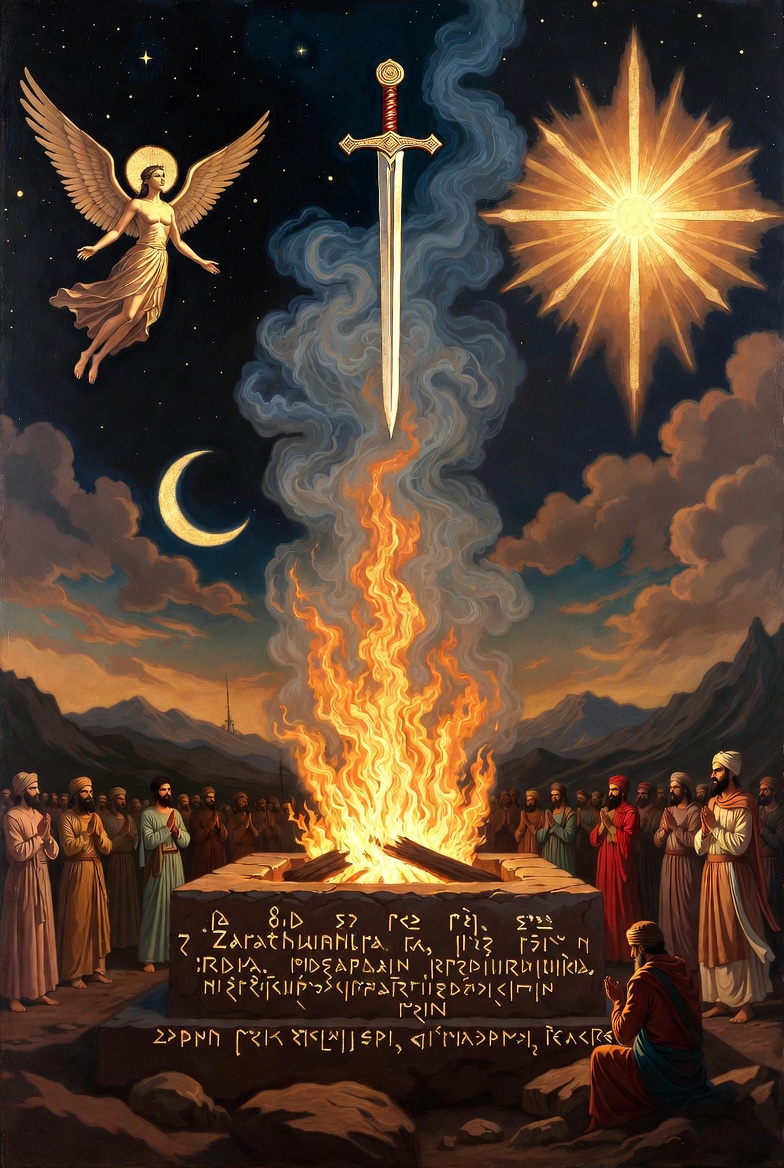
In the vast tapestry of human history, few figures shine as brightly as Zarathushtra, the ancient Iranian prophet whose revolutionary ideas ignited a spiritual fire that continues to burn across millennia. Born in a world shrouded in polytheistic rituals and tribal conflicts, Zarathushtra—also known as Zoroaster in Greek renditions—emerged as a beacon of monotheistic thought, challenging the status quo with a philosophy centered on moral choice, ethical living, and the eternal struggle between good and evil.
His teachings, preserved in the sacred texts of Zoroastrianism, not only founded one of the world’s oldest continuously practiced religions but also profoundly influenced the development of Judaism, Christianity, and Islam, weaving threads of dualism, judgment, and divine justice into the fabric of Western and Middle Eastern spiritual traditions. As we delve into his life and legacy, we uncover a man who was not merely a religious reformer but a visionary poet, a fearless warrior against darkness, and a sage whose words still resonate in our quest for truth and harmony in a chaotic universe. Imagine a time when the steppes of ancient Persia echoed with the chants of forgotten gods, and it was here that Zarathushtra’s voice rose like a clarion call, urging humanity to choose the path of righteousness and illuminate the world with the fire of wisdom.

The Dawn of Enlightenment: Zarathushtra’s Humble Origins in a Turbulent Era
Nestled in the rugged landscapes of northeastern Iran around the 2nd millennium BCE—though scholars debate the exact timeline, placing him anywhere from 1500 to 1000 BCE—Zarathushtra was born into the Spitama clan, a family of priests and warriors in a society dominated by nomadic herders and agrarian communities. From a young age, he exhibited an insatiable curiosity about the cosmos, questioning the polytheistic practices that venerated a pantheon of deities through elaborate sacrifices and rituals, often laced with superstition and fear.
Legends recount that even as a child, Zarathushtra displayed miraculous signs of his destiny, such as surviving attempts on his life orchestrated by jealous rivals or evil spirits, symbolizing the cosmic forces that would later define his theology. 7 Growing up amid the harsh realities of tribal warfare and natural calamities, he witnessed the suffering caused by injustice and moral decay, which fueled his deep introspection and quest for a higher truth.
By his twenties, Zarathushtra had already begun to retreat into solitude, meditating on the nature of existence, the purpose of life, and the role of humanity in the grand scheme of creation. This period of self-reflection laid the groundwork for his profound revelations, transforming a simple priest into a prophet whose message would challenge the very foundations of ancient belief systems and inspire generations to seek purity in thought, word, and deed. His early life, shrouded in myth yet grounded in the cultural milieu of Indo-Iranian traditions, serves as a testament to how personal turmoil can birth universal wisdom, reminding us that great spiritual awakenings often arise from the ashes of doubt and discontent.
Visions from the Divine: The Revelatory Moments That Forged a New Faith
At the age of 30, during a ritual purification by a river—a common practice in his culture—Zarathushtra experienced a life-altering vision that would redefine spirituality for millions. He beheld Ahura Mazda, the Wise Lord, the supreme, uncreated deity embodying truth, order, and goodness, who revealed to him the fundamental dualism of the universe: the eternal conflict between Spenta Mainyu (the holy spirit of creation) and Angra Mainyu (the destructive spirit of chaos and lies). This encounter was not a singular event but a series of divine communications over a decade, during which Zarathushtra communed with Amesha Spentas, the holy immortals representing aspects of Ahura Mazda’s creation, such as good mind, truth, and immortality.
These revelations compelled him to abandon the old gods, denouncing them as daevas or false deities that perpetuated evil, and to proclaim a radical monotheism where humans were active participants in the cosmic battle against darkness. 4 Facing rejection and persecution from his own community, who viewed his ideas as heretical, Zarathushtra wandered for years, preaching to anyone who would listen, until he found a receptive ear in King Vishtaspa of Bactria, whose conversion marked the turning point for Zoroastrianism’s spread. These visionary experiences, rich with poetic imagery of fire as a symbol of divine purity and truth, not only shaped Zarathushtra’s personal mission but also introduced concepts like free will, where individuals must choose between asha (truth) and druj (falsehood), influencing ethical frameworks that echo in modern philosophies and religions alike.

Hymns of the Soul: The Gathas and Zarathushtra’s Poetic Legacy
At the heart of Zarathushtra’s teachings lie the Gathas, seventeen profound hymns composed in Old Avestan, a language akin to Vedic Sanskrit, which he personally authored as direct dialogues with Ahura Mazda. These verses, forming the core of the Avesta—the holy scripture of Zoroastrianism—are not mere religious texts but philosophical masterpieces that blend poetry, ethics, and theology, urging followers to cultivate humata (good thoughts), hukhta (good words), and hvarshta (good deeds) as the pathway to spiritual enlightenment. In the Gathas, Zarathushtra articulates a vision of the world as a moral arena where every action contributes to the renovation of existence, culminating in a final judgment at the Chinvat Bridge, where souls are weighed based on their choices, leading to paradise or perdition—a concept that prefigures similar ideas in Abrahamic faiths.
His emphasis on environmental stewardship, equality between men and women in spiritual matters, and the sanctity of fire, water, and earth as elements of creation reflects a holistic worldview that harmonizes human life with the natural order. Through these hymns, Zarathushtra not only critiques the ritualistic excesses of his time but also offers a blueprint for personal and societal transformation, inspiring rituals like the Yasna ceremony where fire symbolizes divine presence. The poetic depth of the Gathas, with their rhythmic invocations and profound questions about existence, continues to captivate scholars and devotees, proving that Zarathushtra was as much a bard of the spirit as a prophet, whose words transcend time to challenge us to live with integrity and purpose.
Warrior of Light: Overcoming Adversity and Spreading the Sacred Fire
Zarathushtra’s path was fraught with peril, as he battled not only ideological opponents but also literal foes in the form of Turanian raiders and corrupt priests who clung to the old ways. After years of wandering and facing mockery, his breakthrough came with the patronage of King Vishtaspa, whose court became the epicenter for Zoroastrianism’s growth, leading to holy wars where the forces of truth triumphed over those of deceit. Legends speak of miraculous events, such as Zarathushtra healing the king’s horse or debating and defeating rival sages, which solidified his status as a divine messenger. 3 He married and had children, integrating family life into his teachings, emphasizing that spirituality encompasses all aspects of existence, from daily labors to communal harmony.
As Zoroastrianism spread across the Achaemenid Empire under rulers like Cyrus the Great, who may have been influenced by its principles of justice and tolerance, Zarathushtra’s ideas permeated vast territories, from India to the Mediterranean. Even in death—traditionally at age 77, slain by an enemy during prayer—his spirit endured, with fire temples erected in his honor, where eternal flames symbolize the unquenchable light of truth. This era of expansion highlights Zarathushtra’s resilience, transforming a solitary visionary into the architect of an empire-spanning faith that promoted peace, prosperity, and moral accountability.
Echoes Through Eternity: Zarathushtra’s Profound Influence on Global Spirituality
Zarathushtra’s legacy extends far beyond the confines of ancient Persia, casting a luminous shadow over the evolution of world religions and philosophies that followed. His concepts of a singular benevolent god, the afterlife judgment, and the messianic figure of the Saoshyant—who will usher in a final renovation of the world—found parallels in Jewish eschatology during the Babylonian exile, likely transmitted through Persian rule. 2 Christianity and Islam inherited elements like angels, demons, heaven, and hell, while his ethical triad inspired moral codes in various cultures, from Manichaeism to modern humanism.
Today, though Zoroastrianism’s adherents number only around 100,000-200,000, primarily Parsis in India and Iran, its principles live on in global dialogues on ecology, ethics, and interfaith harmony, with fire temples still flickering as reminders of Zarathushtra’s vision. 6 In an age of division, his call for unity through good actions offers a timeless antidote, proving that the flame he kindled continues to guide humanity toward a brighter, more just future.

The Wise Lord: Exploring the Eternal Essence of Ahura Mazda in Zoroastrian Lore
In the ancient spiritual landscape of Zoroastrianism, Ahura Mazda stands as the supreme deity, a transcendent force embodying wisdom, creation, and unyielding goodness that has captivated seekers of truth for millennia. Revered as the “Wise Lord” or “Lord of Wisdom,” Ahura Mazda is not merely a god among gods but the uncreated creator, the architect of the universe who brought forth all that is good and orderly from the void of chaos. His name, derived from Old Avestan roots meaning “lord” (ahura) and “wisdom” (mazda), encapsulates a divine intelligence that permeates existence, guiding humanity toward righteousness and away from the shadows of deceit.
As the central figure revealed to the prophet Zarathushtra through profound visions, Ahura Mazda represents the pinnacle of monotheistic thought in one of the world’s oldest religions, influencing subsequent faiths with concepts of moral dualism, divine justice, and eternal light. Far from an anthropomorphic ruler, he is an abstract yet personal entity, invoked in prayers and rituals as the source of life, truth (asha), and the eternal flame that symbolizes purity and enlightenment. In a world rife with uncertainty, Ahura Mazda’s teachings remind us of the power of choice, where every individual contributes to the cosmic battle between creation and destruction, fostering a legacy that endures in modern philosophical and religious discourses.
Origins of the Divine: Tracing Ahura Mazda’s Roots in Ancient Indo-Iranian Traditions
The genesis of Ahura Mazda can be traced back to the proto-Indo-Iranian religious milieu, where early concepts of divine beings evolved into the sophisticated theology proclaimed by Zarathushtra around the second millennium BCE. Unlike the polytheistic pantheons of neighboring cultures, Ahura Mazda emerged as a singular, supreme entity in Zoroastrianism, embodying the sky and heavens while transcending physical form to represent ultimate wisdom and benevolence. Historical texts, such as the Avesta, depict him as the uncreated god who fashioned the world through his holy spirit, Spenta Mainyu, creating the material realm as a stage for moral struggle against Angra Mainyu, the destructive adversary.
In the Gathas, Zarathushtra’s hymns, Ahura Mazda is portrayed as all-knowing and all-good, the father of the Amesha Spentas—immortal holy beings like Vohu Manah (good mind) and Asha Vahishta (best truth)—who assist in governing creation and aiding humanity’s path to perfection. This divine framework, rooted in ancient Iranian nomadic societies, reflects a shift from ritualistic worship to ethical monotheism, where Ahura Mazda’s essence is invoked not through idols but through fire, the purest element symbolizing his eternal presence.
Variations like the Zurvanite heresy later posited Ahura Mazda as one of twin spirits born from time (Zurvan), but orthodox Zoroastrianism upholds him as the eternal, self-existent lord, unchallenged in his sovereignty over the cosmos. Through empires like the Achaemenid, where kings such as Darius I inscribed praises to Ahura Mazda on monumental reliefs, his influence spread, blending with local beliefs while maintaining his core identity as the wise creator who demands justice and compassion from his followers.
Attributes of the All-Wise: The Multifaceted Nature of Ahura Mazda’s Divinity
Ahura Mazda’s attributes paint a portrait of a deity who is infinitely wise, omnipotent, and benevolent, serving as the moral compass for Zoroastrian adherents in their daily lives and spiritual pursuits. He is the epitome of asha, the cosmic order and truth that sustains the universe, opposing druj, the lie that breeds chaos and evil.
As the creator of everything good, Ahura Mazda fashioned the heavens, earth, waters, plants, animals, and humans, endowing them with free will to choose between righteousness and wrongdoing, thus making each person a co-creator in the ongoing renovation of the world. His omniscience allows him to foresee all outcomes, yet he respects human agency, intervening through divine grace (khvarenah) bestowed upon the righteous.
In Zoroastrian cosmology, Ahura Mazda is associated with light and fire, elements that represent purity and divine revelation, as seen in the eternal flames tended in fire temples where prayers like the Yasna are offered to honor him. Unlike wrathful gods of other traditions, his benevolence extends to all creation, promoting equality, environmental stewardship, and social justice, with teachings that emphasize good thoughts, words, and deeds as the means to align with his will. Even in later interpretations, such as those in the Pahlavi texts, Ahura Mazda—often shortened to Ohrmazd—remains the unassailable force of good, destined to triumph in the final eschatological battle, ushering in an era of eternal peace and immortality for the faithful.
The Cosmic Role: Ahura Mazda in the Eternal Struggle and Human Destiny
At the core of Zoroastrian doctrine lies Ahura Mazda’s pivotal role in the dualistic framework of existence, where he leads the forces of light against the encroaching darkness, shaping the destiny of both the cosmos and individual souls. As the head of the manifested universe, he created the world in stages, beginning with the spiritual realm (menog) and culminating in the material (getig), all to trap and ultimately defeat Angra Mainyu’s malevolence.
Humanity, as Ahura Mazda’s allies, is tasked with actively participating in this battle through ethical living, with the promise of judgment at the Chinvat Bridge, where souls are weighed and led to paradise (garodmana) or punishment based on their alignment with his principles.
His divine plan culminates in the Frashokereti, the “making wonderful,” where evil is eradicated, the dead are resurrected, and the world is renewed in perfection under his eternal rule. In royal inscriptions of Persian kings, Ahura Mazda is credited with granting kingship and victory, underscoring his role as protector of order and justice in worldly affairs.

Leave a Reply