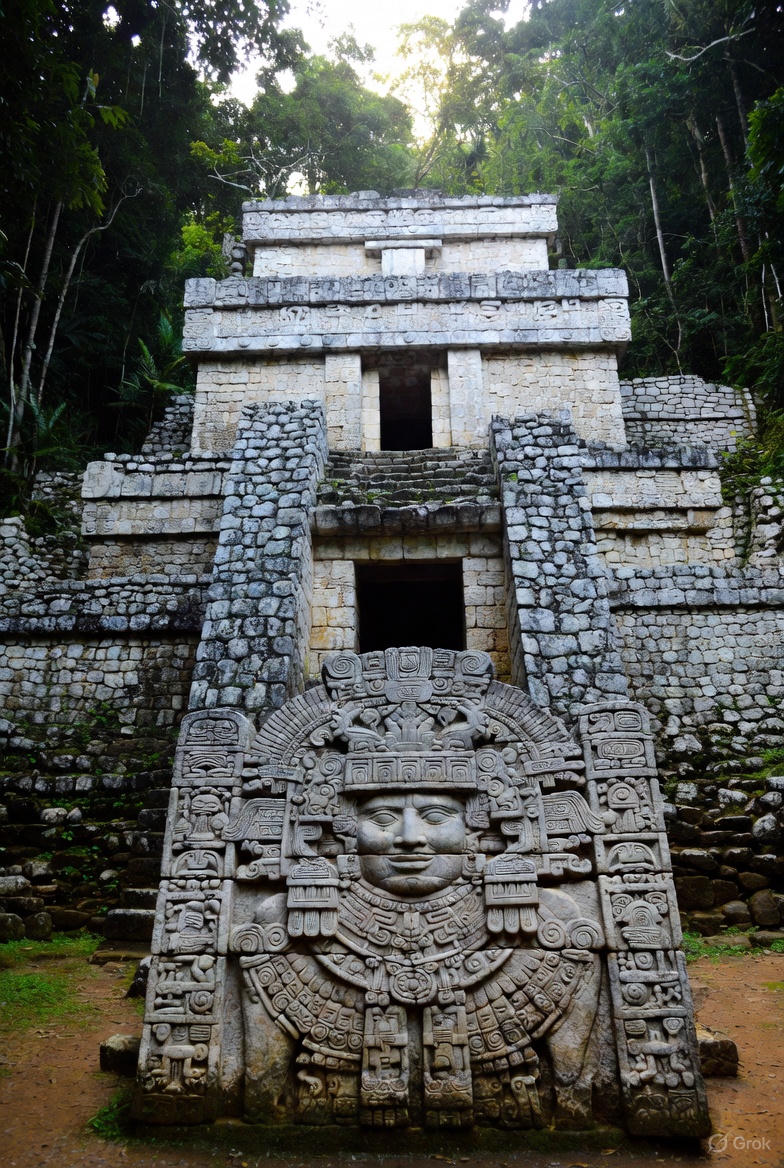
In the sweltering jungle of Chiapas, Mexico, stands the Temple of the Inscriptions—a pyramid that looks like a green mountain wearing a stone crown. For centuries it guarded one of the greatest secrets of pre-Columbian America: the sarcophagus of K’inich Janaab’ Pakal, the king the Maya called “Pacal the Great.” When archaeologist Alberto Ruz Lhuillier finally breached the tomb in 1952, after four years of clearing rubble from a hidden staircase, he found something that would ignite both scholarly wonder and wild speculation for generations: a magnificent jade-clad ruler beneath a lid carved with what many now believe is the single most sophisticated astronomical diagram ever made by the ancient Maya.
Pacal ruled the city-state of Palenque from 615 to 683 CE—longer than any other known Mayan king. He came to the throne at age 12 and died at 80, an almost biblical lifespan for the 7th century. His tomb lid, a 5-ton slab of limestone, shows him seemingly falling into the jaws of a monster, surrounded by celestial symbols. For years, fringe writers insisted this was proof he was an extraterrestrial astronaut piloting a rocket ship. The truth, once deciphered, is far more astonishing: Pacal was depicting his death and rebirth in perfect alignment with the cycles of the cosmos, using astronomy so precise that it still staggers modern scientists.

The Lid: A Star Map in Stone
Let’s look closely at the famous carving.
At the center, Pacal reclines on the mask of the Earth Monster (or perhaps the Maize God’s rebirth throne). Above him rises the great World Tree—a cross-shaped ceiba that the Maya saw connecting the underworld, earth, and sky. Perched at its apex is the Celestial Bird (Itzam-Ye), often identified with the constellation we call the Big Dipper or, more intriguingly, the three bright stars in Orion’s belt framing the Orion Nebula.
But here’s where it gets mind-bending.
Modern astronomers and Mayanists (notably Linda Schele, David Freidel, and later John Major Jenkins) have shown that the entire scene is an exact snapshot of the sky on the winter solstice as it appeared from Palenque around the time of Pacal’s death. The World Tree aligns with the Milky Way in its upright “tree” position that occurs only around the December solstice. The “jaws” Pacal falls into are the Dark Rift in the Milky Way—the Mayan “Black Road” or xibalbe, the entrance to the underworld. Even the double-headed serpent bar he holds corresponds to the ecliptic crossing the Milky Way near Sagittarius and Scorpio.
In other words, Pacal didn’t just commission a pretty tomb lid. He turned his own sarcophagus into a working astronomical instrument that told initiates exactly when and where he was reborn among the stars.
The Telektonon Prophecy and the Return of Pacal Votan
Pacal’s posthumous career is almost as remarkable as his earthly one.
The Maya believed certain kings became ahauob—solar lords—who continued to influence events after death. Pacal claimed direct descent from the primordial First Mother and First Father, and his name glyphs include the shield (pacal) and the rare “Votan” title, linking him to a mysterious culture-hero remembered in highland Maya traditions as the bringer of writing, calendar science, and the sacred ballgame.
Centuries after Palenque fell into ruin, Chilam Balam books from Yucatán still spoke of “the return of Pacal Votan” in the final katun of the Great Cycle. This prophecy caught the attention of José Argüelles (Valum Votan), the controversial New Age scholar who in the 1980s–90s popularized the idea that the end of the 13-baktun Long Count on December 21, 2012, marked not the end of the world but the return of Pacal’s wisdom in a new form. Argüelles claimed to have received a modern revelation called the Telektonon (“Prophecy of the Talking Stone”), supposedly channeled from Pacal himself through the numbers encoded in his temple.
Whether you accept Argüelles’ mystical interpretation or not, the mathematics are uncanny. Pacal’s accession date (9.9.2.4.8, 5 Lamat 1 Mol) plus exactly 1,260 years (a sacred Venus–Earth cycle number) lands precisely on July 26, the start of the Mayan “New Fire” year that Argüelles used as the anchor for his Dreamspell calendar. Skeptics call it coincidence. Mayan daykeepers call it destiny.
Palenque: Observatory of the Western Hemisphere
Pacal didn’t just understand the sky—he built his entire city to observe it.
The Temple of the Cross complex at Palenque contains three shrines whose doorways, when sighted across the plaza, mark the September equinox sunrise and the extreme rising points of Venus. The famous Tower—an astronomical observatory unique in the Maya world—has windows aligned to the solstices and to the heliacal rising of Canopus, the second-brightest star in the night sky, which the Maya associated with the underworld god Seven Macaw from the Popol Vuh.
Even the layout of Pacal’s palace encodes star positions. Recent LiDAR surveys reveal that Palenque’s architects oriented the entire site to the setting of the Pleiades on the zenith passage date—a moment of zero shadow at noon that the Maya used as a cosmic clock.
Legacy: From Jade Mask to Galactic Synchronization
When you stand in the misty ruins of Palenque today, you can still feel it: this wasn’t just a city. It was a machine for talking to the stars.
Pacal the Great—shield of the sun, heir of Votan—left us a message carved in stone 1,300 years ago: time is not linear, death is not final, and human beings can participate consciously in the great turning of galactic seasons.
Whether the 2012 date marked a true “shift of ages” or simply the turning of another page in the Long Count, one thing is certain: every 52 years, when the Calendar Round resets; every 1,872,000 days when the great cycle completes; every time Venus rises as morning star after inferior conjunction—the spirit of Pacal Votan is still watching from the center of the Milky Way, waiting for those with eyes to see.
And if you visit Palenque on the December solstice, stand quietly before the Temple of the Inscriptions at dusk. Look up. The same Milky Way World Tree that swallowed Pacal thirteen centuries ago will rise again, exactly as he planned, reminding us that some kings never really die. They just become constellations.
You are invited to the Illuminarium Mystica vaults!
Packed with esoteric business for entrepreneurs, Kundalini and growing your electromagnetism. These sacred books are for anyone looking to enhance their knowledge of the arcane but there is practical knowledge for everyone!

Leave a Reply