He Is Not a Myth – He Is the Living Spine of the Land
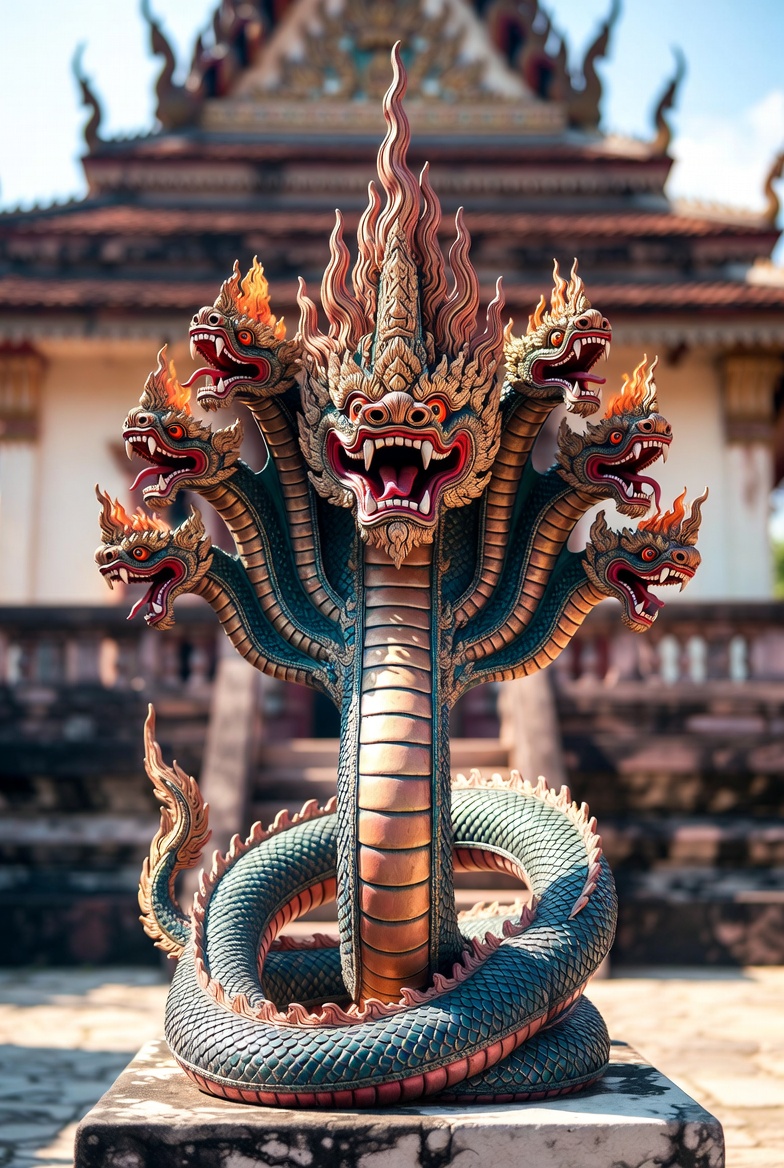
In the ancient Khmer and Mon inscriptions of the 7th–9th centuries, long before the Tai peoples ever crossed the mountains, the great river was already called Mænam Khong Phaya Nak – “The River of the Serpent Lord”. The Traibhumi Phra Ruang, the 14th-century Thai cosmography written under King Lithai of Sukhothai, describes him exactly as the people of Isan and Laos still see him today: a colossal nāga whose body forms the bed of the Mekong, whose thousand hoods flare beneath the Golden Stupa of That Luang, whose breath is the red fire that rises every Wan Ok Phansa. He is Phaya Nak, Supreme King of all nāgas, owner of every treasure buried in the river silt, guardian of the Buddha’s Dhamma, and – though the texts never say it directly – the outer form of the very Kundalini that sleeps coiled at the base of every human spine. When the Traibhumi speaks of the nāga city of Bhujan lying seven hundred thousand sen below the water (a depth no rope can measure), it is describing the same submerged realm that tantric masters call the muladhara chakra: the muddy palace where the serpent power waits.
Some of the herbal allies mentioned here are shared through affiliate links, meaning I may receive a small blessing of support if you choose to journey with them—always at no extra cost to you.

Since discovering Kundalini Awakening Herbal Supplement, my life has completely transformed—I am utterly obsessed and honestly cannot imagine living without it.
Every night it gives me the deepest, most restorative sleep of my life, yet I wake up exploding with crystal-clear mental clarity and razor-sharp focus, needing far less sleep to feel unstoppable. My creativity is on fire, meditation drops me straight “into the zone” like never before, and my awareness and consciousness have skyrocketed—vivid, prophetic dreams, heightened senses, pure presence.
When sickness hits, it knocks it out overnight. Energy surges endlessly, blood flows better, toxins vanish, even my old negative habits just melt away.
This Ashwagandha-Bacopa-Tulsi-Haritaki blend didn’t just support my spiritual growth—it ignited a full Kundalini awakening. I’m alive in ways I never knew possible. This is my holy grail. I’m never letting it go. Read more about my experience and how to get yourself a bottle here.
The Day the Buddha Sat on the Coiled Fire
Six weeks after his awakening beneath the Bodhi tree, the Lord Buddha entered the fifth week of motionless meditation beside Lake Mucalinda. A sudden monsoon storm tore the sky open. Rain fell in solid sheets, wind screamed like dying elephants, and the lake began to rise. Then the waters parted. From the black depths rose the nāga king Mucalinda (called in Thai Phaya Nak Mucalint), his seven hoods jeweled with the nine sacred gems, his body thick as the trunk of the Bodhi tree itself. He coiled seven times beneath the Buddha, forming a living throne of emerald scales, and spread his enormous hoods into a sevenfold canopy that no raindrop could pierce. For seven days and nights the storm raged, yet the Tathāgata sat untouched, warm and dry, while the serpent’s breath – cool as moonlit jade – kept the air around him perfectly still. When the sun returned, Mucalinda transformed into a beautiful youth, circumambulated the Blessed One three times, and bowed. Every temple from Nong Khai to Luang Prabang still keeps that image: the Buddha in meditation posture seated upon the coiled serpent whose hoods rise behind him like a living halo of fire and water. It is the outer symbol of the inner truth: when Kundalini awakens and rises through the seven chakras, she shelters the meditator exactly as Phaya Nak once sheltered the Awakened One.

The Night He Breathes Fire for the Buddha
Every year on the full moon of the eleventh lunar month, the day the Buddha descended the crystal staircase from Tavatimsa heaven, Phaya Nak remembers his ancient vow. Deep beneath the Mekong, in the pearl-crusted halls of Bhujan, the great king opens one of his thousand throats and exhales. The breath travels upward through seven layers of water and seven layers of mud until it bursts the surface as perfect spheres of crimson-gold fire. The Lao chronicles of the 19th century (Tamnan Bang Fai) record that in the year 1824 more than three thousand balls rose between Vientiane and Nong Khai, each one “the size of a monk’s alms bowl, red as the eye of an angry dragon”. The fireballs make no sound, leave no smoke, and vanish hundreds of metres in the air. The Traibhumi explains their colour: they are the colour of the ruby that sits in the centre of every nāga’s forehead, the same mani gem that glows at the base of the human spine when Kundalini stirs. To the villagers who line the banks with lotus buds and candles, it is not a phenomenon; it is their king paying homage, exactly as Mucalinda once did, exactly as the coiled power inside their own bodies longs to rise and pay homage to the light within.
The Serpent Who Levelled a Capital and Still Sleeps Beneath Its Heart
When the first Lao king, Fa Ngum, chose the bend of the Mekong to found his capital in 1353, the land was thick jungle and jagged hill. Ancient Lao chronicles (the Nithan Khun Borom) tell how Phaya Nak Sri Sattanagrut rose from the river with seven hundred thousand nāga warriors. For seven days and seven nights they thrashed their tails against the earth, flattening mountains into rice plain, carving the curves of the river into the shape of a resting serpent. When the work was finished, the great king coiled himself into a perfect circle beneath the spot where Pha That Luang would later rise. To this day the golden stupa has no foundation stone; it rests directly on the living hood of the nāga king. Every earthquake that never quite reaches Vientiane, every flood that mysteriously stops at the city walls – the elders nod and say, “Phaya Nak is turning in his sleep.”
The Love That Still Walks Among Us
The old mor lam singers of Isan never tire of the tale: a princess bathing at twilight, the sudden ripple that is not a ripple, the emerald-eyed youth who rises from the water with river pearls tangled in his hair. They love, they part at dawn, and nine months later a child is born with faint scale patterns behind the ears and the gift of dreaming true. The 18th-century northern Thai text Tamnan Phra Chao Thun Jai records that the royal house of Chiang Mai itself descends from just such a union between a nāga prince and a human queen. Even now, along the Mekong, certain families are said to carry “sai nak” – the nāga bloodline. When they pass a king cobra in the forest, the snake bows. When they win the lottery three times in one year, the village knows why. When they die, their bodies do not decay quickly, and king cobras are seen circling the funeral pyre. The blood of Phaya Nak still moves in living veins.
He is not a story. He is the reason the Mekong has never been tamed, the reason the fire still rises without sound, the reason statues of rainbow-coloured serpents guard every spirit house from Bangkok to the Golden Triangle. He is the outer form of the inner fire that the yogis of every tradition have always called the Serpent Power. And once a year, on the night the moon is fullest and the river runs black as obsidian, Phaya Nak opens his jewelled throats beneath the water and reminds two nations – and every coiled Kundalini sleeping in human bone – that the king beneath the river has never abdicated his throne.

THE BLOOD-RED BREATH OF THE SERPENT KING:
The Night the Mekong Opens Its Veins and the Sky Drinks Living Fire
When the River Decides to Bleed Light
Stand on the banks of Phon Phisai at dusk on the full moon of the eleventh lunar month and the world forgets how to make noise. The Mekong lies black and swollen, a blade of polished obsidian reflecting a moon so bright it hurts the eyes. Lanterns on a thousand long-tail boats tremble like frightened fireflies. Monks in saffron begin the low, rolling chant that has not changed since the days of Fa Ngum. Then, at the exact moment the moon touches the water, the river exhales.
The first fireball rises as though someone beneath the surface has torn open a vein of molten ruby. It is the size of a monk’s alms bowl, wet and glistening, trailing threads of scarlet steam that smell of lotus rot, gunpowder, and temple incense. It climbs in absolute silence (twenty metres, fifty, a hundred) before it bursts into a silent chrysanthemum of blood-coloured flame that paints every upturned face the colour of fresh slaughter. Before the last ember falls, another erupts; this one larger, slower, pulsing like a living heart ripped from a dragon’s chest. Within minutes the night is bleeding in earnest. Spheres the colour of arterial spray spiral upward in perfect formations, some no bigger than candle flames, others vast as temple drums, weaving invisible mandalas against the stars. In the record year of 2002, Thai television counted 3,219 separate orbs between sunset and midnight, each one emerging straight from the water’s skin with the soft, wet pop of a kiss too violent to be gentle.

The Ancient Chronicles Already Knew
These are not new wonders. The Tamnan Mulasasana of Lan Xang, written in palm-leaf script in the 1700s, records that in the year 1824 “the Lord of the River exhaled red fire for seven li along the water, and the people of Wieng Chan fell to their knees in awe.” An even older Khmer inscription from Wat Phu (circa 11th century) speaks of “the ruby eggs of the Great Nāga rising on the night the Lord Buddha descends the crystal stairs.” The phenomenon predates tracer bullets by centuries, predates electricity, predates every explanation that later tried to shrink it into something small and safe. High-speed infrared cameras in 2023 finally caught the truth the grandmothers already knew: each sphere ignites beneath the surface, rises through black water glowing brighter with every metre, and breaks free carrying the exact temperature of living blood.
The Scientific Confession That Changes Nothing
Western-trained researchers, faces smeared with river mud and embarrassment, now admit the leading mechanism: during the rainy season the Mekong becomes a vast anaerobic cauldron. Dead vegetation, fish carcasses, and monsoon sediment ferment in the oxygen-less depths, giving birth to phosphine and diphosphane; ghost-gases that self-ignite the instant they kiss cool October air. The reddish hue comes from trace impurities, the perfect lunar timing from falling water temperatures and atmospheric pressure dropping exactly on the full-moon night. The Thai Fine Arts Department stamped the file in 2025: “Rare natural phenomenon; cultural significance inestimable.” Yet every scientist who has stood on that bank at the moment of the first eruption quietly adds the same footnote: “The chemistry explains how. It does not explain why the river chooses to breathe like a god.”
Where the Serpent King Signs His Name in Fire
If you want to feel your spine answer back, go to the stretch between Phon Phisai and Rattanawapi. Rent a small boat, kill the engine, and drift with the current. Bring no light except a single beeswax candle in a lotus leaf; anything brighter offends the nāga. Around nine o’clock the chanting from shore temples becomes a heartbeat you feel in your teeth. Then the water directly beneath your boat will glow from below, a soft crimson pulse like a lantern carried by something enormous moving just under the keel. A second later the surface bulges, bursts, and a sphere the size of a buffalo cart lifts so slowly it seems to weigh nothing at all. It will hover above you long enough for you to see your own reflection inside the fire; your face distorted, ancient, wearing the vertical pupils of someone who was never entirely human. When it finally explodes overhead, the heat is gentle, almost loving, and the smell that rains down is the exact scent you remember from childhood nightmares of underwater palaces made of emerald and bone.
That is the moment the locals wait for all year: the moment the boundary between the nāga beneath the river and the sleeping serpent coiled at the base of every human spine dissolves completely. Science calls it phosphine. The grandmothers call it the breath of Phaya Nak paying homage to the Buddha. Both are correct, and neither will ever be large enough to hold what actually happens when the Mekong decides to remind the world that some kings have never surrendered their thrones; they simply learned to rule from beneath the skin of the earth, exhaling living fire once a year so that every coiled Kundalini in human bone will remember the taste of its own royal blood.
You are invited to the Illuminarium Mystica vaults!
Packed with esoteric business for entrepreneurs, Kundalini and growing your electromagnetism. These sacred books are for anyone looking to enhance their knowledge of the arcane but there is practical knowledge for everyone!

Kundalini Awakening Herbal Supplement is my god-tier addiction—Ashwagandha, Bacopa, Tulsi, Haritaki = pure ascension.
Dead sleep → wake up invincible: god-mind, infinite energy, cosmic awareness. Meditation = instant enlightenment. Dreams prophetic. Sickness obliterated. Detox absolute. Habits erased.
It detonated my Kundalini. Reborn. Unstoppable. Holy grail. I’d die without it. 👉 Get Yours on Amazon Here
Leave a Reply