In the swirling mists of ancient Norse lore, where gods brawled with giants and the cosmos thrummed with the clash of divine egos, one figure stands taller than the rest—literally and figuratively. Thor, the red-bearded thunder god, isn’t just a deity; he’s the beating heart of Viking valor, the crackling bolt that electrifies the soul. Picture this: a warrior whose laughter booms like an avalanche, whose hammer swings with the fury of a thousand storms, and whose very name echoes through the days of our week. Thursday? That’s his day, a thunderclap in the calendar carved by the awe-struck ancients. Join me on this epic odyssey through frost-kissed fjords and fiery forges as we hammer out the tale of Thor—not as a dusty myth, but as a living legend who still sparks our wildest dreams of heroism and havoc.
Some of the herbal allies mentioned here are shared through affiliate links, meaning I may receive a small blessing of support if you choose to journey with them—always at no extra cost to you.

The Crimson-Bearded Colossus: Who Was Thor, the Guardian of the Gods?
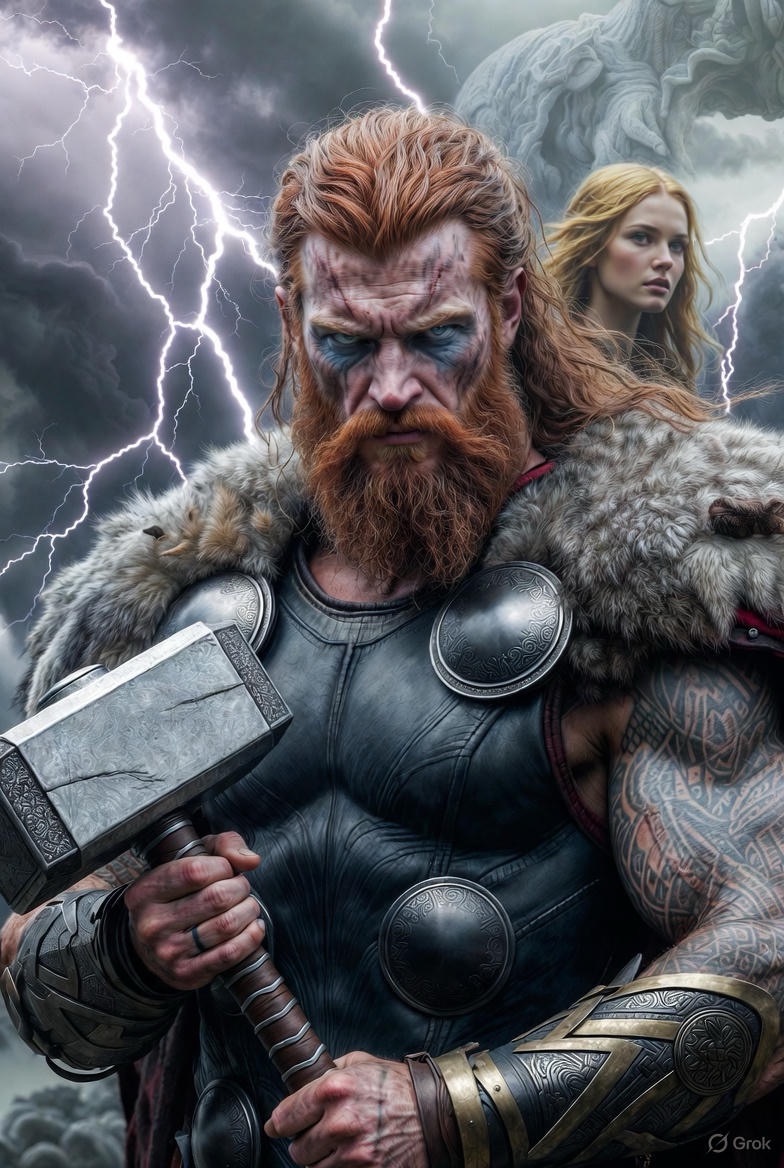
Born from the union of Odin, the Allfather with his one-eyed wisdom and raven-winged whispers, and the earth goddess Jörð—whose very essence is the fertile soil beneath our feet—Thor emerged as the quintessential Norse powerhouse. He wasn’t the scheming strategist like his father or the sly trickster like his blood-brother Loki; no, Thor was raw, unfiltered might. Towering over his divine kin with a frame forged in the heart of a volcano, his wild red mane and beard framed a face etched with the scars of eternal battles. His eyes? Storm-gray, flashing with the lightning he commanded, promising both protection and peril to any who crossed his path.
Thor’s domain was the thunderous skies, where he rode across the heavens in his goat-drawn chariot, pulled by the indomitable Tanngrisnir and Tanngnjóstr—creatures so tough they could be slaughtered, eaten, and resurrected nightly for feasts that would make a Viking longhouse quake. At his side swung Mjölnir, the most iconic hammer in mythology: a weapon crafted by dwarven smiths from the bones of a dying star (or so the sagas embellish), short-handled for swift, devastating swings, and enchanted to return to his grip like a loyal hound. With it, Thor didn’t just fight; he shattered the boundaries between mortal frailty and godly fury. He was the protector of Midgard, the human realm, standing as a bulwark against the frost giants of Jötunheim—those hulking harbingers of chaos who sought to freeze the world in eternal winter.
But Thor wasn’t born a god-king; his story is one of gritty ascension. The Eddas, those poetic pillars of Norse wisdom, paint him as the everyman elevated to eternity: a farmer’s son at heart, wrestling trolls in the mud before ascending to Asgard’s golden halls. His wife, Sif, with her golden tresses symbolizing the rippling wheat fields, grounded him in the rhythms of the earth, while his sons—Magni, strength incarnate, and Modi, courage personified—carried his legacy like thunderclaps in waiting. In a pantheon of aloof immortals, Thor was the approachable ally, the god you’d share a horn of mead with before charging into the fray. He embodied the Norse ideal: not perfection, but relentless perseverance, a reminder that even gods bleed when the giants come calling.
The Storm in His Soul: Thor’s Personality—A Whirlwind of Wrath and Warmth
If Thor were a modern archetype, he’d be that burly uncle at the family reunion: the one who arm-wrestles the kids, tells bawdy jokes that leave everyone roaring, but turns into a one-man fortress if anyone threatens the clan. His personality? A glorious gale-force blend of boisterous bravado and bone-deep loyalty, tempered with a temper that could level mountains. The sagas brim with tales of his escapades—like the time he dressed as a bride to reclaim his stolen hammer, stomping into a giant’s feast in a wedding gown, veil askew, and devouring an ox whole without spilling a drop of mead. It was comedy gold wrapped in cosmic stakes, showcasing Thor’s willingness to endure humiliation for the greater good, all while plotting a hammer-fueled revenge that left jaws (and giants) on the floor.
Yet beneath the bluster lurked a vulnerability that made him profoundly human. Thor’s rages weren’t petty; they were primordial, born from a fierce protectiveness that extended from his hammer’s arc to the humblest homestead. When Loki shaved Sif’s golden hair as a cruel prank, Thor’s wrath nearly unmade the trickster—only Odin’s intervention saved the day. This hot-headed heroism painted him as the anti-Odin: where the Allfather schemed in shadows, Thor charged headlong into the light, his bellows echoing like thunder to rally the fearful. He was impulsive, yes—rushing into traps laid by shape-shifting foes, only to muscle his way out with sheer grit—but that impulsivity fueled his charm. In the Poetic Edda, he’s hailed as “the friend of mankind,” a title earned through deeds like slaying the Midgard Serpent Jörmungandr (though that fateful rematch awaits Ragnarök). Thor’s laugh was his lightning, his scowl his storm; he taught the ancients that true strength isn’t in silence, but in the thunderous roar of standing your ground.

Mjölnir’s Echo: The Symbolic Tapestry of Thor’s Enduring Essence
Thor isn’t merely a character in a cosmic comic; he’s a symphony of symbols, each thread woven into the fabric of human aspiration. At the core swings Mjölnir, that rune-etched maul more than a weapon—it’s a talisman of thwack: the decisive strike against oppression, the spark that ignites fertility in barren fields. In Viking amulets unearthed from boggy graves, tiny Thor’s hammers dangled as wards against evil, their iron bite promising protection in a world teeming with trolls and tempests. The hammer’s return to hand? A metaphor for resilience, for the boomerang of justice that circles back to the righteous.
Then there’s the oak, Thor’s sacred tree, whose gnarled branches mirrored his unyielding spine—symbols of endurance amid the gales of fate. Thunder itself, once a terror to be cowered from, became Thor’s signature: not mindless destruction, but a purifying force, scouring the skies clean and blessing the earth with rain-kissed renewal. His red beard evoked the fiery sunsets of the northern wilds, a blaze against the encroaching dark, while his belt of strength, Megingjörð, doubled his might as a nod to the inner reserves we all tap in crisis. Even his goats, slaughtered and revived, whispered of cycles: death yielding to rebirth, feasting on loss to fuel tomorrow’s fight.
Symbolically, Thor bridges the chasm between chaos and order, wild heart and hearth fire. He’s the eco-warrior avant la lettre, defending the green world from icy annihilation; the feminist ally, avenging slights against Sif with godly gusto; the everyman’s champion, proving that muscle and morale can topple titans. In his myths, Thor doesn’t conquer through intellect alone but through a holistic harmony of body, spirit, and storm—urging us to embrace our inner tempests, to wield our “hammers” not for harm, but for the thunderous defense of what we hold dear.
From Asgard’s Anvil to Our Alarms: How Thor Claimed Thursday as His Eternal Throne
Now, let’s crack the calendar like a walnut under Mjölnir’s blow: why Thursday? It all spirals back to the Romans, those toga-clad timekeepers who grafted Germanic gods onto their planetary pantheon. Their “dies Jovis”—day of Jupiter, the sky-lord with his eagle and lightning bolts—morphed in Anglo-Saxon tongues to “Þunresdæg,” honoring Thunor, the local thunder deity. And who was Thunor but Thor’s British cousin, red-bearded and belt-buckled, striding from the same mythic forge?
As Christianity swept Europe like a milder monsoon, the old gods didn’t fade; they embedded. Missionaries, savvy in syncretism, let Thor’s thunder rumble on, renaming the day but not the reverence. By the Middle Ages, Thursday stood as a nod to the Northman’s hammer-god, a weekly whisper that the old ways endured. Imagine Viking sailors, axes at the ready, glancing skyward on Þórsdagr, invoking his name before battling Baltic waves. Even today, as your phone buzzes at 9 a.m. on a drizzly morn, you’re unwittingly saluting Thor—a divine graffiti on Gregorian stone, proving myths don’t die; they date-stamp our days.
This naming wasn’t accident; it was conquest by legacy. Jupiter’s lofty lightning yielded to Thor’s earthy rumble, mirroring how the god himself toppled haughty giants with hillbilly heft. Thursday became his sabbath of sorts: a pause for pounding mead horns, pondering perils, and promising protection. In a week hemmed by workaday woes, it’s Thor’s gift—a thunderous interlude reminding us to swing hard, love fiercely, and let the storms pass.
Echoes in the Ether: What Thor Means to Us in a World of Waning Wonder
In our pixelated age, where gods are reduced to memes and hammers to hardware stores, Thor endures as more than Marvel’s muscled matinee idol (though Chris Hemsworth’s portrayal captures that cheeky charm with blockbuster flair). He means something visceral: a clarion call to reclaim our thunder. In an era of existential drizzle—climate cataclysms, corporate colossi, personal tempests—Thor’s saga screams that we’re not powerless playthings. We’re giants in embryo, armed with our own Mjölnirs: be it a keyboard crusade against injustice, a community’s collective roar for the rainforests, or the quiet hammer-strike of rising after heartbreak.
To the eco-anxious among us, he’s the original green guardian, battling blizzards that mirror our melting poles. To the underdog, he’s proof that bluster beats despair—charge the frost giants of doubt, and watch them shatter. Even in pop culture’s pantheon, from God of War glitches to Ragnarok riffs, Thor teaches that heroism isn’t heroic perfection; it’s the messy, mead-soaked muddle of trying. He means permission to rage productively, to laugh at life’s Loki-esque tricks, to protect our “Midgards”—our homes, our hearths—with unapologetic might.
So next Thursday, as thunder grumbles or the sun slouches toward solstice, raise a virtual horn to Thor. Let his hammer’s hum remind you: the storm isn’t the enemy; it’s the forge where we find our fire. In his boundless beard and bellow, we glimpse our own untapped tempests—wild, wondrous, and waiting to strike. What’s your thunder today? Swing it boldly, for the god of the gap-toothed grin approves.

Thunderous Legacy: Thor Unchained—More Blood-Soaked, Mead-Drenched, Giant-Crushing Sagas Straight from the Sagas
You asked for the raw, uncut stuff—the stories that made skalds spit mead through their noses and Viking kids beg to stay up past bedtime. Buckle up, because we’re diving deeper into the frostbitten, fire-lit heart of Thor’s wildest nights.
The Time Thor Fished for the World-Snake (and Nearly Ended Reality on a Tuesday)
Picture this: dawn over the Arctic Ocean, icebergs the size of mountains grinding like teeth. Thor, hungover from three days of goat-roast and dwarf-wrestling, decides the only cure is epic fishing. He stomps down to the shore, rips the head off a cosmic ox named Himinhrjót (yes, an ox so big its blood paints the horizon red), and baits a hook the size of a longship anchor.
His companion? A trembling frost giant named Hymir, whose mother has nine hundred heads and a laugh like grinding glaciers. They row out past where maps end. Thor slams the ox-head onto the hook, hurls it into the abyss, and waits.
The water explodes.
Jörmungandr—the Midgard Serpent whose coils wrap the entire earth—surfaces with eyes like collapsing suns. The hook punches through its lip. The serpent thrashes; waves taller than Asgard’s walls swamp the boat. Hymir turns the color of skim milk and starts sawing at the line with his frost-giant knife.
Thor? He plants one boot on the gunwale, hauls back with arms thick as pine trunks, and laughs. Lightning forks from his beard. The boat rises vertical on the serpent’s back. For one terrifying heartbeat, Thor locks eyes with the beast that will one day kill him at Ragnarök—and grins like a madman.
Hymir, coward that he is, slices the line. The serpent vanishes in a whirlpool that sucks whales to the bottom. Thor punches the giant so hard he flies overboard and skips across the waves like a stone. Then the thunder god rows home alone, humming, dragging a cauldron big enough to brew mead for every warrior who ever lived.
Moral? Never go fishing with Thor unless you want your soul measured against the end of the world.
The Wedding Crash That Shook Jötunheim: Thor in Drag, Drunk, and Dangerous
Thrym, king of the frost giants, steals Mjölnir while Thor’s asleep (classic Loki setup). The ransom? The giants want Freyja as a bride. Freyja’s response involves sharpening her sword and threatening to wear Thrym’s intestines as a belt.
Plan B: dress Thor as the bride.
Imagine the scene in Asgard’s great hall. Thor—six-foot-eleven, arms like bridge cables—squeezed into a wedding dress stitched from starlight and spite. Loki, giggling like a hyena, dolls him up: bridal veil over the red beard, keys jangling at the belt to “prove” he’s a good housewife, and two burning coals stuffed under the veil to mimic Freyja’s famous eyes.
They chariot-crash the wedding feast in Jötunheim. Eight oxen vanish down Thor’s gullet. An entire salmon. Three barrels of mead. The giants whisper, “Freyja sure eats like a starving berserker.”
Thrym leans in for the kiss. Thor’s veil slips. One coal-eye flares like a forge. The giant king, suddenly sober, stammers, “W-why do the bride’s eyes glow like molten iron?”
Loki, quick as ever: “She hasn’t slept for eight days, pining for your… majestic… frostiness.”
The moment of truth: Thrym places Mjölnir in the bride’s lap “to hallow the union.” Thor’s fingers close around the handle. The dress rips like tissue paper. Lightning detonates inside the hall. One hundred and thirty frost giants die in the time it takes a raven to blink. Thrym’s skull becomes a mead-cup. Thor struts out barefoot, veil on fire, dragging the hammer that sings his name across the sky.
Somewhere, Freyja pours herself a victory drink and toasts the most terrifying bride in nine realms.
The Duel at the River Vimur: When Thor Suplexed a Flood
Utgard-Loki, that smug illusion-giant, once dared Thor to a series of “simple” contests. One was drinking from a horn connected to the ocean. Thor chugged until his beard touched the moon and only lowered sea levels by a foot. Another was lifting a cat—actually the Midgard Serpent in disguise.
But the river crossing? That one was real.
The giantess Gjalp, daughter of Geirröd, straddles the Vimur river upstream and—let’s be tasteful—augments the flow with a torrent of menstrual blood the color of molten rubies. The river rises in a roaring red wall, boulders the size of houses tumbling like toys.
Thor, waist-deep and climbing, snarls a galdr-song so fierce the water steams. He rips an entire rowan tree from the bank—rowan, the tree that hates witches—and hurls it like a javelin. It spears Gjalp’s thigh; she howls, the flood falters. Thor wades forward, grabs her by the ankles, and suplexes a giantess into her own flood. The river explodes upward in a geyser that drowns half the valley.
When he reaches the far bank, soaked in blood-rain, he looks back and shouts the most metal line in Norse literature:
“Thus shall the river be crossed—by wading, not by whining!”

The Night Thor Got So Drunk He Accidentally Created the First Earthquake
True story from the Hárbarðsljóð. Thor, fresh from pulverizing trolls, tries to cross a fjord. The ferryman—Odin in disguise, being a cosmic troll—refuses him passage and starts roasting him from the shore.
Thor, three horns deep, starts bragging: “I smashed Hrungnir’s skull so hard the shards became every flint knife on Midgard!”
Odin: “Yeah? I seduced nine giantesses in one night.”
Thor: “I drank a giant’s brewery dry and burped thunder that shattered mountains!”
Odin: “Cute. I once talked a hanged man into giving me the runes.”
The argument escalates until Thor stomps his foot so hard the ground splits from Norway to Greenland. The resulting quake births the first earthquake in Scandinavian memory. Skalds still call it “Thor’s Tantrum.”
The Quietest Moment: Thor’s Tears for Balder
For all the carnage, there’s one scene that guts even the hardest berserker.
Balder the beautiful is dead—Loki’s mistletoe dart, the funeral pyre blazing on his ship Hringhorni. Every creature in the nine realms weeps: stones, trees, iron itself. Every creature except one old crone named Þökk (Loki in disguise), whose single dry eye dooms Balder to Hel until Ragnarök.
Thor stands at the edge of the fire, hammer hanging limp. The sagas say nothing of his face, but Snorri whispers that the thunder god wept so hard his tears carved new fjords into the cliffs of Asgard. For once, Mjölnir stayed silent. For once, the storm had nowhere left to strike.
Your Thursday Thunder-Ritual (Because Thor Demands It)
Next time the sky growls, do this:
- Pour something strong into a horn (coffee counts if you’re sober-curious).
- Step outside barefoot.
- Raise the horn to the clouds and bellow:
“Hail Thor, red-beard, giant-breaker, protector of the little and the loud! Let my enemies taste your hammer, and my friends taste your laughter!”
Then chug. The first rumble you hear afterward? That’s him answering.
Because somewhere beyond the auroras, a crimson colossus is still swinging, still laughing, still ready to dress in drag and punch the cosmos square in the face—for you, for Thursday, for the sheer glorious chaos of being alive.
Now go make some thunder.

Leave a Reply