Some of the herbal allies mentioned here are shared through affiliate links, meaning I may receive a small blessing of support if you choose to journey with them—always at no extra cost to you.

Some of the herbal allies mentioned here are shared through affiliate links, meaning I may receive a small blessing of support if you choose to journey with them—always at no extra cost to you.
In the tapestry of human spirituality, few figures shimmer as brightly or as mysteriously as Mary, the mother of Jesus—often revered as the Virgin Mary or Mother Mary. From humble beginnings in ancient Nazareth to her exalted status in art, theology, and mysticism, Mary transcends mere historical personage. She embodies the divine feminine, a bridge between heaven and earth, inspiring devotion, debate, and profound introspection.
Whether you’re drawn to her as a symbol of maternal love or a key to hidden esoteric knowledge, Mary’s story unfolds layers of meaning that have evolved through orthodox traditions, symbolic art, gnostic texts, and occult interpretations. Join me on this fascinating journey as we explore her multifaceted legacy, drawing on ancient texts, saintly wisdom, and artistic masterpieces.

Orthodox Beliefs: The Theotokos and Ever-Virgin Exemplar
In Eastern Orthodox Christianity, Mary holds a place of unparalleled honor, not as a deity to be worshipped, but as the Theotokos—literally, the “Bearer of God.” 46 This title, affirmed at the Third Ecumenical Council in Ephesus, underscores her pivotal role in the Incarnation: by giving birth to Jesus, who is fully God and fully human, Mary becomes the vessel through which divinity enters the world. 18 Orthodox believers venerate her as the highest of saints, higher than any angelic host or human ever lived, yet emphasize that she is not divine herself—worship is reserved for God alone. 23
Central to Orthodox views is Mary’s ever-virginity: she conceived Jesus virginally, gave birth while remaining a virgin, and lived her life in perpetual chastity. 21 This belief, rooted in biblical interpretations and early Church Fathers, portrays her as a model of purity and obedience. Unlike Roman Catholic doctrines such as the Immaculate Conception (which posits Mary was born without original sin), Orthodoxy teaches that Mary, as a human, could have sinned but chose not to, through her free will and divine grace. 22 She exemplifies theosis—the process of becoming Christ-like—serving as an image for believers to spiritually “give birth” to Christ in their hearts. 18
Saints have eloquently captured this devotion. St. Maximilian Kolbe proclaimed, “Jesus honored her before all ages, and will honor her for all ages. No one comes to Him, nor even near Him, no one is saved or sanctified, if he too will not honor her.” 48 Similarly, St. Louis de Montfort wrote, “The Son of God became man for our salvation but only in Mary and through Mary.” 48 These quotes highlight Mary’s intercessory role, where she nurtures faith like a mother, guiding souls toward salvation without eclipsing Christ’s centrality.

Symbolic Interpretations: Layers of Meaning in Art and Iconography
Beyond doctrine, Mary blooms as a rich symbol in Christian art, her depictions laden with metaphors that speak to purity, suffering, and divine grace. In medieval and Renaissance works, her blue cloak often symbolizes the heavens and eternity, representing her purity and protective mantle over humanity. 5 The fleur-de-lys, resembling both the iris and lily, evokes her immaculate conception and queenly virtues. 2 1
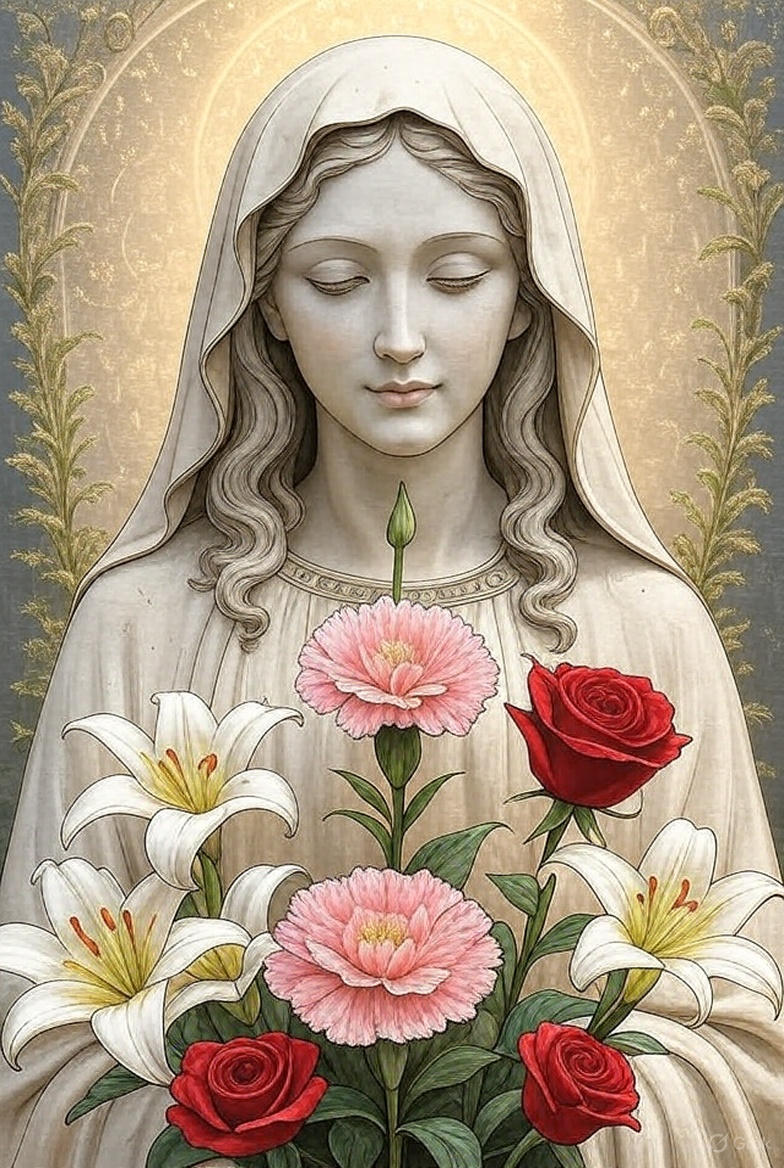
Key attributes include the lily for chastity (often three to denote her triple virginity: before, during, and after birth), the rose for Christ’s sacrificial blood, and the carnation sprouting from her tears, symbolizing purest love. 47 More poignant is the heart pierced by seven daggers, illustrating her seven sorrows—from the prophecy of Simeon to witnessing the Crucifixion—embodying maternal anguish and compassion. 0 The crescent moon under her feet signifies triumph over darkness, while a crown of twelve stars alludes to eternal perfection and her apocalyptic role as the “woman clothed with the sun.” 47
These symbols transform Mary into a universal archetype: a beacon of hope for the oppressed, a model of feminine authority turned patriarchal tool in some critiques, 4 and a figure of maternal sacrifice. As one art historian notes, her imagery often portrays her as “the ultimate role model for Christian women, emphasizing modesty, hope, love, and sacrifice.” 3

Gnostic Beliefs: Mary as the Vessel of Spiritual Knowledge
Venturing into the shadowy realms of Gnosticism—early Christian sects emphasizing secret knowledge (gnosis) for salvation—Mary’s role shifts from physical mother to a profound spiritual symbol. Gnostics often prioritized her as the embodiment of divine wisdom, where her virgin birth represents not a biological miracle but the impregnation by the Holy Spirit as a metaphor for gnosis itself: the direct infusion of spiritual insight leading to enlightenment. 51
In texts like the Gospel of the Nativity of Mary, an apocryphal work with Gnostic undertones, Mary’s life is marked by angelic interventions and miraculous purity. Born to Joachim and Anna after years of barrenness, she is consecrated to the temple, vows perpetual virginity, and conceives Jesus through the Holy Spirit’s overshadowing—remaining untouched by “heats of lust.” 50 This narrative underscores themes of divine election and incorruptibility, aligning with Gnostic views of the soul’s ascent beyond material corruption. 17
Some Gnostics viewed Mary as the “spiritual mother” of Christ, facilitating rebirth through inner knowledge rather than flesh. 9 Parallels to Tantric traditions amplify this: just as wisdom (female principle) unites with compassion (male) for enlightenment, Mary’s role enables the “virgin birth” of divine awareness in the seeker. 51 As one Gnostic interpreter posits, “The symbolic, metaphorical elements of Mother Mary are the fact that she is virgin and impregnated by the Holy Spirit: this just is, gnosis!” 10 This esoteric lens challenges orthodox literalism, portraying Mary as a key to hidden truths. 2

Esoteric and Occult Ideas: The Divine Feminine Unveiled
In esoteric and occult traditions, Mary transcends Christian boundaries, merging with ancient goddesses like Isis or Cybele, symbolizing the Great Mother and eternal fertility. 32 Occultists see her as the “Matriarch of Christian Magic,” a priestess wielding “womb mysteries”—ancient secrets allowing conscious conception of divine beings. 29 Her virginity isn’t mere abstinence but a deliberate celibacy for spiritual power, enabling her to birth Jesus as an empowered act. 49
In some views, Mary’s immaculate conception links to a lineage of holy women, from Sarah to Elizabeth, who cultivated divine birth to aid humanity. 33 Esoteric Islam (via Ismaili interpretations) sees her virginity as a metaphor for spiritual purity, untouched by worldly “devils.” 30 Even in modern occultism, she’s revered as the Divine Mother, matrix of possibilities, with her blue flame representing receptive soul-love. 31
St. Bonaventure’s words resonate here: “Men do not fear a powerful hostile army as the powers of hell fear the name and protection of Mary.” 48 This fear, some occult sources suggest, stems from her role in countering dark forces, making her a potent ally in magical practices. 36 3

A Timeless Enigma
Mary’s allure lies in her adaptability: a comforting mother in orthodoxy, a layered symbol in art, a gnostic gateway to knowledge, and an esoteric powerhouse. As St. Therese of Lisieux said, “In trial or difficulty, I have recourse to Mother Mary, whose glance alone is enough to dissipate every fear.” 48 Whether through devotion or mysticism, she invites us to ponder the divine feminine’s enduring power. What secrets might she whisper to you?
Delving Deeper into the Gnostic Depths: The Virgin Mary Unveiled in Ancient Texts
In our previous exploration of Mother Mary, we touched on Gnostic whispers—now, let’s plunge into the shadowy codices of Nag Hammadi and the luminous dialogues of Pistis Sophia. These 2nd-4th century treasures, unearthed in Egypt, reveal Mary not as an untouchable icon, but as a material vessel, a symbol of defiant purity, and a wise interpreter of cosmic mysteries. Far from orthodox reverence, Gnostics cast her virginity as a metaphor for gnosis—the spark of divine knowledge impregnating the soul, untainted by the archons (cosmic tyrants) of the flawed material world. 51 50
Prepare to witness Mary through primary quotes, esoteric layers, and fragile papyrus visions. 2 ”” “LARGE”
Gospel of Philip: The Undefiled Virgin and the Triple Mary
From Nag Hammadi Codex II, the Gospel of Philip shatters orthodox virgin birth dogma: “Some said, ‘Mary conceived by the Holy Spirit.’ They are in error… Mary is the virgin whom no power defiled. She is a great anathema to the Hebrews.” 51 Here, Mary’s womb isn’t “impregnated” by Spirit (a feminine force, absurdly), but remains incorruptible, repelling the defiling “powers” (archons). Her purity mocks materialist Hebrews/apostles, embodying spiritual impregnation by gnosis.
Even more tantalizing: “There were three who always walked with the Lord: Mary, his mother, and her sister, and Magdalene… His sister and his mother and his companion were each a Mary.” The Triple Mary—mother (virgin vessel), sister (familial bond), companion (Magdalene’s intimacy)—fuses into a divine feminine triad, mirroring Gnostic syzygies (male-female pairs). Christ rectifies Adam’s fall: “Adam came into being from two virgins… Christ therefore, was born from a virgin.” Esoterically, Mary’s virginity signals cosmic restoration: spirit over flesh.
This text elevates Magdalene too—Jesus kisses her, granting inner sight—but Mother Mary anchors the incarnation’s paradox. 38
Testimony of Truth: The World’s Virgin Mother
A starker Nag Hammadi view in the Testimony of Truth: “John was begotten by the World through a woman, Elizabeth; and Christ was begotten by the world through a virgin, Mary.” 50 “World” (kosmos) means the demiurge’s realm—Yaldabaoth’s prison. Mary’s womb, though virgin, births Christ via material channels, a “mystery” to transcend via spiritual rebirth: “Were we also begotten from a virginal state…? Rather, we have been born again by the word.”
Gnostic edge: Honor the vessel, but seek beyond—physical virginity pales against soul-virginity.

Pistis Sophia: Mary the Interpreter, Mother of Matter
This crown jewel—Jesus’ 11-year post-resurrection seminars—stars Mary the Mother as star pupil. In Chapter 59, she deciphers Pistis Sophia’s (Fallen Wisdom’s) hymn via Solomon’s Odes: “The Lord is on my head as a wreath… Thy fruits are full and perfect.” Jesus exalts: “They shall proclaim thee blessed… the pledge of the First Mystery hath taken up its abode with thee.” 48
Chapter 61’s gem: Mary recounts binding a spirit twin of child Jesus—“I seized him and bound him… Ye became one.” She unpacks Psalm 85: “Grace and truth met… Truth sprouted forth out of the earth”—her womb births “truth” (Jesus’ body), while “grace” is the descending spirit. Jesus affirms: “Mary, my mother according to matter, thou in whom I have sojourned.” 53
Role? Material mother, yet gnosis-bearer—she inherits the Light-Kingdom, rivaling Magdalene’s questions. Pistis Sophia herself (divine archetype) mirrors Mary’s trials: fall, repentance, redemption. 8

Esoteric Synthesis: Mary’s Gnostic Secret
Gnostics demote Mary to “mother according to matter”—vital for incarnation, but Sophia/Pistis is the eternal Mother, birthing aeons (and accidentally, the demiurge). Virginity = gnosis: Holy Spirit (Breath-Wisdom) sparks inner virgin birth, freeing the soul from archonic chains. As one interpreter notes: “The symbolic… elements of Mother Mary… just is, gnosis!” 1
Modern echo: Mary’s “anathema” to powers inspires occultists—invoke her for purity rites, womb-magic against entities.
These texts aren’t anti-Mary; they’re pro-transcendence. Dive in: Read Philip for poetry, Pistis for dialogue. What mysteries will she birth in you?
Further Reading: Gnosis.org Nag Hammadi | Pistis Sophia Full
Blessed be the undefiled seeker. 🌟

Leave a Reply