Some of the herbal allies mentioned here are shared through affiliate links, meaning I may receive a small blessing of support if you choose to journey with them—always at no extra cost to you.

The Rosicrucian Order, a mystical and esoteric tradition, has captivated seekers of spiritual truth for centuries. Emerging in the early 17th century with the publication of enigmatic manifestos, the Rosicrucians weave together threads of Gnosticism, Christianity, Egyptian mysticism, pagan traditions, and Hermetic principles into a unique spiritual philosophy. This blend fosters self-awareness, balance, and the development of mind, body, and soul, creating communities dedicated to illumination and service. Below, we explore the Rosicrucian Order’s origins, its syncretic beliefs, the significance of initiation, the Eye of Providence, and the concept of the “hidden Christ within.”

Origins and Historical Context
The Rosicrucian Order first came to public attention with the publication of three manifestos in Europe between 1614 and 1616: Fama Fraternitatis, Confessio Fraternitatis, and The Chymical Wedding of Christian Rosenkreutz. These texts, attributed to the mysterious figure Christian Rosenkreutz, described a secret brotherhood dedicated to spiritual reform, universal knowledge, and the betterment of humanity. While the historical existence of Rosenkreutz is debated, scholars suggest the manifestos were likely written by a group of intellectuals, possibly including Johann Valentin Andreae, during a time of religious and political turmoil in Europe (Yates, 1972).
The Rosicrucians drew heavily from Renaissance esoteric traditions, blending Christian mysticism with Hermeticism, Kabbalah, and alchemical symbolism. Their teachings resonated with those seeking a deeper, more personal connection to the divine, beyond the rigid dogmas of the Catholic and Protestant churches. The Order’s elusive nature—claiming to operate in secrecy while inviting seekers to join—added to its allure, sparking curiosity across Europe.
A Syncretic Tapestry: Blending Traditions
The Rosicrucian philosophy is a vibrant mosaic, integrating diverse spiritual traditions into a cohesive framework. At its core, it emphasizes the pursuit of gnosis—direct, experiential knowledge of the divine—while harmonizing seemingly disparate beliefs.
- Gnosticism: Rosicrucians share the Gnostic emphasis on inner enlightenment and the belief that divine wisdom resides within each individual. Like Gnostics, they view the material world as a realm of illusion, with the true self (the soul) seeking liberation through knowledge and spiritual practice. This aligns with the Gnostic concept of the “divine spark,” which Rosicrucians interpret as the “hidden Christ within,” a latent spiritual essence that can be awakened through study and meditation.
- Christianity: While rooted in Christian mysticism, Rosicrucianism reinterprets traditional Christian doctrines. The figure of Christ is central, not as a distant savior but as an inner archetype of divine consciousness. Rosicrucians see Jesus as a master initiate who exemplified the path to illumination, encouraging followers to cultivate their own Christ-like qualities of compassion, wisdom, and service (Heindel, 1909).
- Egyptian Mysticism: The Rosicrucians draw heavily from ancient Egyptian spirituality, particularly the Hermetic tradition attributed to Hermes Trismegistus. Egyptian concepts of Ma’at (cosmic balance) and the pursuit of immortality through spiritual transformation resonate in Rosicrucian teachings. The Order’s use of symbols like the ankh and the pyramid reflects this influence, connecting the soul’s journey to ancient wisdom.
- Pagan Traditions and Astrology: Pagan elements, such as astrology and nature-based spirituality, are integral to Rosicrucian practice. Astrology, rooted in the belief that celestial movements influence human destiny, is used as a tool for self-awareness and understanding cosmic cycles. Rosicrucians view the stars and planets as reflections of divine order, aligning their spiritual practices with planetary rhythms to harmonize mind, body, and soul (AMORC, 2025).
- Zoroastrianism and Illumination: The influence of Zoroastrianism, with its dualistic cosmology of light and darkness, appears in the Rosicrucian emphasis on illumination—the triumph of spiritual light over ignorance. The concept of the soul’s journey toward divine unity echoes Zoroastrian teachings about the eternal struggle between good and evil, culminating in the restoration of divine order.

Hermetic Principles and the Path to Balance
At the heart of Rosicrucian philosophy are the Hermetic principles, derived from the Corpus Hermeticum, a collection of texts attributed to Hermes Trismegistus. These principles, including “As above, so below” and the law of correspondence, teach that the universe is interconnected, with the macrocosm (the cosmos) reflected in the microcosm (the individual). Rosicrucians use these principles to cultivate balance and self-awareness, viewing the self as a microcosm of the divine.
Through meditation, study, and ritual, Rosicrucians seek to align their mind, body, and soul. This holistic approach emphasizes:
- Mind: Developing intellectual clarity through study of esoteric texts, philosophy, and science.
- Body: Maintaining physical health through practices like yoga, diet, and breathwork, which are seen as vehicles for spiritual growth.
- Soul: Nurturing spiritual connection through meditation, prayer, and contemplation of universal truths.
This balance fosters what Rosicrucians call “cosmic consciousness,” a state of heightened awareness where the individual perceives their unity with the divine and the cosmos.
Initiation and Service: The Rosicrucian Path
Initiation is a cornerstone of Rosicrucian practice, symbolizing the seeker’s commitment to spiritual transformation. Unlike traditional religious sacraments, Rosicrucian initiation is an inner process, often facilitated through rituals that awaken the seeker’s latent spiritual potential. These rituals, conducted in lodges or through personal study (as with organizations like the Ancient Mystical Order Rosae Crucis, or AMORC), involve symbolic journeys that mirror the soul’s ascent toward enlightenment (Lewis, 2009).
Service is equally vital, reflecting the Rosicrucian ideal of applying spiritual wisdom for the betterment of humanity. Members are encouraged to practice compassion, charity, and intellectual inquiry, contributing to fully developed communities grounded in mutual support and shared wisdom. Rosicrucian communities often engage in educational outreach, offering lectures, workshops, and publications to disseminate esoteric knowledge.

The Eye of Providence: A Symbol of Divine Awareness
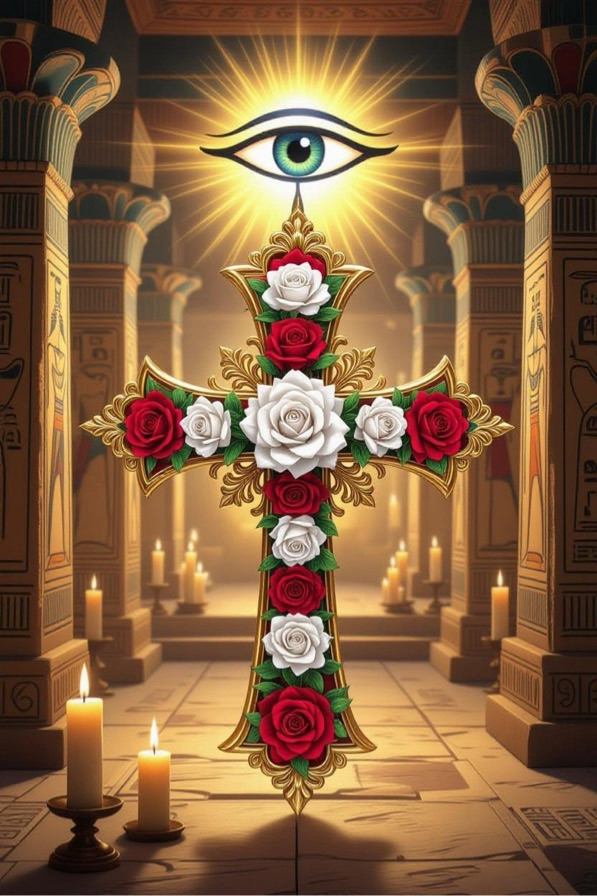
The Eye of Providence, often depicted as an eye within a triangle surrounded by rays of light, is a potent Rosicrucian symbol. While popularly associated with Freemasonry and conspiracy theories, its roots lie in esoteric traditions. For Rosicrucians, the Eye represents divine omniscience and the inner vision of the soul. It symbolizes the “hidden Christ within,” the divine spark that illuminates the path to self-realization (Hall, 1928).
The triangle surrounding the eye signifies the trinity of mind, body, and soul, while the rays of light denote spiritual illumination. Rosicrucians meditate on this symbol to awaken their inner vision, aligning their consciousness with the universal mind. The Eye of Providence reminds members that divine wisdom is ever-present, guiding them toward truth and balance.
The Hidden Christ Within
The concept of the “hidden Christ within” is central to Rosicrucian spirituality. Drawing from Gnostic and Christian mysticism, Rosicrucians believe that every individual carries a divine essence, a spark of the universal Christ-consciousness. This inner Christ is not a historical figure but a universal principle of love, wisdom, and unity. Through spiritual practice, Rosicrucians seek to awaken this latent divinity, achieving a state of illumination where they recognize their oneness with all creation (Heindel, 1909).
This belief fosters a sense of personal empowerment and responsibility. By cultivating the hidden Christ, Rosicrucians strive to embody divine qualities in their daily lives, serving as beacons of light in their communities. This inner transformation is seen as the key to creating harmonious, spiritually awakened societies.
Building Fully Developed Communities
The Rosicrucian blend of Zoroastrian illumination, Hermetic wisdom, and Christian compassion creates a framework for building vibrant, holistic communities. Rosicrucian lodges, such as those operated by AMORC, serve as hubs for spiritual study, meditation, and service. These communities emphasize:
- Education: Offering courses on metaphysics, mysticism, and practical spirituality.
- Collaboration: Encouraging members to share insights and support one another’s growth.
- Service: Engaging in charitable acts and promoting universal brotherhood.
By integrating diverse traditions, Rosicrucians create inclusive spaces where individuals from varied backgrounds can explore their spiritual potential. The emphasis on balance and self-awareness fosters communities that are not only spiritually enlightened but also socially responsible.

The Uniqueness of Rosicrucianism
What sets the Rosicrucian Order apart is its ability to synthesize seemingly disparate traditions into a unified path of self-discovery. Unlike dogmatic religions, Rosicrucianism encourages personal exploration and experiential knowledge, allowing members to tailor their spiritual practice to their unique needs. Its emphasis on initiation as an inner journey, rather than a rigid hierarchy, empowers individuals to take ownership of their spiritual growth. Furthermore, the Order’s commitment to service ensures that spiritual insights are applied practically, benefiting both the individual and society.
Conclusion
The Rosicrucian Order is a beacon of esoteric wisdom, blending Gnosticism, Christianity, Egyptian mysticism, pagan traditions, and Hermetic principles into a transformative spiritual path. Through initiation, service, and the pursuit of balance, Rosicrucians cultivate the mind, body, and soul, awakening the hidden Christ within. The Eye of Providence serves as a powerful reminder of divine awareness, guiding seekers toward illumination. By fostering fully developed communities grounded in universal wisdom, the Rosicrucians offer a timeless vision of spiritual unity and human potential.

References:
- Yates, F. A. (1972). The Rosicrucian Enlightenment. Routledge.
- Heindel, M. (1909). The Rosicrucian Cosmo-Conception. Rosicrucian Fellowship.
- Lewis, H. S. (2009). Rosicrucian Questions and Answers. AMORC.
- Hall, M. P. (1928). The Secret Teachings of All Ages. Philosophical Research Society.
- AMORC (2025). Official Website of the Ancient Mystical Order Rosae Crucis. Retrieved from https://www.amorc.org.
This blog post aims to illuminate the rich tapestry of Rosicrucian thought, inviting readers to explore its mysteries and embrace their own journey toward enlightenment.
Leave a Reply