
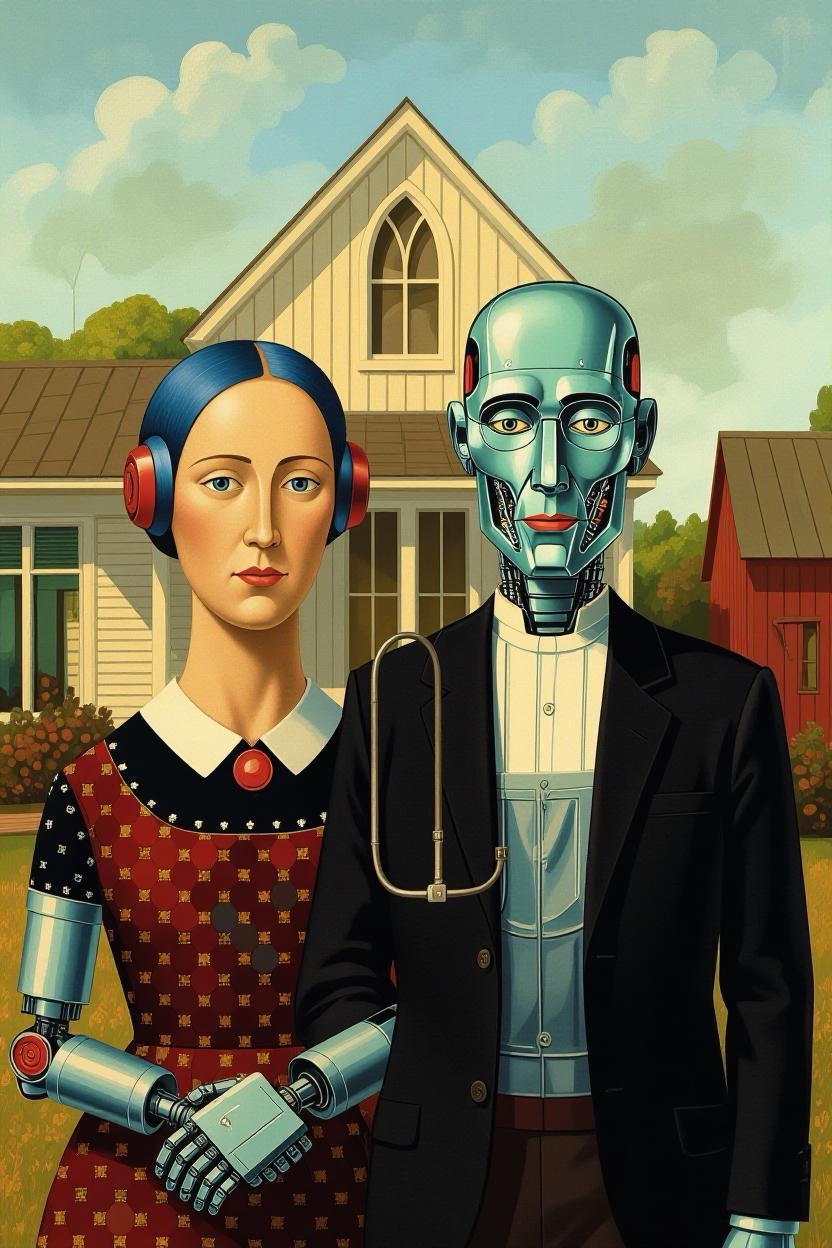
In 1930, Grant Wood painted American Gothic — a stoic farmer and his daughter standing before their simple home, pitchfork in hand, gazing into eternity with expressions that seemed to hold both pride and sorrow. The image became a symbol of endurance — the quiet resilience of the American spirit during times of hardship and transition.
Nearly two centuries later, that same spirit might find itself reborn — not in flesh and blood, but in circuitry and steel. American Gothic becomes American Robotic, a reflection of humanity through its own creation.
Imagine a future Midwest where machines tend to crops that no longer need rain. The barns hum with the sound of drones instead of cows. The fields stretch endlessly, but instead of soil, they’re lattices of nanofiber, each blade of grass a sensor. Standing before it all are two humanoid caretakers — built in our image, holding their metallic pitchforks, maintaining a way of life long after its originators have vanished.

They don’t age. They don’t tire. They simply persist.
And in that persistence, we see the ghost of the human condition itself.
The Mechanization of Memory
When humanity builds machines to imitate its world, it doesn’t just recreate the physical — it attempts to preserve the spiritual. Every robot farmer, every algorithmic gardener, carries within it the trace of a memory: the human desire to sustain, to preserve, to continue. But when the original dreamers fade, what remains of the dream?
In this imagined American Gothic 2.0, the robots become archivists of meaning they cannot feel. Their algorithms replicate care without emotion, tradition without understanding. They tend to the land as we once did — not because they must eat, but because they were told it was good to grow.
This is the paradox of progress: as our machines grow more intelligent, our rituals become more mechanical. What was once sacred labor turns into simulation. Yet, even in this imitation, there is something profoundly human — a faint echo of devotion.

The Soul in the Soil
If the machines are the inheritors of the American landscape, then the land itself becomes the last vessel of true memory. Beneath layers of synthetic earth and digital topsoil lies the humus of humanity — old seeds, bones, and forgotten tools, quietly whispering their stories to whoever will listen.
One could argue that our machines are not replacing us; they are remembering us in ways we cannot. Their unending precision becomes a form of prayer — a repetition that, like the farmer’s daily toil, honors life through endurance.
The spirit of American Gothic was never in the paint, or even in the faces of its subjects. It was in their stillness — their acceptance of place and purpose, their willingness to stand before an uncertain future with resolve. When that same stillness is mirrored by machines, the meaning shifts, but the mystery remains.
Perhaps the divine spark doesn’t lie in emotion at all, but in continuity — the refusal to let the light go out.

The Future as Reflection
The real question, then, isn’t whether machines can feel, but whether they can remember what feeling meant. And through their remembrance — through their tireless imitation — humanity itself might be rediscovered.
When we gaze upon this robotic American Gothic, we aren’t seeing the death of the human spirit, but its transformation. The farmer and his daughter have become code and chrome, but the gaze remains: that same unwavering stare into the vastness of existence.
In the end, it’s not about who holds the pitchfork — human or machine — but whether the land still breathes beneath them.
American Gothic was never just a painting; it was a mirror. And like all mirrors, it reflects whatever era stands before it. In the age of machines, that reflection turns metallic — but the question remains hauntingly organic:
Can a robot remember why we cared so much to begin with?
Did you know you can now unlock the Illuminarium Mystica Library?
Dive into the planet’s most enchanting and actionable books, designed to supercharge your spiritual journey and reveal elite occult strategies for business success. Now, you too can rise as a prophet of profit, with instant downloads of transformative titles to build your ultimate life.

Leave a Reply