
Some of the herbal allies mentioned here are shared through affiliate links, meaning I may receive a small blessing of support if you choose to journey with them—always at no extra cost to you.

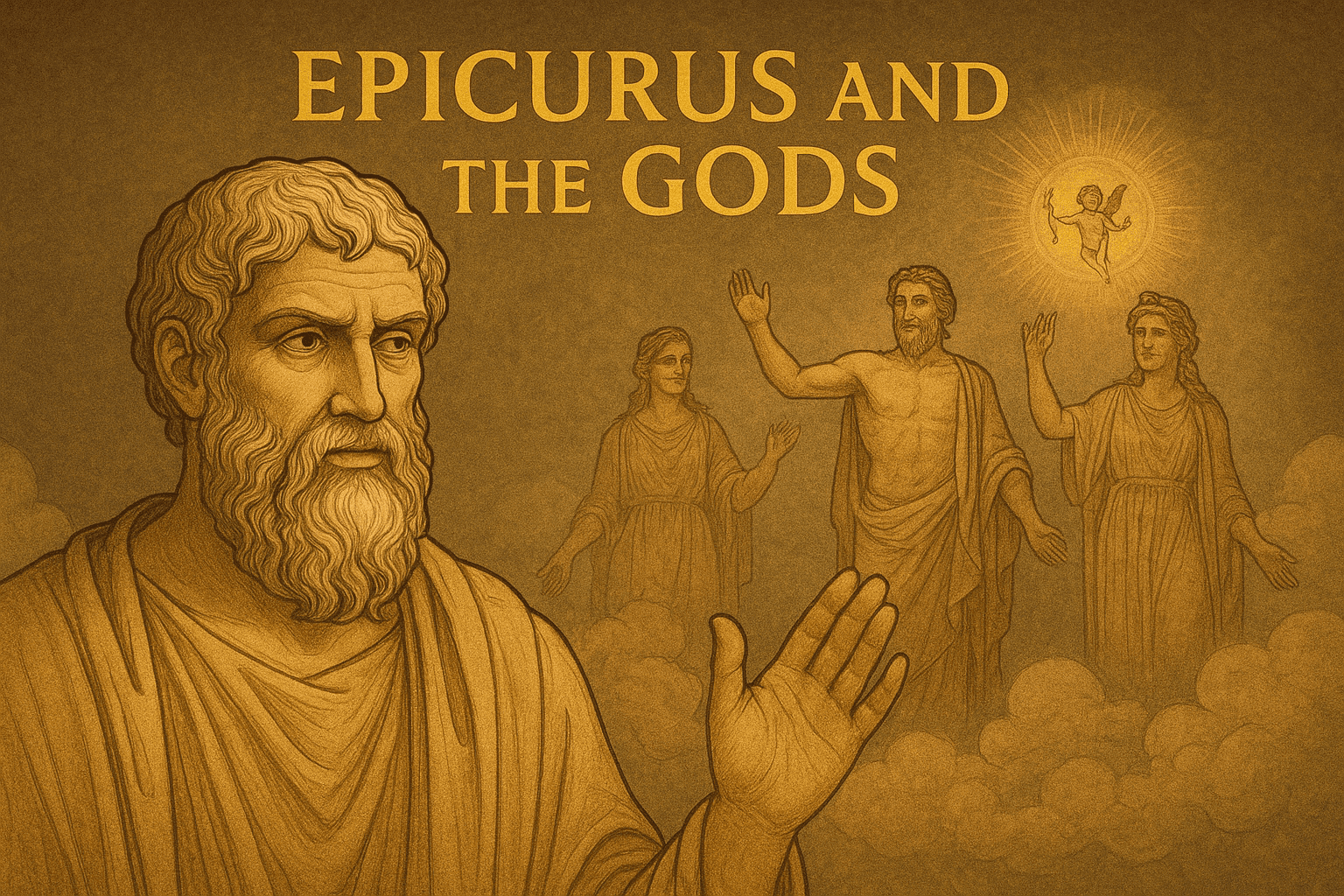
Epicurus (341-270 BCE) was a Greek philosopher whose system combined atomist physics, empiricist epistemology, and a hedonistic but highly disciplined ethics. A lot of people assume Epicureanism is just about pleasure, but underlying that is a project: to free human beings from fear — especially fear of the gods and fear of death — so they can live tranquil lives. The way Epicurus conceives of the divine is central to that project: by redefining what gods are, he aims to remove divine-fear from human life.
The Reality of the Gods — Existence, Nature, Attributes
Existence: From Prolepsis
Epicurus believed that people everywhere share certain “preconceptions” (prolēpsis) of gods — basic ideas or intuitions that are natural to human beings, implanted by nature. These ideas arise from sensory impressions and mental images, not from philosophical proof or religious dogma.
So, in Epicurus’s view, the existence of gods is certain, not as myths or legends, but as beings we intuitively believe in. However, this belief must be cleansed of superstition and false beliefs.
Attributes: Blessedness, Immortality (or Incorruptibility), Tranquility
Epicurus holds that the gods are immortal (or, more precisely, incorruptible) and blessed. They are free from suffering, disturbance, decay, or any need. In particular:
They are immortal/incorruptible: not subject to illness or time in the way humans are. They are supremely happy: their happiness is perfect, complete, undisturbed. They have human or anthropomorphic form in some sense — though purer, more beautiful, grander, ethereal. Some ancient Epicureans debate whether “form” is literal body, “quasi‐body,” or something more metaphorical.

Location, Corporeality, and Detachment
A striking aspect of Epicurus’s theology is that though the gods are real, corporeal (or at least somewhat bodily in some strain of the tradition), they are completely disengaged from the world and human affairs. They dwell in what are called intermundia — the spaces between worlds. That way they are not part of the chaos, turmoil, or moral concerns of human life.
They do not:
Create the world, or intervene in its operation. Answer prayers in the sense of granting favors. Judge or punish individuals (in the supernatural sense) nor is there an afterlife punishment inflicted by gods. Epicurus believed the soul dissolves and is not immortal in the sense of surviving personal consciousness.
Purpose of the Gods in Epicurean Thought
Why posit gods if they do nothing for us? Their role is mostly psychological, theological, and ethical:
Psychological Relief Epicurus aims to remove anxiety stemming from the idea that gods might punish you, reward you, or manipulate human affairs in arbitrary ways. Fear of divine wrath is, for him, one of the great sources of human disturbance. By redefining gods as blissful, uninvolved, and incorruptible beings, he hopes to calm such fears. Moral Ideal / Mirror of Tranquility The gods serve almost as models of what perfect happiness looks like — beings completely free of fear, pain, disturbance. Their very existence helps illustrate what peace of soul and absence of anxiety are. If one can aspire to a life free from fear about death or cosmic punishment, one lives more like the gods. Natural Origins of Religion By pointing out that belief in gods arises naturally (via sensory impressions, mental images, and prolepses), Epicurus explains religion as something human nature gives rise to, rather than something imposed by external tyranny or supernatural mandates. This helps in distinguishing false beliefs (superstition, myths) from what humans can reasonably accept.

Dangers of False Beliefs: Myth, Superstition, and Human Error
Although Epicurus accepts gods, he is sharply critical of the many popular beliefs people have about them. He thinks that most myths, stories, and popular religions project onto gods human fears, human faults, moral judgments, and then attach superstitious practices (sacrifices, rituals, appeals, fear of divine retribution). These are sources of unnecessary anxiety and ignorance.
In particular:
Attributing anger, jealousy, intervention, retribution to gods is false. This distorts the natural conception of what it means to be blessed and immortal. The idea that the gods created the world, guide its destiny, or care about individuals’ moral behavior is part of superstition — these beliefs are not supported by the evidence Epicurus accepts.
Implications: Ethics, Death, and Serenity
Because gods don’t punish or reward us in the afterlife, many ethical motivations change. Epicurus doesn’t deny that there’s virtue; he affirms justice, friendship, modesty, self-control. But the reasons for virtue are not fear of divine punishment or hope of divine reward. Virtue is useful because it helps produce a stable, tranquil life.
Regarding death: one big fear is what happens after death — often imagined in religious traditions as judgment or eternity of some kind. Epicurus argues that since the soul disintegrates with the body, consciousness ends, and thus any suffering or reward ends. So fear of death (and fear of post-mortem divine retribution) is irrational. One should live without that fear.
How Epicurus’s Gods Differ from Other Ancient and Modern Gods
To fully appreciate how radical Epicurus’s view is, here are contrasts:
Homeric / Classical Greek Gods: These gods meddle, have human flaws, jealousy, anger, favoritism, intervened in battles, curses, etc. Epicurus rejects all this. Platonic / Aristotle-type divine beings: Often more abstract, needing less anthropomorphism, often perfect in knowledge and matter of cosmic order. Epicurus differs especially in denying that gods are concerned with cosmos order or moral agency in human affairs. Monotheistic Gods of later religions: Attributes like omnipotence, moral involvement, creator, judge — these are largely absent, or at least reinterpreted or rejected, in Epicurus’s theology. For Epicurus, gods are not moral supervisors.

Some Difficulties and Interpretive Controversies
There are a number of complex points and debates among scholars about Epicurus’s theology:
Corporeality vs. “Quasi-Bodies”: Are gods truly bodies (made of atoms), or are they “like bodies” (perhaps metaphorical, idealized, or slightly abstract)? Some Epicurean interpreters argue that human-like form is metaphorical or a mental image rather than strictly physical. Knowledge of Davidism vs. Delusion: How, exactly, do human beings have knowledge of gods? The idea of prolepsis means that even if people have preconceptions, many distort them. Determining which beliefs are accurate is non-trivial. Gods and Atomism: Since everything is (for Epicurus) atoms and void, how do gods fit? If gods are bodies of atoms, atoms that are incorruptible, how are they different from other large beings? They differ in isolation, in perfection, in lack of needs, disturbance. But some argue there is tension in how literally corporeal to take gods. Moral Motivation Without Divine Reward/Punishment: Critics ask: if gods don’t intervene, judge, punish, or reward, what ensures morality? Epicurus answers via the consequences for oneself: peace of mind, absence of fear, tranquility, friendship. Virtue is instrumentally valuable in securing those.
Why Epicurus’s God(s) Still Fascinates
Therapeutic Philosophy: His theology is aimed at healing, calming fear. People often turn to religion to cope with anxiety — Epicurus offers a philosophy that reduces reliance on supernatural fear. This is strikingly modern in feel. Boundary-Crossing Belief: Epicurus accepts gods, but refuses to make them agents in human life. This is unusual in ancient theology: gods exist, but are not controllers. That middle path challenges standard religious models. Influence on Later Thought: His ideas influenced later skeptics, materialists, even modern secular thinkers. The problem of evil, fear of gods, ideas about what makes a “good life” in absence of divine intervention — all have echoes back to the Epicurean project.
Summary: The Epicurean God in a Nutshell
Gods exist, as immortal, blessed beings. They are incorruptible, free from pain, disturbance, need, worry. They are corporeal (or at least have form) but completely removed from human concerns; they do not create, judge, intervene. Belief in gods arises naturally by human nature, but popular depictions are distorted and lead to fear and superstition. Removing fear of gods is essential to achieving ataraxia (tranquility) and aponia (absence of pain), two key Epicurean goods.

Leave a Reply