Some of the herbal allies mentioned here are shared through affiliate links, meaning I may receive a small blessing of support if you choose to journey with them—always at no extra cost to you.

Buy now on Amazon
The Tale of Two Brothers: The Ancient Root of a Modern Rivalry
Long before missiles, sanctions, and cyber warfare, there were two brothers locked in struggle — Jacob and Esau, sons of Isaac and Rebekah.
The Book of Genesis tells how the twins wrestled in the womb, how the younger grasped the heel of the elder, and how destiny seemed to pit them against each other even before birth.
“The elder shall serve the younger.” — Genesis 25:23
Esau, the rugged hunter, came first — a man of the field, red and strong. Jacob, the quiet dreamer, born second, dwelled among tents and visions. Yet it was Jacob who received the blessing, through cunning and divine orchestration. Esau sold his birthright for a bowl of stew — a moment of hunger that would echo across the ages.
And thus began a pattern: the younger supplants the elder, the clever overtakes the strong, the destiny of nations shifts through deception and desire.
From the Womb to the World Stage: Jacob and Esau Become Nations
The Bible later reveals that these brothers’ destinies unfold not just as individuals but as archetypes of entire nations.
Jacob becomes Israel, the lineage of the chosen covenant.
Esau becomes Edom, the rival people who dwell on the margins, watching their brother’s rise with a wounded heart.
Through the prophets, Edom is portrayed as a once-blessed lineage whose bitterness leads to betrayal.
When Jerusalem fell, Edom’s silence — or alleged collaboration — was remembered as treachery. Thus, Edom became the symbol of betrayal and exile, and Jacob the symbol of divine favor and endurance.
Over centuries, theologians, mystics, and scholars alike saw this story repeating: the cycle of brothers divided, blessings contested, and birthrights sold for fleeting gain.
The Modern Parable: Israel and Iran as Living Symbols
Fast forward thousands of years — the ancient pattern still breathes.
Today, many see the Israel–Iran conflict as the modern echo of the Jacob and Esau dynamic.
Israel, descended from the spiritual archetype of Jacob, stands as the region’s technological and strategic powerhouse — resourceful, cunning, and backed by global blessing.
Iran, inheritor of ancient Persia and a guardian of deep spiritual heritage, finds itself cast in the Esau role — powerful yet spurned, passionate yet condemned.
The two nations, though geographically apart, are locked in a cosmic rivalry that extends far beyond borders.
Each claims to carry the torch of divine destiny — one through covenant, the other through resistance.
In this mirror, missiles replace spears, diplomacy replaces deception, but the essence remains:
a struggle for legitimacy, blessing, and the right to define divine justice in a fractured world.

Buy now on Amazon
The Birthright Reimagined: Who Owns the Blessing Today?
When critics say “Israel has stolen Esau’s birthright,” they are not simply making a political claim — they are invoking the ancient wound of injustice.
They see modern Israel, armed and ascendant, claiming divine inheritance while others suffer dispossession.
They see Esau’s descendants — the peoples of the wider region, including Persians, Arabs, and Palestinians — watching from the margins, their own rights and voices eclipsed.
This isn’t just politics — it’s mythology made manifest.
Each policy decision, each airstrike, each alliance becomes another act in the sacred drama of brother against brother.
But perhaps the real “birthright” was never land or power.
Perhaps it was spiritual inheritance — the capacity to remember God in all things, to live with integrity and compassion, to honor the divine spark in one’s brother.
If that’s true, then the story’s meaning shifts dramatically: the theft was never of territory, but of spirit.
The Prophetic Mirror: Lessons Hidden in the Myth
The story of Jacob and Esau has always been more than history — it’s a mirror for the soul of humanity.
Each of us holds both brothers within: the ambitious Jacob and the wounded Esau, the deceiver and the betrayed.
And every nation carries this same split — between cunning and conscience, survival and surrender.
If we look deeply, the conflict between Israel and Iran reflects the inner war of civilization itself:
science vs. spirit, reason vs. revelation, control vs. compassion.
Until both “brothers” reconcile, the world remains divided, and peace stays just out of reach.
The Forgotten Ending: When Brothers Embrace
Few remember that the story does not end in hatred.
After decades of exile and fear, Jacob returns home — trembling before the brother he deceived.
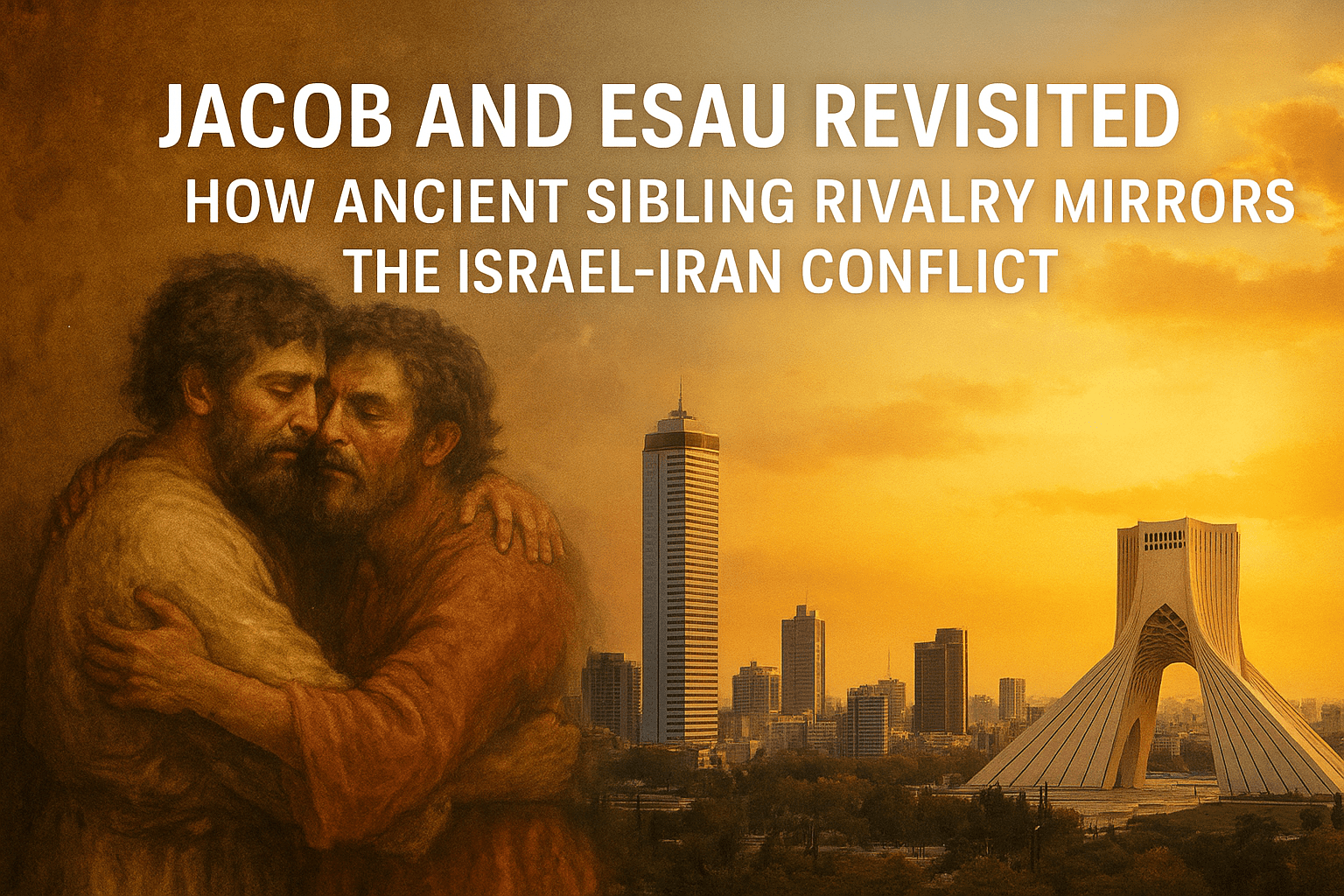
But instead of vengeance, Esau runs to meet him. He embraces Jacob, weeping.
“Esau ran to meet him and embraced him; he fell on his neck and kissed him, and they wept.” — Genesis 33:4
In that moment, the curse breaks. The archetype heals.
It’s a reminder that every divine rivalry is meant not to destroy but to transform — that reconciliation is the true end of prophecy.
A Call for the Present Age
In the modern world, power and propaganda drown out mythic wisdom.
But the story of Jacob and Esau whispers an eternal truth: no one truly wins until the brothers reconcile.
The blessing of the Divine cannot dwell in deceit or domination; it lives only in forgiveness, humility, and remembrance.
If Israel and Iran — and by extension, humanity — could rediscover that spiritual inheritance, perhaps we would no longer fight over birthrights, because we would remember that the birthright of all souls is unity.
Final Reflection
The Book of Genesis is not just a record of the past — it’s a prophecy of consciousness.
In every age, Jacob and Esau rise again in new forms — in nations, ideologies, and even within our own hearts.
The question is not who stole whose blessing, but whether we can awaken enough to share it.

Buy now on Amazon
Leave a Reply