
Some of the herbal allies mentioned here are shared through affiliate links, meaning I may receive a small blessing of support if you choose to journey with them—always at no extra cost to you.

There is a sacred force slumbering within each of us, a coiled serpent of divine energy known to the ancients as Kundalini. This primordial current has been described by sages, saints, and mystics in every era, under countless names — the Holy Spirit in Christianity, Shekhinah in Kabbalah, Shakti in Hinduism, Chi in Taoism, and the Inner Flame in the writings of Christian hermits. Each tradition, though clothed in its own language and symbolism, points toward a single truth: there exists within the human being a living energy that bridges the finite with the Infinite, the mortal vessel with the divine essence. Kundalini, then, is not a sectarian concept — it is the universal root of all spiritual realization, the mystical thread that runs through every true religion and revelation.
The Serpent and the Seed of Light
Kundalini has often been symbolized as a serpent coiled three and a half times at the base of the spine, asleep until awakened through grace, discipline, or divine timing. Yet this imagery is far older than Hindu scriptures; it is archetypal. The serpent appears in the Garden of Eden as the bearer of knowledge, in Egyptian iconography as the uraeus rising from the brow of pharaohs, and in Greek mystery schools as the ouroboros — the serpent devouring its own tail, representing eternal renewal. In each symbol, we glimpse the same eternal drama: spirit descending into matter, sleeping within flesh, and one day rising again toward its Source.
This coiled energy is the seed of enlightenment, the latent spark of divinity within human form. When aroused, it ascends through the subtle channels of the spine — the sushumna nadi — activating and purifying each chakra, or energy center, as it travels upward toward the crown of the head. There, in a union of heaven and earth within the temple of the body, the individual soul merges with universal consciousness. The mystic’s ecstasy, the prophet’s revelation, the saint’s illumination — all are fruits of this inner ascent.
Beyond Dogma: The Inner Path of Direct Experience
Religion, at its best, is a set of sacred signposts guiding humanity toward this inner transformation. Yet when taken as an external authority alone, without understanding the energy that animates its symbols, religion becomes rigid — a vessel without living fire. Kundalini transcends dogma because it belongs not to any particular tradition but to the architecture of the human soul itself. It is a biological, psychological, and spiritual phenomenon — not limited by creed, culture, or geography.
When Jesus said, “The Kingdom of God is within you,” He was speaking of this same awakening. When the Buddha touched the earth beneath the Bodhi tree and attained enlightenment, he symbolically grounded the awakened energy of the crown into the world. When Sufi mystics whirl in ecstatic devotion, they spiral in resonance with the ascending current of divine love that Kundalini embodies. Each path — whether Christian, Hindu, Sufi, Taoist, or indigenous — is an expression of one cosmic pattern: the return of consciousness to its divine source through the awakening of inner light.
Thus, Kundalini does not ask us to abandon religion but to fulfill it — to experience, rather than merely believe. It transforms theology into revelation, scripture into living truth. The awakened being no longer interprets God through borrowed words but knows God as the breath within their own being.
The Science of Inner Alchemy
In the modern world, many perceive spirituality as a matter of faith and religion as a social structure. Yet Kundalini is both science and spirit — a precise technology of consciousness that can be verified through inner experience. Ancient yogic texts describe the physiological correlates of awakening: subtle nerve currents, pranic flows, and brain centers that become activated during higher states of meditation. Modern neuroscience, in its infancy of spiritual understanding, has only begun to glimpse the transformative effects of meditation, breathwork, and devotion on the human brain and endocrine system.
But the ancients already knew: the body is the laboratory of divine alchemy. Within it lies the philosopher’s stone — the spinal column — through which the base metal of instinct is transmuted into the gold of illumination. The serpentine motion of Kundalini mirrors the double helix of DNA, the caduceus of Hermes, and the electromagnetic currents that pulse through all living organisms. To awaken this force consciously is to reclaim our evolutionary purpose, to realize that humanity itself is the bridge between heaven and earth.
The Universal Awakening
In our time, many feel drawn to Kundalini awakening, often without prior religious training. This is not coincidence — it is the next step in collective evolution. As dogmas dissolve and global consciousness expands, humanity begins to see the unity beneath all traditions. The same divine current that illuminated the prophets and mystics of old now stirs within countless seekers across the world, igniting a new form of spirituality that is experiential, integrative, and inclusive.
Kundalini, therefore, represents not only the awakening of the individual soul but also the rebirth of humanity into a higher octave of being. It teaches that divinity is not distant but immanent, that heaven is not elsewhere but here, within the sacred circuitry of the body. When this understanding becomes embodied, compassion naturally arises, for one perceives all beings as expressions of the same divine current. Religion, then, finds its true fulfillment — not in separation, but in unity.
The Serpent and the Cross
In the deepest sense, Kundalini is not Hindu, Buddhist, Christian, or Muslim — it is the universal pulse of creation itself. Every true religion is an outer reflection of this inner science, pointing humanity back toward the same sacred ascent. To awaken Kundalini is to see that God has never been outside of us, that every temple and scripture was but a mirror for the divine spark within.
The serpent rising upon the staff, the cross upon the hill, the lotus blooming from mud — all are symbols of one truth: through the awakening of the inner fire, spirit redeems matter, and humanity rediscovers its divine nature.
Kundalini is the silent witness, the breath of eternity whispering through all faiths, calling us to remember who we are. When that serpent uncoils, the many religions dissolve into one pure experience of being — Love itself — infinite, radiant, and free.

The Transformative Benefits of Awakening Kundalini
Kundalini is not merely a spiritual symbol or esoteric concept—it is a living force that transforms the body, mind, and spirit simultaneously. Those who commit to practices that awaken this energy experience profound shifts that can be observed across multiple dimensions: physiological, emotional, psychological, and spiritual. These benefits are not abstract; they are tangible changes that ripple into daily life, enhancing clarity, resilience, and alignment with one’s higher purpose.
1. Yoga: The Physical and Energetic Gateway
Hatha and Kundalini Yoga provide the foundational practices for awakening the coiled energy. Through asanas, breathwork (pranayama), and mudras, yoga cultivates flexibility in the body and openness in the energy channels.
Benefits:
Strengthens the spine, creating a stable conduit for the energy to rise. Increases lung capacity and pranic flow, enhancing vitality. Harmonizes the chakras, balancing emotional and mental states. Releases stagnant energy, reducing stress, anxiety, and physical tension. Prepares the body to withstand the subtle intensity of Kundalini’s ascent.
Yoga is the discipline that aligns body and energy, ensuring the awakening is both safe and sustainable.
2. Meditation: The Mind’s Alchemy
Meditation is the crucible in which raw energy is refined. Through sustained attention, mindfulness, and visualization, the practitioner learns to direct Kundalini consciously, transforming mental patterns and accessing higher states of consciousness.
Benefits:
Deepens self-awareness, creating clarity and insight into habitual thought patterns. Promotes emotional regulation, reducing fear, anger, and depression. Opens intuitive perception, allowing guidance from the inner self or universal consciousness. Facilitates experiences of unity, bliss, and transcendence beyond egoic limitations.
Meditation transforms mental energy into spiritual illumination, ensuring that the awakening is not chaotic but integrated.
3. Pranayama and Breathwork: The Current of Life
Breath is the vehicle of prana, and prana is the vehicle of Kundalini. Breath control techniques such as Nadi Shodhana (alternate nostril breathing) and Kapalabhati (skull-shining breath) purify the energy channels and stimulate the dormant serpent.
Benefits:
Detoxifies the nervous system, balancing sympathetic and parasympathetic activity. Amplifies vitality and energy levels naturally. Strengthens focus and willpower by training the mind to follow the rhythm of breath. Triggers heightened states of awareness and subtle perception.
Through breath, the practitioner learns to flow with the energy, rather than resist it, creating harmony between mind, body, and spirit.
4. Mantra and Sound: Vibrational Activation
The use of sacred sound — mantras, chants, and toning — awakens Kundalini by resonating with the subtle frequencies of the chakras. Sound acts as a bridge between the material and spiritual, opening the heart and stimulating the higher mind.
Benefits:
Harmonizes the nervous system and balances brainwave activity. Evokes joy, peace, and ecstatic states naturally. Clears emotional blocks that prevent energy from rising. Strengthens connection to universal consciousness through vibration.
Sound is the alchemical spark, transforming psychic resistance into receptivity and devotion.
5. Tantra and Sacred Sexual Energy: Transmutation and Expansion
Tantric disciplines understand the sexual energy as a concentrated life force, identical to Kundalini at its root. Through celibacy, conscious sexual practices, or energy transmutation, this primal force can be redirected to nourish higher consciousness.
Benefits:
Elevates sexual energy into creative, spiritual, and emotional expression. Enhances intimacy, empathy, and presence in relationships. Facilitates the unification of polarities within the self, balancing masculine and feminine energies. Accelerates spiritual insight and ecstatic union with the divine.
Through tantra, the practitioner experiences Kundalini as pure vitality transformed into wisdom, harmonizing body, heart, and spirit.
6. Devotion and Surrender: The Heart’s Path
Bhakti (devotion) practices open the heart, which is the conduit for the highest states of Kundalini awakening. Love, surrender, and faith dissolve the resistance of the ego, allowing energy to flow unimpeded.
Benefits:
Cultivates compassion, forgiveness, and unconditional love. Reduces attachment to fear and control, creating inner freedom. Invites mystical experiences and direct communion with the divine. Strengthens resilience against life’s challenges through inner peace.
Devotion transforms the awakening into a living, heartfelt experience, where spiritual realization is inseparable from love.
Integration Across Disciplines
Kundalini is not achieved through a single method but through a holistic alignment of body, mind, breath, sound, energy, and heart. Each discipline — yoga, meditation, pranayama, mantra, tantra, and devotion — represents a pathway into the same living current. When practiced together, they awaken the serpent safely, cultivate wisdom, and integrate spiritual illumination into daily life.
The ultimate benefit of Kundalini awakening is the realization of one’s true nature: not bound by religion, culture, or identity, but free as pure consciousness, radiant, compassionate, and whole. It is a living proof that spirituality is universal, that enlightenment is accessible to anyone willing to journey inward, and that the divine pulse within transcends all forms, doctrines, and dogmas.

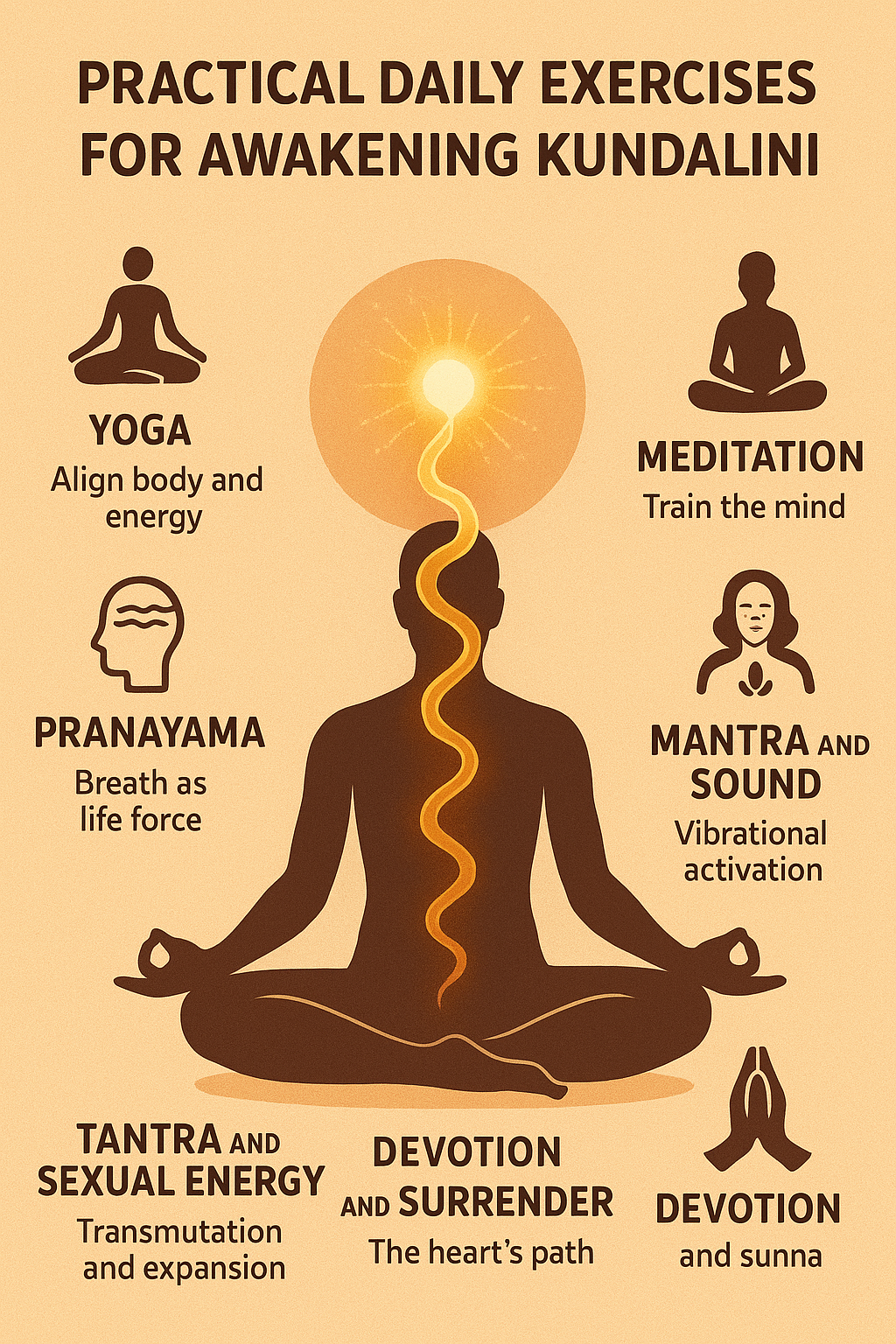
Practical Daily Exercises for Awakening Kundalini
Awakening Kundalini is a journey that requires patience, discipline, and respect for the body and mind. By practicing consistently, even in small doses, you can gradually activate and integrate this divine energy. Below are exercises for each discipline, designed for beginners through intermediate practitioners.
1. Yoga: Aligning the Body and Energy
Daily Practice: 20–30 minutes
Spinal Breathing Stretch: Sit cross-legged or on a chair, lengthen the spine, and inhale as you lift the chest. Exhale, relax shoulders. Repeat 10 times. Cat-Cow Flow (Marjaryasana-Bitilasana): Moves energy up and down the spine. 10 rounds in the morning. Cobra Pose (Bhujangasana): Opens the heart and activates the lower chakras. Hold 20–30 seconds, repeat 3 times. Lotus or Half-Lotus Meditation Seat: Even 2–5 minutes a day helps align the lower chakras for energy ascent.
Tip: Focus on gentle, mindful movement. Overstretching or forcing poses can create energy blockages.
2. Meditation: Training the Mind
Daily Practice: 10–20 minutes
Chakra Scanning Meditation: Starting from the base of the spine, visualize energy centers one by one. Imagine light, warmth, or a spinning wheel at each chakra. Silent Awareness: Sit quietly, observe thoughts without judgment, and feel the subtle energy rising in the spine. Kundalini Visualization: Visualize a coiled serpent at the base of your spine gradually rising to the crown. Maintain calm awareness.
Tip: Never force energy to rise. Meditation cultivates a receptive mind, allowing Kundalini to awaken naturally.
3. Pranayama: Breath as Life Force
Daily Practice: 5–10 minutes
Alternate Nostril Breathing (Nadi Shodhana): Balances left/right brain and pranic channels. 5–10 cycles. Bellows Breath (Bhastrika): Energizes body and clears energy channels. 20–30 breaths, slowly increasing intensity over weeks. Ocean Breath (Ujjayi): Gentle hissing sound on inhale and exhale. Calms the nervous system and promotes energy flow.
Tip: Always practice in a quiet, seated position. Avoid overexertion early in the morning on an empty stomach.
4. Mantra and Sound: Vibrational Activation
Daily Practice: 5–15 minutes
OM Chanting: Sit comfortably, inhale deeply, exhale with a long “OM.” Feel the vibration through your spine. Repeat 5–10 times. Bee Breath (Bhramari): Hum with a soft vibration, focusing on the third eye. 5–10 rounds. Affirmative Mantras: “I am light. I am energy. I am divine.” Repeat silently or aloud during meditation.
Tip: Sound creates subtle resonance, opening energy channels without physical strain.
5. Tantra and Sexual Energy: Transmutation Practices
Daily Practice: 10–20 minutes
Microcosmic Orbit Meditation: Sit comfortably, visualize sexual energy moving up the spine and down the front of the body in a continuous loop. Energy Circulation: Even without sexual activity, focus on lifting energy from the lower abdomen to the heart and crown. Creative Expression: Channel sexual energy into art, writing, or movement. Transformation of desire into creation awakens vitality safely.
Tip: Avoid forcing arousal or using external stimulation; the goal is energy mastery, not indulgence.
6. Devotion and Heart Opening: Bhakti Practices
Daily Practice: 5–15 minutes
Gratitude Meditation: Sit quietly, focus on the heart, and silently express gratitude for life, body, and breath. Prayer or Chanting: Repeat the name of the divine, a saint, or a sacred phrase that resonates. Acts of Compassion: Spend time helping others or engaging in mindful kindness to cultivate open-hearted energy.
Tip: Bhakti ensures Kundalini awakens in alignment with love, preventing ego-driven distortions.
Integration: Building a Daily Routine
For beginners, a simple 30–45 minute routine can include:
5 minutes of gentle yoga or stretches 10 minutes of pranayama 10–15 minutes of meditation or visualization 5 minutes of mantra chanting Optional 5–10 minutes of heart-opening practice or energy circulation
As the practitioner matures, the duration and intensity can gradually increase. The key is consistency, awareness, and respect for the body-mind system.
Awakening as Daily Practice
Kundalini is not an event but a journey of daily alignment. By integrating yoga, meditation, breathwork, mantra, tantra, and devotion into a cohesive practice, seekers awaken the divine current safely and fully. Each discipline feeds the others: breath energizes the body, meditation trains the mind, mantra opens vibration, tantra channels desire, and devotion grounds the heart. Together, they create a harmonious, living system for awakening Kundalini in a way that transcends religion, culture, and dogma — proving that the divine is always within reach.

Leave a Reply