Some of the herbal allies mentioned here are shared through affiliate links, meaning I may receive a small blessing of support if you choose to journey with them—always at no extra cost to you.

Buy now on Amazon
Dancing in the Void: The Mystical Symbolism of Ma Kali
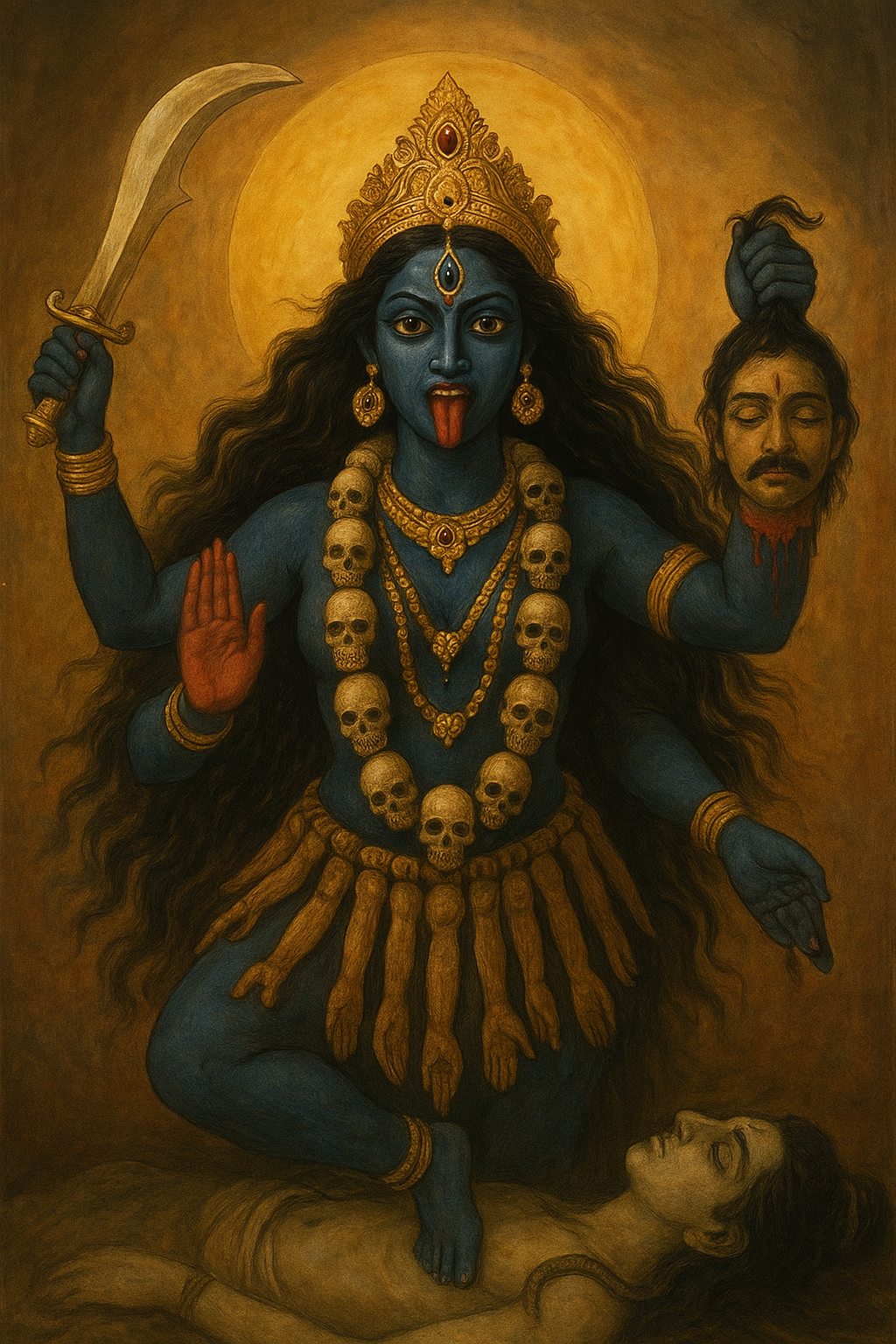
Ma Kali, the dark and fierce mother goddess of Hindu tradition, is one of the most misunderstood yet deeply revered deities in the spiritual world. To the untrained eye, her image can appear terrifying—black or deep blue skin, wild hair, a necklace of skulls, and a skirt made of severed arms. She stands upon the chest of her consort Shiva, tongue dripping with blood, holding a sword in one hand and the severed head of a demon in another. But for those who look deeper, Kali is not a goddess of cruelty—she is the embodiment of divine love in its most powerful, uncompromising form. Her symbolism is not meant to frighten, but to awaken. Every detail of her form tells us something about the nature of reality, the ego, and the path to liberation.
Ma Kali: The Eternal Mother Beyond Time and Illusion
At the heart of Kali’s symbolism is destruction, but not destruction for its own sake. She is the destroyer of illusion, the one who slices through the veil of Maya that binds us to ignorance and suffering. Her sword is not a weapon of war—it is the blade of wisdom, cutting away the false identities and attachments we cling to. The demons she slays are not merely mythical creatures, but the inner demons of greed, anger, pride, and fear that haunt every human soul. When we call upon Kali, we are asking for the courage to face these inner demons and to surrender them at her feet. In this way, her terrifying appearance is an invitation to confront what we usually try to avoid—the shadow within ourselves.
The Dark Radiance of Ma Kali: Gateway to Liberation
Her dark skin, often depicted as black or deep blue, is another profound symbol. It represents the infinite void, the womb of creation itself. Just as the night sky holds the stars, her darkness holds the entire universe. It is a reminder that everything we see arises from emptiness and will one day return to it. Far from being something negative, her darkness is nurturing and protective, like the mother who absorbs all pain and fear from her children. She is the womb and the tomb, the beginning and the end, the cycle of life in its purest truth. To meditate on Kali’s dark form is to remember that behind all appearances, there is one eternal source.

Buy now on Amazon
Veil of Shadows, Light of Truth: Understanding Kali’s Mystical Power
Perhaps the most shocking aspect of Kali’s imagery is her necklace of skulls and her skirt of severed arms. These symbols might appear gruesome, but they carry deep meaning. The skulls around her neck are not trophies of violence—they represent the letters of the Sanskrit alphabet, the building blocks of speech and creation itself. By wearing them, Kali reminds us that language, thought, and identity are transient and ultimately consumed by time. The severed arms around her waist symbolize the consequences of karma. Our actions cling to us and bind us, but Kali, in her mercy, removes them so that we can be free of endless cycles of cause and effect. In this way, even her fearsome ornaments are gifts of liberation.
Ma Kali: The Fierce Embrace of the Infinite
One of the most famous images of Kali shows her standing with one foot on Shiva, who lies calmly beneath her. This moment carries immense symbolic weight. Kali, in her wild dance of destruction, loses herself in divine ecstasy until Shiva places himself beneath her to stop the chaos. Her outstretched tongue, dripping with blood, is often interpreted as shame or surprise upon realizing she has stepped on her beloved. But on a deeper level, this image teaches balance—the interplay of Shakti (the active feminine energy of the universe) and Shiva (the stillness of pure consciousness). Without Shiva, Kali’s energy would be uncontrolled; without Kali, Shiva’s stillness would remain barren and inactive. Together, they represent the truth that action and stillness, energy and awareness, are inseparable in the dance of life.
For her devotees, Kali is not only a cosmic force but also the most intimate of mothers. She is fierce because she loves fiercely. Just as a mother will scold or discipline her child for their own good, Kali destroys our illusions so that we may grow into our highest potential. Those who surrender to her do not experience her as frightening, but as a source of unconditional protection and compassion. She teaches that life is impermanent, that the ego must die for the soul to awaken, and that real love is not soft or indulgent—it is fearless and liberating.
In modern times, Kali continues to inspire seekers of truth who are tired of surface-level spirituality and want to go deeper. She invites us to embrace the uncomfortable truths we often hide from: death, impermanence, loss, and transformation. In her embrace, we learn that these are not enemies but teachers. By meditating on her form or chanting her mantras, devotees find the courage to let go of fear and to live in freedom. Kali does not ask us to worship her out of fear, but to see her as the embodiment of reality itself—raw, untamed, and profoundly compassionate.
In the end, Ma Kali’s symbolism is a reminder that spiritual growth is not always gentle. Sometimes it requires tearing down what no longer serves us, even if it hurts. She shows us that destruction and creation are two sides of the same coin, and that love sometimes wears a fierce face. To walk with Kali is to walk into the fire of transformation, trusting that what is burned away was never truly us, and what remains is eternal. For those brave enough to look into her eyes, Kali does not bring death, but freedom.

Leave a Reply