Some of the herbal allies mentioned here are shared through affiliate links, meaning I may receive a small blessing of support if you choose to journey with them—always at no extra cost to you.

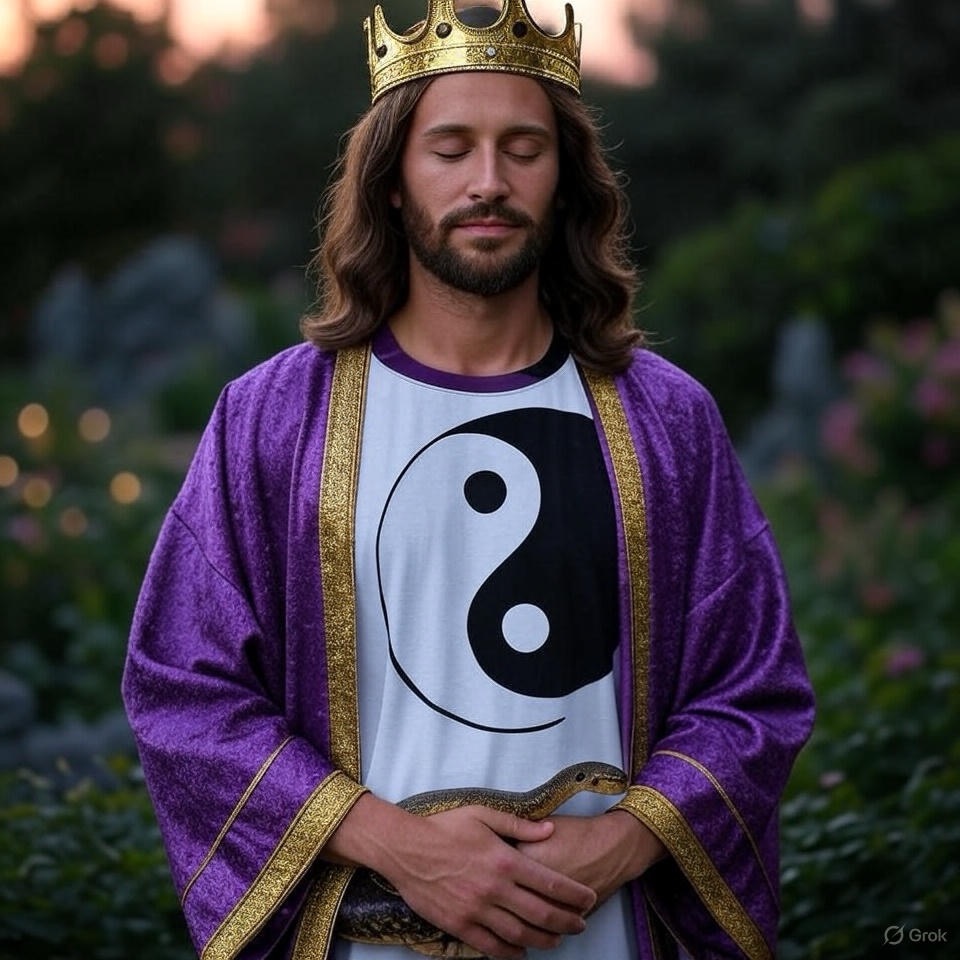
Across time, cultures have left us strange and beautiful symbols—images that blend the mystical with the anatomical. One such vision is an imagined image of Jesus Christ sitting in a purple robe and shiny crown, a snake in his lap, a yin-yang emblazoned on his shirt. At first glance, this seems like a collage of religious metaphors. But if we look closer, it may be a map of the human body itself, describing biological processes that modern science can now explain.
The Crown and the Brain
The shiny crown, worn above the brow, echoes the “crown chakra” of Eastern traditions—the Sahasrara, a symbolic lotus that blossoms when consciousness expands. From a Christian perspective, the crown may represent divine authority or victory over death, but in biological terms, it points to the brain’s highest centers of perception. Here, the pineal gland regulates light-sensitive hormonal rhythms, while the prefrontal cortex enables higher reasoning, empathy, and abstract thought. Ancient people may not have used these modern words, but they told stories of “crowns” and “halos” to mark the pinnacle of human potential.

The Purple Robe and the Nervous System
Purple, the color of royalty and spiritual dignity, was also the most expensive dye in the ancient world—reserved for the sacred and powerful. Neurologically, purple sits at the high-frequency end of the visible spectrum, a subtle nod to refined, elevated perception. The robe that covers the body mirrors the way the nervous system sheaths our flesh, carrying messages from head to toe.
The Snake in the Lap – Kundalini and the Spinal Column
The serpent is a universal emblem—sometimes feared, sometimes revered. In Hinduism, it is Kundalini Shakti, the coiled life-force energy at the base of the spine. In the Book of Numbers, Moses lifts the bronze serpent in the wilderness, symbolizing healing. In modern anatomy, the snake mirrors the spinal cord: a flexible, segmented channel conducting electrical signals from brain to body.
When Eastern texts say “the serpent rises,” they describe an experience in which dormant energy moves upward through the central nervous system, activating higher brain centers. Western science might frame this as an integration of autonomic functions, a heightened synchronization between neural circuits, and the release of neurochemicals like dopamine and serotonin. Both traditions describe the same process—one in poetry and myth, the other in data and neurophysiology.
The Yin-Yang Shirt – Balance in the Body
The yin-yang symbol on the chest speaks of duality and harmony—opposites that form a whole. Biologically, this can point to the autonomic nervous system’s two branches: sympathetic (yang, activating) and parasympathetic (yin, calming). The heart lies between them, responding to their constant push and pull, maintaining homeostasis. Spiritually, the yin-yang is a reminder that light and dark, active and passive, masculine and feminine all coexist within us.
Why the Ancestors Told Stories in Symbols
Ancient teachers—whether prophets, shamans, yogis, or sages—were not merely telling fairy tales. They were encoding truths that could survive for millennia, truths about the body, mind, and spirit. Myths of serpents, crowns, and cosmic balance were mnemonic devices for remembering how to live in alignment with both nature and the divine.
What we see in the symbolic Jesus with his snake, crown, purple robe, and yin-yang shirt is a compressed manual for human wholeness:
Crown: Awaken your highest mind. Robe: Guard and honor your nervous system. Serpent: Direct your life force upward. Yin-Yang: Maintain balance in all things.

The Eternal Message
Whether told by Hebrew prophets, Indian mystics, Taoist sages, or modern neuroscientists, the story is the same: The human body is a temple of energy, wisdom, and transformation. The language may change—serpents may become synapses, crowns may become the prefrontal cortex—but the underlying pattern is eternal. Our ancestors left us these symbols not just as art or doctrine, but as maps for awakening the full potential within.
If you’d like, I can also make a symbol-to-anatomy chart for this post so readers can visually connect each religious element to its biological counterpart. That would make the symbolism crystal clear.

Leave a Reply