
Some of the herbal allies mentioned here are shared through affiliate links, meaning I may receive a small blessing of support if you choose to journey with them—always at no extra cost to you.

Buy now on Amazon
When most people think of American symbols, the Statue of Liberty, Uncle Sam, or the bald eagle come to mind. But long before Lady Liberty raised her torch, another powerful figure stood as the embodiment of the United States: Columbia.
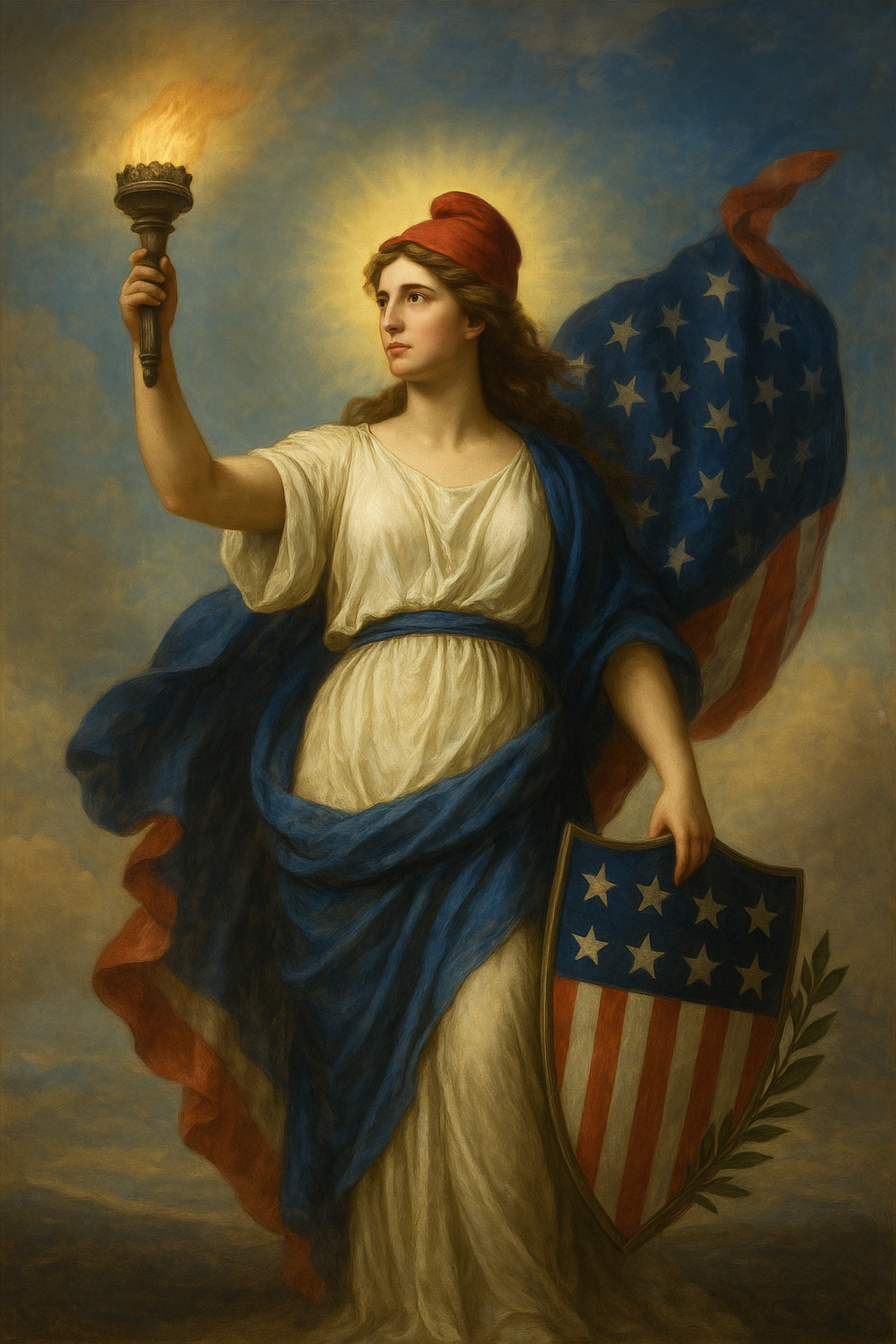
Often described as a goddess of America, Columbia isn’t a deity in the religious sense. She’s a personification—a symbolic figure created to represent the ideals, values, and aspirations of a young nation. From Revolutionary War poetry to World War I posters, she once commanded the American imagination.

Let’s explore who Columbia is, her deep ties to the United States, and the rich symbolism woven into her image.
Who Is Columbia?
Columbia emerged in the 18th century as a poetic name for the Americas, drawn from Christopher Columbus. By the time of the American Revolution, “Columbia” became shorthand for the United States itself—a fresh identity apart from European monarchies.
Her first recorded appearance came in 1738, in The Gentleman’s Magazine, as a term for the colonies. As independence approached, Columbia evolved into a distinctly American icon, appearing in poems, songs, political cartoons, and official seals.
Although her prominence faded in the 20th century—eclipsed by the Statue of Liberty—she still lives on in place names like the District of Columbia and in cultural relics like the Columbia Pictures logo.
Columbia’s Ties to the United States
Columbia became a central part of America’s self-image during its most formative years:
A Revolutionary Symbol During the American Revolution, Columbia was a rallying figure in literature and art. In 1776, poet Phillis Wheatley referred to “Columbia’s scenes of glorious toils” in a poem to George Washington, casting her as a beacon of liberty. National Anthem & Namesake In 1789, “Hail, Columbia” was composed for Washington’s inauguration and served as the unofficial national anthem until 1931. Her name spread to Columbia University, the capital (District of Columbia), towns, rivers, and ships. A Wartime Icon In the Civil War, she appeared in political cartoons urging unity—sometimes as a grieving mother, sometimes as a determined defender. In World War I, posters used her image to recruit soldiers and sell war bonds. Precursor to Lady Liberty Before 1886, Columbia was America’s main female symbol. While Lady Liberty came from France, Columbia was homegrown, born from the nation’s own myth-making.
Aspects of Columbia
Columbia embodies several qualities that mirror America’s evolving ideals:
Liberty – Often shown with a Phrygian cap or liberty pole, she champions freedom and democracy. Progress – In 19th-century art like American Progress (1872), she leads settlers westward, symbolizing innovation and destiny. Unity – In divided times, she appears as a maternal figure urging reconciliation. Strength & Protection – In wartime, she becomes a warrior—flag in one hand, sword in the other.
Symbolism of Columbia
Her visual language draws heavily from Greco-Roman art, echoing the Founders’ admiration for classical republics:
Neoclassical Gown – Purity, virtue, and timeless ideals. Phrygian Cap – Emancipation and resistance to tyranny. Torch or Star – Enlightenment and America’s role as a guiding light. Flag & Shield – Patriotism and defense of the Union. Laurel Wreath or Olive Branch – Victory and peace. Diverse Forms – While classically depicted as white, modern reimaginings cast her as Black, Indigenous, or multicultural, reflecting America’s diversity.

Columbia’s Legacy and Modern Relevance
By the early 20th century, Columbia’s visibility faded, replaced by Lady Liberty and Uncle Sam. Yet traces remain:
The Columbia Pictures logo still lights up movie screens. Cities, rivers, and schools bear her name. In literature like Neil Gaiman’s American Gods, she appears as a fading deity, a metaphor for forgotten symbols.
Today, Columbia’s unifying spirit is perhaps more relevant than ever. She represents a vision of America that is idealistic, resilient, and adaptable—a nation always striving toward liberty and progress.
Why Columbia Matters Now
Columbia is a reminder that symbols shape identity. She united Americans in revolution, comforted them in war, and inspired them in expansion. In an era of division, her image—a figure of liberty, unity, and vision—offers a timeless rallying point.
So next time you hear “Hail, Columbia” or see that glowing torch before a movie, remember: before Lady Liberty, Columbia carried America’s hopes. And she still has something to teach us about who we are—and who we could be.
Explore More:
Search for American Progress by John Gast. Listen to the patriotic anthem “Hail, Columbia.” Look for her in vintage wartime posters.

Buy now on Amazon
Leave a Reply