
Some of the herbal allies mentioned here are shared through affiliate links, meaning I may receive a small blessing of support if you choose to journey with them—always at no extra cost to you.

Buy now on Amazon
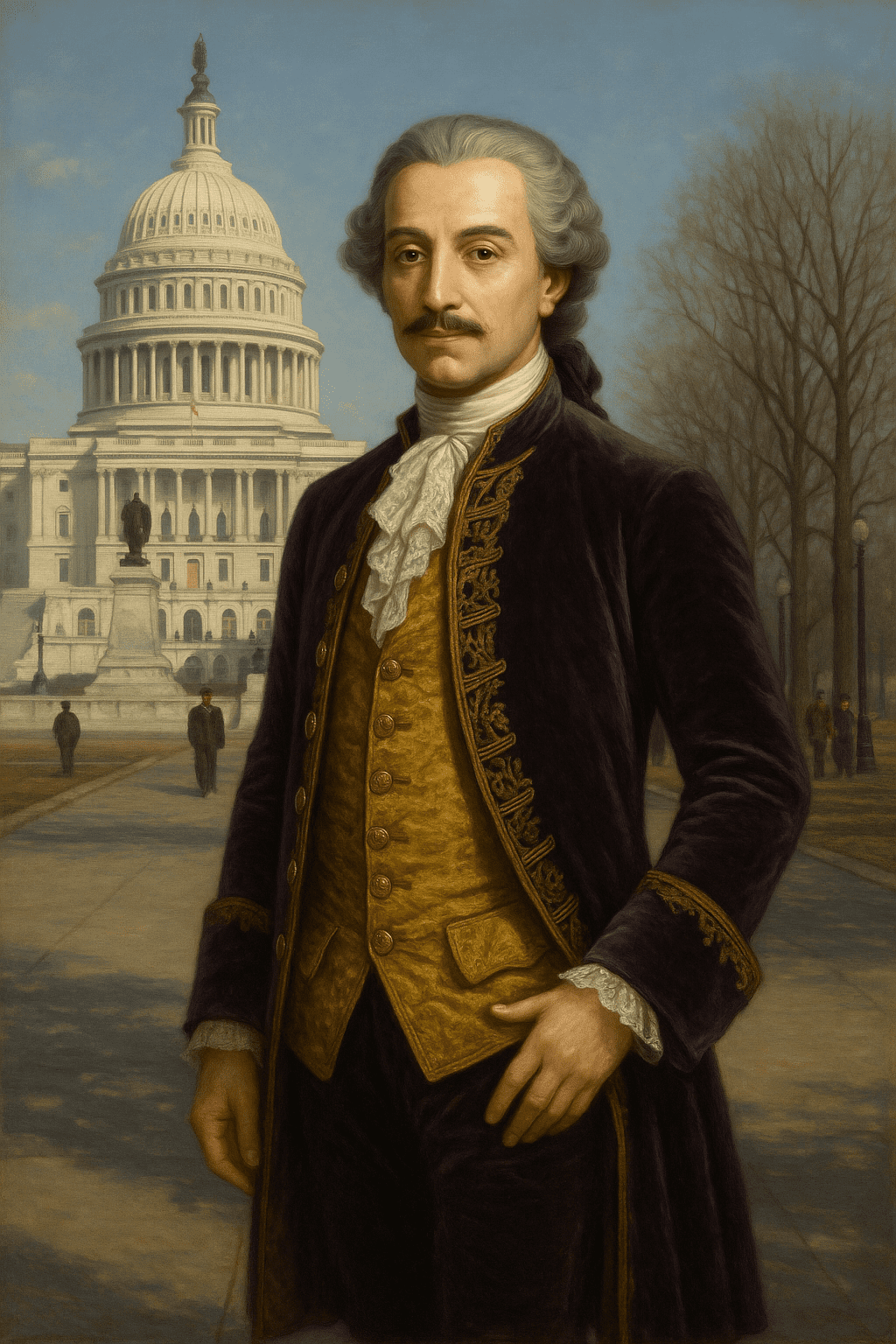
There are men in history whose names are bound not only to time but to mystery. Then there are those like Count Saint Germain, whose very existence seems to dance between the veils of space, memory, and myth—his life not just lived but echoed across centuries like the tolling of a great esoteric bell. In dusty libraries, within secret lodges, in the quiet corridors of Versailles and Vienna, his name has stirred whispers: “The Immortal,” “The Wonderman of Europe,” “The Count who never died.” It is here, on the boundary between historical fact and the mystical unknown, that we seek him—not to define him, but to feel his presence, and understand his purpose as an emissary of something far greater than ourselves.
Born… or perhaps revealed… in the early 18th century, the Count of Saint Germain appeared suddenly in the courts of Europe, dazzling kings and queens with his impossible knowledge, refined elegance, and ethereal presence. Prince Charles of Hesse and Voltaire both noted his profound intellect and seeming immortality. “He is a man who does not die,” Voltaire once said—sarcastically, perhaps, but beneath his wit was awe. He spoke every major language fluently, played music with a mastery to rival the great composers, painted exquisitely, and was versed in all sciences, from metallurgy to medicine. He bore the bearing of a sage, wore garments of a timeless cut, and often refused to eat in public, claiming to sustain himself on rare alchemical elixirs and secret formulations.

Buy now on Amazon
Who was he, really?
Some believed him to be the son of a Transylvanian prince. Others said he had lived since the time of Christ, wandering the Earth as a divine messenger. Still others whispered he was the same person known as Joseph of Arimathea, Plato, Merlin, or even the biblical prophet Samuel. Wherever he walked, the air of the occult followed—the scent of rose and sandalwood, the rustle of robes of violet and gold. Those sensitive to energy claimed he had no aura, no shadow. He simply was—eternally poised, ever watchful, the embodiment of the Philosopher’s Stone made flesh.
But the real story of Count Saint Germain cannot be confined to dates or palaces. His story belongs to the secret teachings of the Mystery Schools—the Hermetic circles, the Rosicrucians, the Theosophists, and the Brotherhoods of Light. According to these hidden orders, Saint Germain was—and remains—a Master of Wisdom, an Ascended Being who has shed the chains of karmic rebirth. He voluntarily returned to guide humanity through dark ages of confusion, bearing the torch of divine alchemy—the sacred art not only of turning lead into gold but of transmuting the soul’s base instincts into divine purity.
The Count’s life, if we dare call it that, was a mirror. He arrived in moments of great upheaval—before the French Revolution, during the rise of Enlightenment, at the turning points of empires. And always, he spoke gently but with thunderous resonance, of peace, of unity, of inner transformation. His true alchemy was not in laboratories, but in hearts. He taught that immortality was not a potion to be swallowed, but a path to be walked—the divine science of elevating consciousness above the illusions of death, fear, and separation.
Those who met him spoke of the eyes—ageless, luminous, filled with the knowledge of civilizations past and stars unborn. He moved not with haste but with purpose, as if he had seen this moment before and was merely fulfilling a sacred script written in the stars. Some say he never died. Others claim he left this realm by choice, to work from higher planes, manifesting only when the Earth is in need. In esoteric circles, it is believed that Saint Germain is the Chohan of the Seventh Ray, the overseer of transmutation, spiritual freedom, and the Violet Flame—the mystical fire said to cleanse karma and purify the soul.
To invoke his name is to stir the memory of our own divinity. He is not just a man of history; he is an archetype, a whisper from the future, a friend of the soul. He invites us to reclaim our spiritual nobility—not through grand acts, but through the quiet mastery of self. In moments of despair or doubt, you may feel his presence—subtle, reassuring, violet-hued—as if he stands beside you in the great alchemical laboratory of your life, reminding you to trust in the slow, beautiful art of transformation.
Whether he was real or merely a symbol, does it matter? Saint Germain lives where all great truths live—in the heart. In the yearning for wisdom. In the fire that longs to ascend. And in that sacred, ineffable knowing that you, too, are more than flesh and time. You are an eternal being, capable of love without end, and destined for remembrance.
So light the candle. Whisper his name. And feel the mystery not as a riddle to be solved, but as a divine melody calling you home.

Leave a Reply