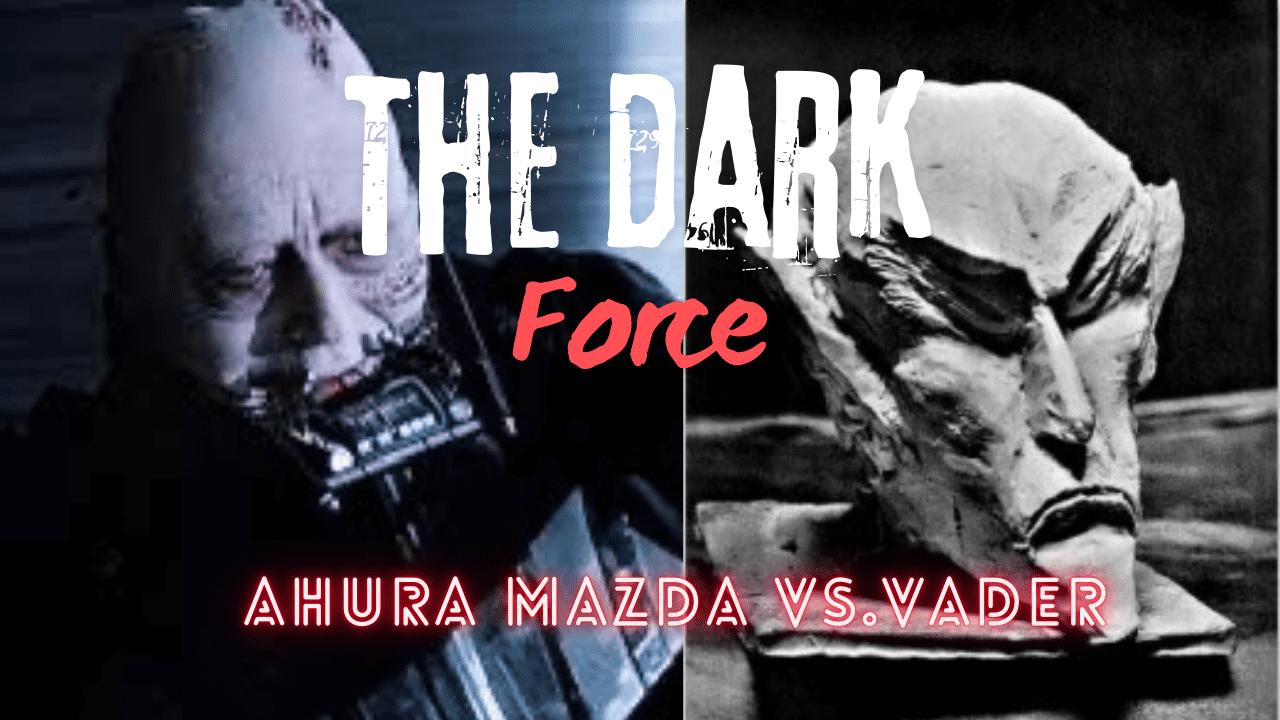
In the heart of every myth lies a truth deeper than fact, and in the subtle dance of light and shadow, one must ask: was the Force’s Dark Side in Star Wars a veiled retelling of an ancient cosmic struggle? Was Darth Vader, the armored phantom of pain and power, a modern embodiment of Ahriman—the Zoroastrian spirit of destruction and deceit? Today, we journey beyond cinema and scripture, into the mystical parallels that bridge galaxies and spiritual dimensions.
The Eternal Struggle: Light vs. Darkness
Zoroastrianism, one of the oldest known spiritual systems, speaks of a dualistic universe—one born of the cosmic tension between Ahura Mazda, the Wise Lord of Light, and Angra Mainyu (Ahriman), the spirit of deception, decay, and chaos.
The universe, in this tradition, is a battleground. Every soul is a soldier. Every choice, a ripple in the war between illumination and obscurity.
Now shift your gaze to a galaxy far, far away.
There, too, we find a mystical dualism: the Force, a spiritual energy that flows through all living things, divides into two aspects—light and dark. The Jedi serve the Light Side, guided by serenity, harmony, and sacrifice. The Sith are seduced by the Dark Side, driven by passion, control, and conquest.
Sound familiar?
Ahriman: The Primordial Adversary
Ahriman is not evil in the petty human sense. He is cosmic opposition incarnate. Where Ahura Mazda births order and truth, Ahriman poisons the well—unleashing disease, war, and the illusion of separation.
He is the master of temptation, whispering that power is the path to peace, that domination can protect love, and that fear is safer than trust. His presence in the soul is not always thunderous; it is often subtle, seductive—a corruption of will disguised as wisdom.
Now consider Anakin Skywalker.
The Fall of the Chosen One
Anakin, born of prophecy, was to bring balance to the Force. But like all who face the shadow without inner clarity, he was seduced by its lies. He feared loss. He craved control. He believed that by bending the world to his will, he could prevent suffering. And so, the boy of light became the black-clad fist of terror.
In this fall, we see the ancient echo of Ahriman’s temptation—a divine being, turned adversary, not out of hatred but out of fear disguised as love.
Darth Vader becomes more than a villain. He becomes a mythic archetype: the luminous soul eclipsed by the very fire it sought to master.

The Redemption That Ahriman Never Knew
And yet, a mystical divergence occurs.
Darth Vader, in his final moments, turns back toward the Light—not for glory, but out of love. This act of selfless sacrifice is what distinguishes him from the timeless archetype of Ahriman. In turning against the Emperor, Vader does what Ahriman never could: he chooses unity over division, surrender over control, and love over fear.
This is not just a cinematic twist. It is an initiation. A revelation.
The shadow, when embraced and transmuted, becomes fuel for rebirth.
Conclusion: A Galactic Gnostic Mirror
In the tapestry of Star Wars, we see a mystical mirror of ancient truth. The Force echoes the primal energies of spirit. The Sith and Jedi are echoes of Zoroastrian duality. And Darth Vader is a vessel of the Ahrimanic archetype—a soul swallowed by shadow, yet ultimately capable of reclaiming the light.
The myth lives on, not merely in stories, but in us.
For within each of us, there is an Anakin—a chosen one who may stumble, falter, and fall. And within each fall, there is the echo of Ahriman’s whisper… and the potential for awakening.
Choose wisely, traveler. The Force—and the cosmos—are watching.
“From the ashes of the dark, light is reborn.”

Leave a Reply