
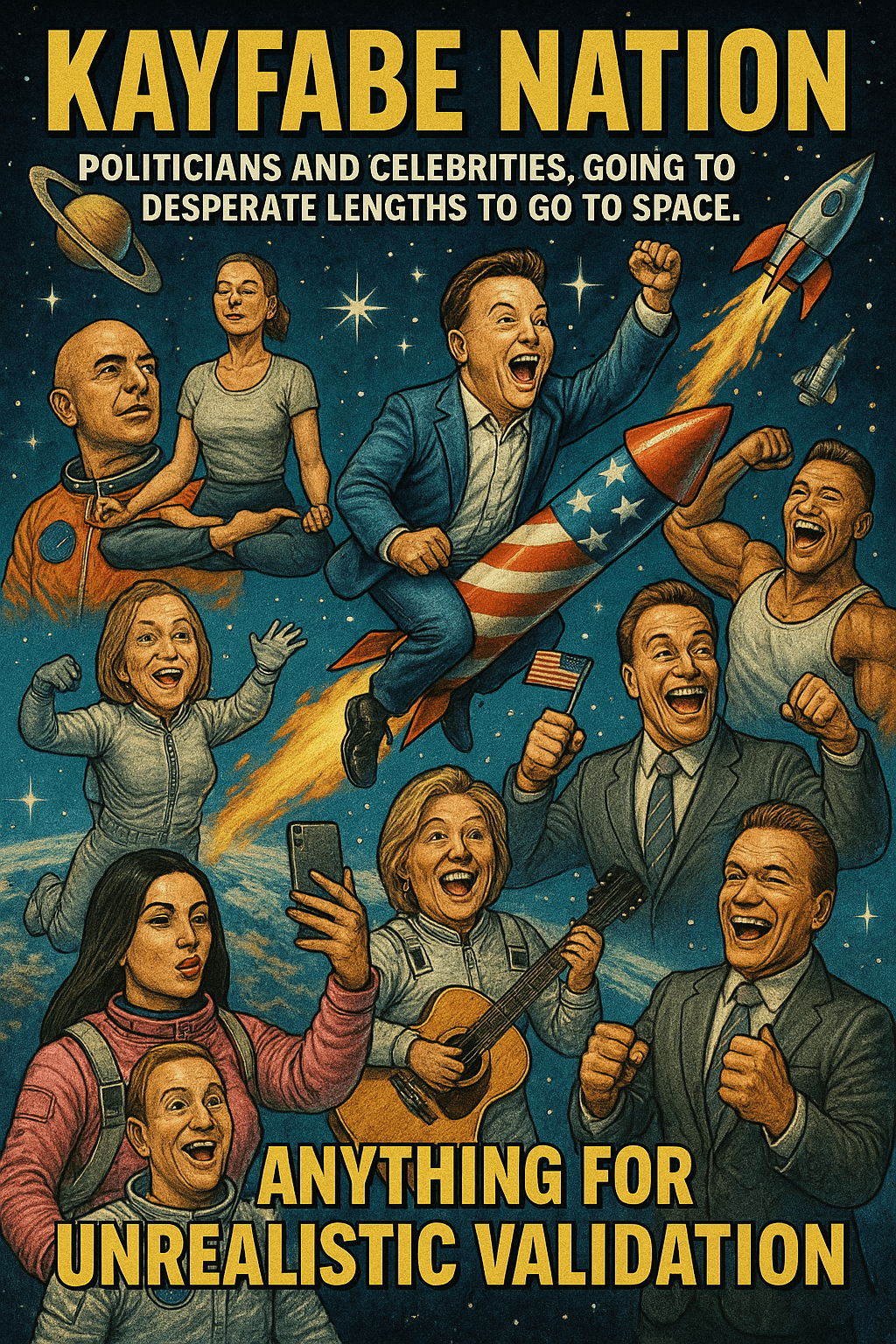
In the old days of professional wrestling, “kayfabe” was a sacred code—a suspension of disbelief where performers maintained the illusion that their rivalries, victories, and defeats were all real. Wrestlers stayed in character on and off stage, weaving a fictional reality into the public consciousness so tightly that audiences accepted the spectacle as truth. But kayfabe didn’t die with the fall of the WWF’s golden era. It simply evolved—and today, it’s the lifeblood of our media-saturated culture, particularly among celebrities and politicians desperate to stay in the spotlight.
Welcome to the Kayfabe Era of Reality
In 2025, kayfabe has gone mainstream. It’s no longer confined to the wrestling ring—it’s now embedded in campaign trails, influencer reels, and late-night Twitter rants. Politicians play roles so exaggerated they border on caricature—flaming patriots, cartoonish villains, heroic saviors. Celebrities perform “meltdowns,” “comebacks,” and “feuds” with an orchestrated sense of urgency, each drama a calculated move in the chessboard of clicks, followers, and relevance.
What was once a tool of entertainment has become a tool of manipulation. Kayfabe is now a weapon for exploiting public attention, monetizing outrage, and redirecting scrutiny away from truth.
Why the Desperation?
We live in an era of shrinking attention spans and inflated egos. The media economy rewards controversy, not consistency. In this environment, fading fame can feel like death. So celebrities manufacture drama to resurrect themselves. Politicians invent enemies to rally support. The truth becomes inconvenient. Authenticity is optional. What’s real is whatever gets traction.
This is desperation disguised as strategy. When real talent or genuine service no longer capture hearts, the only thing left is performance art. The outrage becomes the product. The spectacle becomes the message. The audience, unknowingly, becomes both the consumer and the participant in this distorted theater.
The Danger of Blurred Realities
What makes kayfabe dangerous in this context is that the lines between performance and reality are no longer clearly drawn. Politicians say things they don’t believe to manipulate their base, then walk it back in private. Celebrities create online personas that crumble under scrutiny, leaving fans disillusioned. And the public, caught in the loop, loses touch with what’s real. We stop asking important questions and start rooting for teams, villains, and plot twists like we’re watching a Netflix show.
In wrestling, the fight was fake but the pain was real. In politics and pop culture, the performance is fake—but the consequences are very real. Wars are waged, laws are passed, and lives are ruined, all under the guise of kayfabe posturing.
Conclusion: Cut the Act
It’s time to start seeing through the performance. As citizens and consumers, we must demand transparency over theatrics. Don’t be hypnotized by the never-ending drama. Question the storyline. Who benefits? Who profits? Who’s writing the script?
Kayfabe belongs in the ring—not in the realm of democracy or human dignity. Because once reality becomes just another stage, truth itself becomes the biggest casualty.
Leave a Reply