Some of the herbal allies mentioned here are shared through affiliate links, meaning I may receive a small blessing of support if you choose to journey with them—always at no extra cost to you.

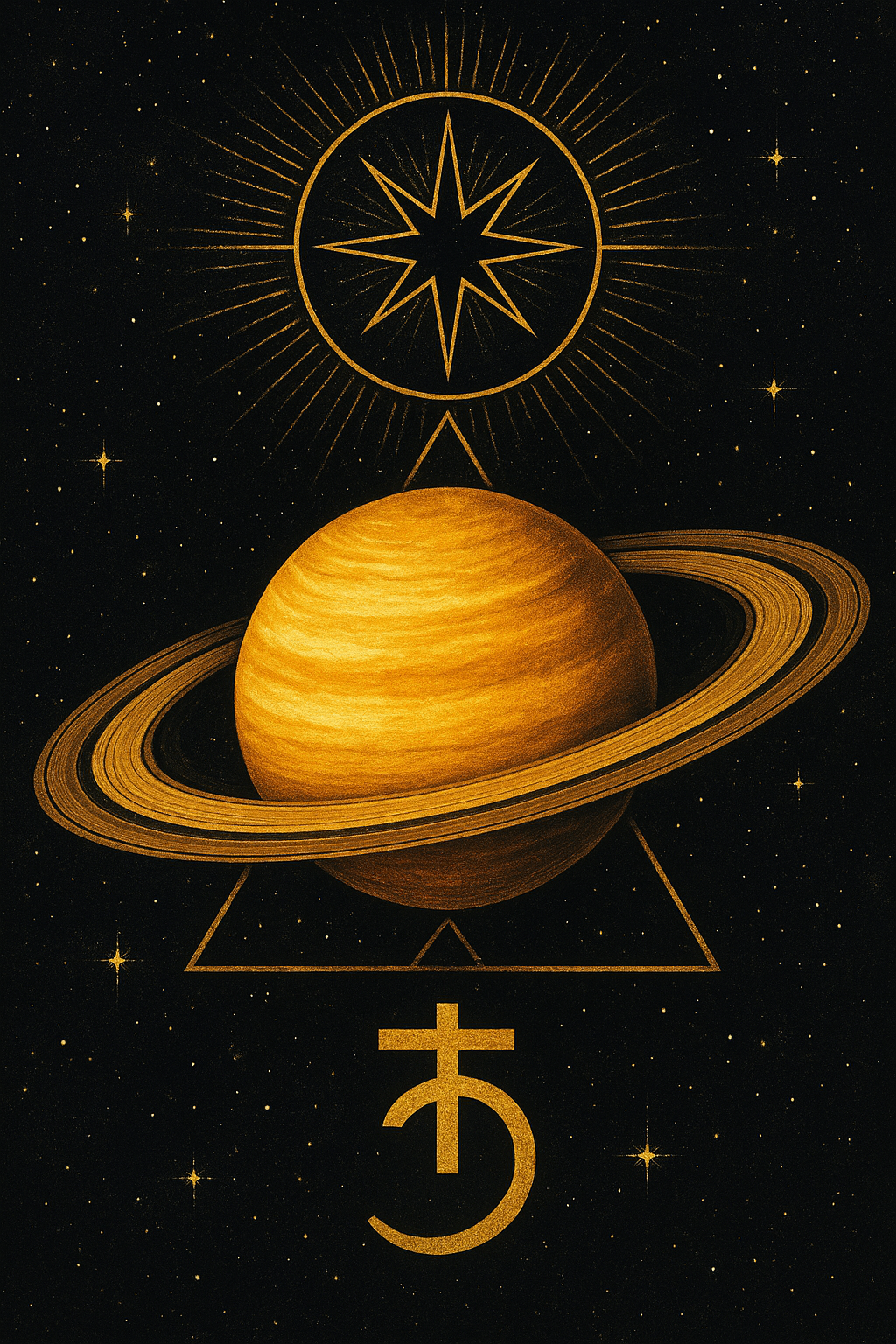
Few celestial bodies have inspired such awe and fear as Saturn, the ancient god of time, structure, and limitation. To the mundane eye, it is a distant gas giant with majestic rings — yet to the initiated, Saturn represents far more: the threshold between spirit and matter, freedom and bondage, immortality and decay. In every esoteric tradition, Saturn holds the key to mastery — but only for those willing to face the weight of its lessons.
The Black Sun Behind the Rings
In the secret schools of antiquity, Saturn was not merely a planet, but a metaphysical principle — the Demiurge, the architect of the material world. The Chaldeans called it Kronos, the devourer of his own children — a symbol of time consuming all it creates. In Hermetic philosophy, Saturn’s scythe was not only an emblem of death but of harvest — the reaping of karmic fruit.
To the alchemist, Saturn corresponds to lead, the densest and heaviest of metals, representing the unrefined human condition. Yet within that lead lies the seed of gold, awaiting transmutation through the fire of spiritual discipline. Paracelsus wrote that within the Saturnine metal “dwells the black dragon,” which, when purified, becomes the “solar child.” In other words — enlightenment emerges from the dark night of the soul.
The Black Sun (Sol Niger) of alchemy — a hidden luminary behind the visible sun — is Saturn’s secret face. It symbolizes inner illumination born from suffering, the light hidden within darkness.
Saturn in Ancient Texts: The Serpent of Time
In the Upanishads, the material universe is described as Maya — illusion, veiling the eternal. Saturn governs this veil. The Vedic equivalent, Shani, is feared and revered as the karmic judge, bringing suffering to humble the soul into awakening. “Shani teaches patience, humility, and endurance,” says the Brihat Parashara Hora Shastra. “Those who worship him with sincerity are freed from bondage.”
In Gnostic cosmology, Saturn is linked with the archon Yaldabaoth, the false creator who binds the soul in cycles of incarnation. But the Gnostic initiate learns to see through this — to recognize that the prison of Saturn is not external but psychological. The rings symbolize mental boundaries, self-limitations, and egoic loops. To dissolve these rings is to reclaim one’s divine inheritance.
The Kabbalists place Saturn on the Sephira Binah, the sphere of Understanding — the Great Mother who births all form. She is both compassionate and severe, representing the divine law that all things must return to order. The Hebrew name for Saturn, Shabbatai, links it to the Sabbath, the seventh day of rest — the moment of stillness after creation. Thus, Saturn is both the builder and the destroyer, the law and the rest beyond it.
Saturn in the Modern Mysteries
Modern occultists like Aleister Crowley and the Hermetic Order of the Golden Dawn viewed Saturn as the outer gatekeeper — the boundary of material consciousness before entry into higher planes. Crowley wrote in 777 that Saturn is “the Limit of the Universe, the God of Boundaries, the Lord of Time.” To cross his threshold is to achieve mastery over the lower self.
The philosopher Manly P. Hall described Saturn as the “Keeper of Secrets,” representing the stage in spiritual evolution where knowledge becomes power only when tempered by wisdom. The uninitiated who approach Saturn’s mysteries are crushed by the weight of his rings — the initiate, however, uses them as a ladder.
In astrology, Saturn’s transits and returns bring initiation by fire. At the Saturn Return (around age 29), one faces the reckoning of karma — a test of integrity and endurance. Many ancient initiations were patterned on Saturn’s cycles, marking the transition from youth to wisdom, chaos to order.

The Alchemy of Time and Transcendence
Saturn teaches that freedom cannot exist without form. The mystic learns that to transcend the material, one must first master it. As the Emerald Tablet declares:
“That which is below is like that which is above,
and that which is above is like that which is below,
to accomplish the miracles of one thing.”
This “one thing” — the prima materia — is bound by Saturn’s ring of time. The initiate transmutes it through meditation, discipline, and surrender. The process of Kundalini awakening, too, begins in the root — the Saturnian center of survival and grounding — before it ascends to the sun of enlightenment at the crown.
Saturn’s ultimate gift is liberation through limitation. By facing our fears, karmic debts, and mortality, we discover the eternal spirit that time cannot touch.
Saturn’s Secret Message
Saturn whispers not of punishment, but perfection through patience. Its alchemy is slow, methodical, demanding — yet divine. Every trial, delay, or weight we bear under Saturn’s influence is part of the sculpting of the soul. The lead of suffering becomes the gold of wisdom.
In this age of distraction, Saturn calls us back to discipline, stillness, and sacred order. The secret societies and mystery schools knew that until one conquered Saturn, one could not approach the Sun.
To face Saturn, then, is to face oneself — to dissolve the false and stand in the eternal.
“In the darkness of Saturn’s night,
the soul learns to see its own light.”

Here is an illustrated planetary seal of Saturn from Heinrich Cornelius Agrippa’s De Occulta Philosophia (1533) — the seal as scanned in the Nowotny facsimile.

🜃 Description and Symbolic Anatomy
Let’s unpack its components and hidden meanings:
Element
What you see
Esoteric Symbolism / Interpretation
Intersecting straight lines forming a star-like pattern with arms ending in small circles or “knobs”
These represent directions or emanations, “channels” through which Saturnian force flows.
In Agrippa’s framework, the seals operate through correspondences: with spirits, intelligences, virtues. The knobs perhaps mark terminals of focus, the rings of contract between spirit and matter.
The triangles (or star-points)
Triangles often denote the triadic structure: upper, lower, middle; spirit-mind-matter, or macrocosm-microcosm.
Here, they may indicate the descent of spiritual law into mundane existence — the action of limits, boundaries, laws. Saturn is about structure, constraint, authority — the triangles channeling these.
Symmetry and balance in the design
The seal is not chaotic; it is ordered, balanced, symmetrical.
Saturn demands order; it is the principle that within the chaos of time, form is imposed. The symmetrical layout suggests equilibrium between opposing forces: contraction and expansion, giving and withholding.
Small circles at ends of certain lines
“Seeds,” “gates,” nodes of connection.
These can be seen as focal points for invocation, anchoring points where one “hooks in” to Saturn’s energy. They may also correspond to specific numbers in Saturn’s magic square, each node representing a number or quality.
📜 Agrippa & the Seal’s Source
Agrippa, in Three Books of Occult Philosophy, gives the planetary seals a very precise basis:
Each seal is derived from the magic square corresponding to a planet. Saturn’s magic square is the 3×3 square with numbers 1–9 arranged so that rows, columns, and diagonals all sum to 15. The “line” of the seal — the way it crosses the square — is meant (in some traditions) to touch or “activate” each of the numbers. This symbolizes the seal invoking the full power or totality of that planet. For Saturn, every number in its magic square carries its vibration: limitation, discipline, duty, endurance, sorrow—but also wisdom.
🔍 How One Might Use This Seal (Ritual & Meditation)
Here are some ways this seal has been used or could be used, drawing on Agrippaic methodology and later occult practice:
Talismanic Creation Engrave or draw the seal on a material (lead or pewter are traditional for Saturn) during the hour and day of Saturn (Saturday, during Saturn’s astrological hour). Charge it with prayers or incantations aligned with Saturn’s virtues: patience, structure, restraint. Meditative Gateway Meditate focusing on the seal’s geometry. Trace its lines with visualization; imagine the energy flowing down each arm, filling the circles and nodes. Use this to internalize Saturn’s lessons: self-discipline, humility, the endurance of limitations. Astrological Correspondence Use the seal when Saturn is transiting a critical point in one’s chart (Saturn return, square, opposition) to assist in facing karmic blockages. The seal can serve as a symbolic tool for integrating Saturn’s pressure rather than resisting it. Chanted Invocation Combine the seal with the spirit names associated with Saturn in Agrippa: Zazel (or Zazel / Zazél) and Agiel. These names are often repeated in medieval and renaissance planetary spirit magic. The seal becomes the visual “home” of that invocation.

Leave a Reply